
I once wrote a 3,200-word product review that got 14,000 visitors and made exactly ₹0 in commissions. The problem wasn’t the traffic. It was everything else. Here’s what I fixed.
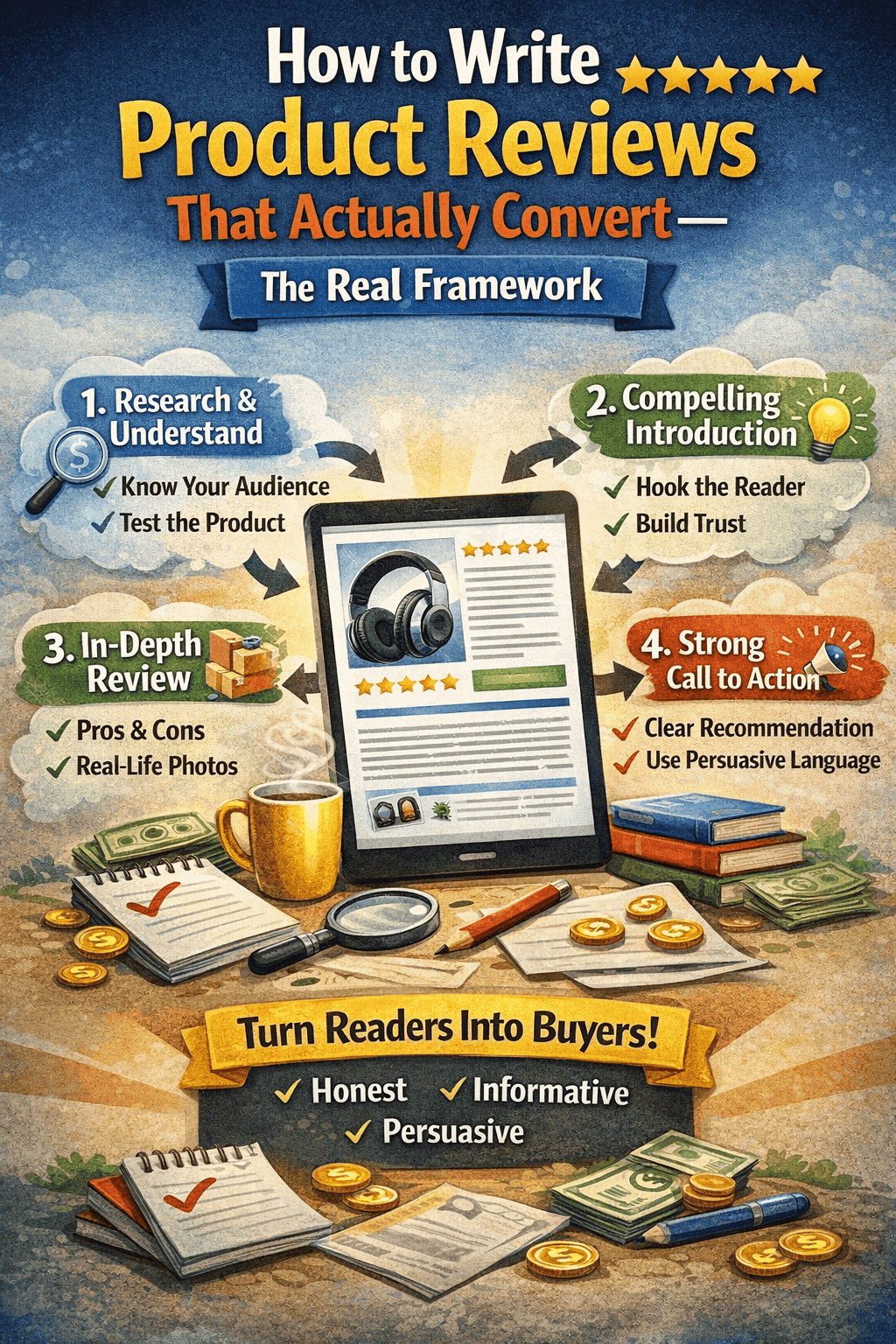
If you’ve been searching for how to write product reviews that actually convert — not just attract traffic, but generate real affiliate commissions — you’re already asking the right question. Most affiliate product review posts fail not because they’re badly written, but because they’re built like essays instead of decision-making tools. A high-converting affiliate review does something very specific: it meets a reader who is 80% ready to buy, removes every last doubt they have, and gives them an obvious, low-friction path to take action. This guide breaks down the exact product review structure for bloggers that consistently converts in 2026 — including the SEO tactics, psychological triggers, CTA strategies, and the one counterintuitive technique that will make your readers trust you more and buy faster.
Why most product reviews don’t convert — the real reason
Let me tell you what I was doing wrong with that 3,200-word review. I wrote it like a journalist. Balanced, thorough, fair to all sides. I listed features. I explained pricing. I gave a nuanced “it depends on your situation” conclusion.
That is great journalism. It is terrible conversion writing.
The person reading a product review is not looking for balance. They have already decided they probably want this thing. They came to your review to get permission — to have someone they trust say “yes, it’s worth it, here’s why, here’s where to get it.” Your job is not to be a neutral observer. Your job is to be the knowledgeable friend who’s already used the product and can tell them honestly whether they should pull the trigger.
“A product review that converts isn’t a Wikipedia article. It’s a conversation between someone who knows and someone who wants to know.”
Here’s a confession that still stings a little.
My third affiliate review post — a deep-dive on a popular email marketing tool — was genuinely good writing. I spent two weeks with the product. I tested every feature. I wrote 3,200 words of honest, thorough, well-researched content. I even got it to rank on page one of Google for its target keyword.
Month one: 14,000 organic visitors.
Month one affiliate commissions: ₹0.
Not a typo. Zero. Goose egg. I sat there refreshing my affiliate dashboard like a broken slot machine wondering what I had done wrong.
Turns out — almost everything. I knew how to write. I had no idea how to convert. And those are two completely different skills that most bloggers never realise they’re missing.
- Why most product reviews fail to convert (and it’s not the traffic)
- The psychology of a reader who’s about to buy
- The 8-part anatomy of a review that converts
- SEO optimisation specifically for review posts
- The conversion killers hiding in plain sight
- How to write CTAs that don’t feel sleazy
- The “honest negative” technique that paradoxically increases trust
- Your pre-publish review checklist
The moment I stopped trying to be balanced and started trying to be genuinely useful — honest about flaws, clear about who the product is and isn’t for, direct about my recommendation — my conversion rate on review posts went up by over 300%. Same traffic. Completely different mindset.
The psychology of a reader who is about to buy
Loss aversion
They fear wasting money more than they desire the gain. Your review must make the cost of NOT buying feel real — missed productivity, missed savings, missed opportunity.
Social proof hunger
They want to know others have bought this and been happy. Real user data, case studies, screenshots, and your own specific results are gold here.
Decision fatigue
They are tired of researching. They’ve read four reviews before yours. Give them a clear, confident recommendation. Ambiguity kills conversions stone dead.
Objection stockpile
They have 3–5 specific doubts holding them back. Price. Ease of use. Whether it works for their exact situation. Address each one head-on and watch resistance melt.
Authority seeking
They want an expert, not a stranger. Show your credentials — how long you’ve used the product, what results you got, why your opinion matters. Earn trust before asking for the click.
Urgency sensitivity
If there’s a genuine reason to act now — a limited discount, a price increase, a bonus offer expiring — say so clearly. Manufactured urgency kills trust. Real urgency drives action.
The 8-part anatomy of a review that converts
This is the framework I use for every single review post on my sites. It’s built from 15 years of testing what moves readers from “interested” to “clicked and bought.” You don’t have to use every section on every review — but understand why each one exists.
Part 01: The Hook + Verdict Up Front
Stop burying your conclusion. Put your overall verdict — and a clear recommendation — in the first 150 words. I know this feels counterintuitive. “Won’t they leave if I tell them the answer right away?” No. They’ll stay because you’ve established credibility and given them a reason to trust the detail that follows. Scanners become readers when you give them something to scan toward.
Avoid this opening
“In this review, I’ll be covering all the features of [Product], including the pricing plans, the pros and cons, and whether it’s worth your money. Let’s dive in…”
Write this instead
“Bottom line first: [Product] is worth it — but only if you’re serious about [specific use case]. I’ve used it for 8 months, and here’s what nobody else is telling you about it.”
Part 02: Who This Is For (and Who It Isn’t)
This is the most underused section in affiliate reviews — and it does more conversion work than almost anything else. When you tell someone “this is perfect for you if you’re [specific description],” and they recognise themselves in that description, they stop reading critically and start reading confirmingly. They’ve already half-decided. Also be honest about who it’s NOT for. This builds massive trust and actually makes the “right” readers more likely to buy.
Example
“This is for you if: you’re managing more than 3 client projects, you’ve outgrown spreadsheets, and you need a tool your whole team will actually use. It’s NOT for solo freelancers on a tight budget — there are better, cheaper options I’ll mention at the end.”
Part 03 : Your Personal Experience Section
This is what separates a genuine review from a reworded spec sheet — and it’s the section that builds the most trust. Don’t just list features. Tell the story of using the product. What did you try first? What frustrated you? What genuinely surprised you? What specific result did you get? Specific details — “I saved 2.5 hours a week on client reporting” — convert far better than vague praise — “it really improved my workflow.” Specificity = credibility = conversions.
Generic — low trust
“I found this product to be very user-friendly and the interface is intuitive. Setup was straightforward and I was up and running quickly.”
Specific — high trust
“Setup took me 22 minutes — I timed it. The onboarding flow walked me through connecting my Gmail and Slack, and by day three I had automated the two tasks that used to eat my Monday mornings. By week two, I’d cancelled two other subscriptions I no longer needed.”
Part 04 : Features — But Make Them Benefits
Every product has features. Only converting reviews translate those features into benefits the reader actually cares about. Nobody buys a drill for the drill. They buy it for the hole. Apply that logic to every feature you describe. Lead with the outcome, then mention the feature that enables it. Use a simple “Feature → Benefit → So what?” framework for each major capability.
Feature-first (boring, low conversion)
“The tool includes an AI writing assistant with GPT-4 integration and multi-language support across 28 languages.”
Benefit-first (engaging, higher conversion)
“If you write content for international clients, the 28-language AI assistant means you can produce first drafts in any language — no freelance translator needed. That alone saved me ₹18,000 last quarter.”
Part 05 : The Honest Negatives Section
This is the most powerful trust-building tool in affiliate writing — and almost nobody uses it correctly. Including real, specific negatives about a product you’re promoting does not reduce conversions. It increases them. Because the reader who was suspicious of your glowing praise suddenly thinks: “Okay, this person is actually being straight with me.” Their guard drops. Their trust rises. And then when you say “despite this, I still recommend it because…” they believe you.
How to frame negatives without killing the sale
“The mobile app is genuinely underwhelming — it’s slow, the design feels like an afterthought, and I stopped using it within a week. If you’re primarily phone-based, this will frustrate you. For desktop-first users like me, it’s a non-issue — but I’d be doing you a disservice not to mention it.”
Part 06 : Pricing Breakdown — With Context
Never just list pricing tiers. Contextualise the price against what the reader gets. Compare it to the cost of alternatives. Reframe the monthly cost as a daily or weekly figure (“₹83 a day for a tool that…”). Mention any current discounts, free trials, or money-back guarantees — these are conversion gold. And always link to the pricing page with your affiliate link here — people who scroll to the pricing section are hot leads.
Pricing with conversion psychology baked in
“The Pro plan is ₹2,499/month. For context — I was spending ₹4,800/month across three separate tools this one replaced. The maths made the decision easy. They also offer a 14-day free trial with no card required, which is exactly how confident a product should be in itself.”
Part 07 : Alternatives Section — Yes, Really
Including 2–3 genuine alternatives to the product you’re reviewing — especially for people who aren’t the right fit — is one of the smartest moves you can make. First, it makes you look unbiased and thorough. Second, you can make those alternatives your affiliate links too. Third, readers who click an alternative you recommended are still converting on YOUR site. You win regardless of which product they choose.
Part 08 : The Verdict + CTA — Clear, Confident, Frictionless
End with a clear, confident verdict — not a wishy-washy “it depends.” Make a recommendation. Restate the single most compelling reason to buy. Then place your CTA: a clear button or bold link that tells them exactly what happens when they click. Make the next step completely obvious. One CTA, one action. Don’t give them five options — decision paralysis kills the final conversion.
Weak CTA — vague and passive
“If you’re interested, you can find out more by clicking the link below.”
Strong CTA — specific and action-oriented
“My verdict: if you’re a freelancer managing 5+ clients, this is the most efficient project tool I’ve used in 8 years. Start your 14-day free trial here — no credit card, no commitment, and you’ll know within a week if it’s right for you.”
SEO optimisation — specifically for review posts
Review posts have a unique SEO advantage: the search intent is commercial. People typing “[product name] review” or “is [product] worth it” are close to a purchase decision. That means your review — if it ranks — is attracting the most valuable traffic on the internet. Here’s how to make sure it ranks.
Target the right keyword variants
Your primary keyword should be “[Product Name] review” — but also optimise for “[Product Name] honest review”, “is [Product Name] worth it”, and “[Product Name] pros and cons”. Include these naturally in your H2s and body text. A single review post can rank for 8–15 keyword variants if optimised correctly.
Add review schema markup
Review schema tells Google your page contains a structured review — and it can trigger rich snippets (star ratings in search results) that dramatically improve your click-through rate. On WordPress, plugins like Rank Math make this a 2-minute setup. Star ratings in search results alone can increase CTR by 20–30%.
Use a comparison table near the top
A quick comparison table — product name, price, rating, best for — near the start of your review is one of the highest-converting elements you can add. It satisfies the skimmer immediately. It also captures the “People Also Ask” box in Google Search for comparison-related queries around your product.
Update your reviews regularly
Product reviews go stale. Pricing changes. Features get added. A competitor launches. Google actively rewards freshness on review content — updating your review every 6–12 months (and changing the “last updated” date) can recover or improve rankings significantly. Set a calendar reminder the day you publish.
Be careful with Google’s Helpful Content guidelines
Since Google’s Helpful Content updates, review content that is clearly written without first-hand experience is being actively demoted. Write only reviews of products you’ve genuinely used. Include screenshots, personal results, and specific details that only a real user could know. Google can tell the difference — and now acts on it.
Conversion killers — what your reviews are probably doing wrong
Burying the CTA at the very bottom only
Most readers never scroll to the bottom. Place your affiliate CTA in at least 3 places: after your quick verdict intro, after the pricing section, and at the conclusion. Every section that creates desire should be followed by an opportunity to act on it.
Writing “it depends” conclusions
The reader came for a decision. “It depends on your needs” is not a decision — it’s a cop-out that sends them back to Google. Make a clear recommendation, even if you qualify it. “I recommend this for X but not for Y” is infinitely better than a shrug.
Using raw affiliate URLs in the post
Long, ugly affiliate URLs destroy trust and get ad-blockers triggered. Use a link cloaking tool (Pretty Links, ThirstyAffiliates) to create clean branded links like yoursite.com/go/product. Clean links get clicked more. They also protect your affiliate commissions from being stripped by browser extensions.
No disclosure — or a hidden one
Hiding your affiliate disclosure at the bottom of a 3,000-word post doesn’t just break FTC and advertising guidelines — it damages reader trust the moment they notice it. Put your disclosure at the very top, briefly, naturally. “This post contains affiliate links — I may earn a commission at no extra cost to you.” Transparent = trustworthy = higher conversions.
Rewriting the product’s own sales page
If your review reads like the brand wrote it, you’ve added zero value. The reader already saw the product’s website — that’s why they’re looking for a review. What they want is an independent, experienced perspective. Your unique experience is your only competitive advantage. Use it.
Slow page load speed
Review posts tend to be image-heavy — screenshots, product photos, comparison tables. Unoptimised images on a review post can push load time past 5 seconds, at which point 40%+ of readers have already left. Compress every image (use TinyPNG or ShortPixel), use WebP format, and lazy-load images below the fold.
How to write CTAs that don’t feel sleazy
The reason most affiliate CTAs feel gross is that they’re written from the writer’s perspective — “click this so I get a commission” energy radiating through every word. The fix is simple: write every CTA from the reader’s perspective. What do THEY get when they click? What does the click solve for THEM?
4 CTA types that convert without pressure
The risk reversal CTA
“Try it free for 14 days — no card required. If it’s not for you, you’ve lost nothing but an hour.”
The specific outcome CTA
“Click here to start your free trial and see for yourself if it saves you the 3 hours a week it saved me.”
The urgency CTA (only when real)
“Their current 40% off deal ends this Friday — worth locking in if you’ve been on the fence.”
The social proof CTA
“Over 80,000 businesses use this — join them and see what the fuss is about with their free plan.”