


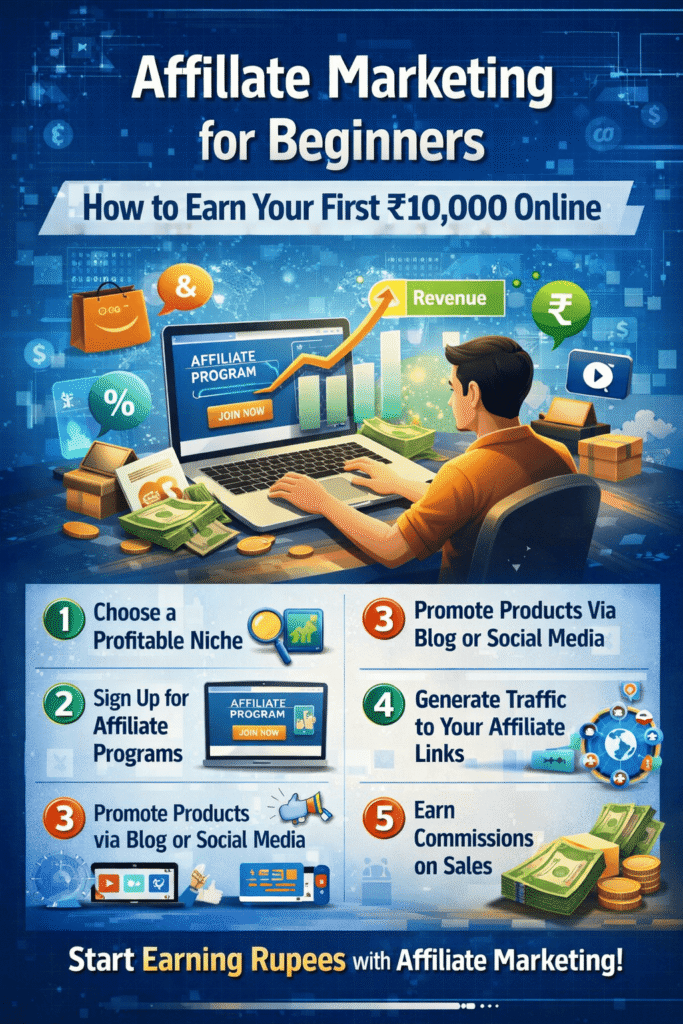
Learn affiliate marketing for beginners in 2026. Step-by-step guide to earning your first $1,000 online — no product, no experience, no big audience needed.
Table of Contents
- What is affiliate marketing?
- Why affiliate marketing is one of the best beginner income models
- How affiliate marketing works (simply explained)
- Choosing your niche
- Best affiliate programs for beginners in 2026
- Step-by-step: How to earn your first $1,000
- Best tools for affiliate marketers
- Common mistakes beginners make
- Pro tips for success
- Real-life examples
- Beginner-friendly action plan
- Conclusion
- FAQ
Introduction
It was a random Tuesday morning. I wasn’t at a desk. I wasn’t on a call. I was making coffee when my phone buzzed — a PayPal notification. Someone I’d never met, in a country I’d never been to, had just bought a product I’d recommended in a blog post I’d written four months earlier. I earned $47 while sleeping.
That first passive commission is one of those moments that changes how you see the internet forever. Because it proves something that sounds almost too good to be true — that you can genuinely earn money recommending things you already use and believe in, to people you’ve never met, at any hour of the day or night.
But here’s what nobody tells beginners about affiliate marketing: that first commission doesn’t happen by accident. It happens because someone learned the system, built something real, and stayed consistent long enough for the money to show up.
This guide is for the person who has heard about affiliate marketing, feels equal parts excited and confused, and wants a clear, honest roadmap to earning their first $1,000 online — without hype, without shortcuts, and without needing a massive following or a technical background.
Let’s build something that earns while you sleep.
What Is Affiliate Marketing?
Affiliate marketing is a performance-based income model where you earn a commission for recommending someone else’s product or service. You share a unique tracking link. When someone clicks your link and makes a purchase, you get paid — typically a percentage of the sale.
That’s the whole model. No inventory. No customer service. No product to create. You are the connector between the buyer and the seller — and you earn for that connection.
Three parties are always involved:
- The merchant: The company that creates the product (Amazon, Bluehost, a software company, a course creator)
- The affiliate: You — the person who promotes the product through content
- The customer: The person who clicks your link and buys
The merchant handles fulfilment, customer support, and everything else. You just send the traffic. They pay you for results.
Why Affiliate Marketing Is One of the Best Beginner Income Models in 2026
Out of all the ways to make money online, affiliate marketing stands out for beginners for several powerful reasons:
- Zero upfront investment: Joining affiliate programs is free. Building a blog or social channel costs next to nothing.
- No product creation needed: You skip the hardest part of running a business — making the thing people buy.
- Scalable without proportional effort: One blog post or video can generate commissions for years. You do the work once.
- Location and time independent: Your affiliate links work 24/7 whether you’re awake, on holiday, or offline.
- Beginner-friendly learning curve: You learn content creation, SEO, and audience building — skills that serve you in every online business.
- Multiple income streams from one platform: A single blog can promote 10 different affiliate products simultaneously.
$0 -Cost to start with most programs
$47–$500 -Avg. first month income for active beginners
$1,000 -Achievable within 3–6 months with a clear strategy
$5K–$50K+ -Monthly ceiling for established affiliates
How Affiliate Marketing Works — Simply Explained
Here’s the process in plain English:
- You join an affiliate program (free) and get a unique link — for example: amazon.com/product?ref=yourname
- You create content — a blog post, a YouTube video, an Instagram Reel, a Pinterest pin — that mentions or reviews that product
- Your audience clicks your link because they trust your recommendation
- They make a purchase on the merchant’s website
- The merchant’s tracking system registers your link and credits you a commission
- You receive payment — usually monthly — via PayPal, bank transfer, or cheque
The key insightYou are not selling anything. You are recommending things. The best affiliate marketers are trusted advisors in their niche — people who genuinely use and believe in what they promote. That authenticity is what converts browsers into buyers.
Choosing Your Niche: The Decision That Shapes Everything
Your niche is your topic — the specific area you’ll create content about. This is the most important decision in your affiliate marketing journey. A good niche is one where you have genuine interest or experience, and where real buyers exist.
The most profitable affiliate niches in 2026 include:
Personal Finance / Health & Fitness / Online Business / Software & SaaS / Travel/ Parenting / Home & Garden
Beauty & Skincare / Pet Care / Food & Nutrition / Self-Development / Gaming & Tech
But don’t just pick what’s “profitable” — pick what you can speak about with genuine authority. The blogger who writes passionately about dog nutrition will always outperform the blogger who picked pets purely because the commissions looked good.
Niche Selection Rule
The best niche sits at the intersection of three things: something you know, something people search for, and something with products to promote. All three matter. Two out of three isn’t enough.
Best Affiliate Programs for Beginners in 2026
High-volume, easy-entry programs
Amazon Associates 1–10% commission All niches
The world’s largest affiliate program. Promotes virtually any physical or digital product. Commissions are lower, but conversion rates are high because everyone trusts Amazon. Best for beginners building product review content across any niche.
ShareASale Varies by merchant Multi-niche
A marketplace hosting thousands of merchants across dozens of niches. One account gives you access to brands in fashion, home, tech, finance, food, and more. One of the best beginner platforms for finding niche-specific programs.
Impact / CJ Affiliate Varies by brand Premium brands
Impact and Commission Junction connect affiliates with premium brands — Adidas, Airbnb, McAfee, and hundreds more. Slightly more competitive to get into but offers higher brand recognition and stronger conversion rates.
High-commission programs (software & digital products)
Bluehost / Hostinger $65–$130 per sale Blogging / Tech
Web hosting affiliate programs are among the most lucrative for bloggers who write about starting websites or online businesses. A single referral earns $65–$130. Just five sales a month is $325–$650 in commissions.
Semrush / Jasper / ConvertKit 20–40% recurring Online business
SaaS tools with recurring commissions are the holy grail of affiliate marketing. When you refer someone to a $99/month tool and earn 30%, you earn $29.70 every single month they remain a customer — without any additional effort.
Teachable / Thinkific Partner Programs 30% recurring Online courses
Online course platforms offer generous recurring commissions. If you write about online business, blogging, or creator economy topics, these programs align perfectly with your audience’s needs and pay month after month.
Step-by-Step: How to Earn Your First $1,000 in Affiliate Marketing
01. Choose your niche and one traffic platform
Pick your topic and choose ONE place to create content — a blog (best for long-term SEO), YouTube (best for trust and visual products), Pinterest (great for lifestyle niches), or Instagram. Don’t spread yourself across all platforms. Master one first.
02. Start a blog — your most powerful affiliate asset
A blog gives you SEO-driven, 24/7 traffic that compounds over time. Set one up on WordPress with a Bluehost or Hostinger hosting plan (under $3/month). Install a lightweight theme like Astra or Kadence. You’re up and running in an afternoon — no coding required.
03. Join 2–3 affiliate programs in your niche
Start with Amazon Associates for broad product coverage plus one high-commission program relevant to your niche. Don’t sign up for 20 programs. Two or three focused programs are easier to promote authentically and track effectively.
04. Create content that answers real buyer questions
The highest-converting affiliate content targets buyer intent keywords — searches made by people about to spend money. “Best budget laptops under $500,” “Jasper AI review 2026,” “Bluehost vs Hostinger — which is better?” These posts attract people who are already in buying mode. Use free tools like Google Search Console or Ubersuggest to find them.
05. Optimize for SEO and publish consistently
SEO is your free traffic engine. Every post should target a specific keyword, include that keyword in the title, first paragraph, and headings, and have internal links to your other posts. Aim for 2–4 posts per week in the first three months. Volume + quality is what builds domain authority and search rankings.
06. Build an email list and promote to it
Email converts at 3–5x the rate of social media for affiliate products. Offer a free lead magnet in your blog sidebar and posts — a checklist, template, or mini-guide. Even 200 engaged email subscribers can generate $200–$500 per promotion. Start building from post one.
07. Track, optimize, and double down on winners
After 60 days, check your Google Analytics and affiliate dashboards. Which posts are getting traffic? Which are generating clicks and conversions? Write more content in the same style as your best performers. Update underperforming posts with better CTAs and product placement. Data removes guesswork.
Your path to $1,000 — what it realistically looks like
Month 1–2: Foundation ($0–$50)
Blog live, 8–15 posts published, affiliate links placed. First clicks but few conversions — this is normal. You’re planting seeds, not harvesting yet.
Month 3: First commissions ($50–$200)
Google starts indexing your content. Organic traffic trickles in. Your first real commissions appear. This is the most motivating milestone of the entire journey.
Month 4–5: Growth phase ($200–$700)
Traffic growing. Several posts ranking. Email list building. You start to see patterns — certain topics and products convert better. You double down on what works.
Month 5–6: First $1,000 month
With 30–50 indexed posts, a growing email list, and optimized content, your first $1,000 month arrives. For most consistent beginners, this happens between month 4 and month 7.
Best Tools for Affiliate Marketers in 2026
WordPress + Astra – Best blogging platform. Free theme, SEO-friendly, and fully customizable without coding.
Bluehost / Hostinger – Affordable, beginner-friendly hosting from $2–$3/month. One-click WordPress install.
RankMath / Yoast SEO– Free WordPress SEO plugins that guide you to optimize every post for search rankings.
Google Analytics – 4Free traffic tracking. See where your visitors come from, what they read, and what converts.
Ubersuggest / Ahrefs– Keyword research tools. Find low-competition buyer-intent keywords your posts can rank for.
ConvertKit / MailerLite– Email marketing platforms with free plans. Build your list and promote affiliate offers via email.
ThirstyAffiliates– WordPress plugin that cloaks and manages your affiliate links cleanly — essential for any serious affiliate blog.
ChatGPT / Claude –AI writing assistants for faster content creation. Generate outlines, draft posts, and write product descriptions in a fraction of the time.
Common Mistakes Beginners Make in Affiliate Marketing
- Choosing a niche purely for money: If you don’t genuinely care about your topic, your content will be hollow — and readers will sense it. Interest outlasts motivation.
- Promoting too many products at once: Scattered promotions confuse your audience and dilute trust. Focus on 3–5 core products you can recommend with genuine conviction.
- Not disclosing affiliate relationships: FTC regulations (and basic ethics) require you to disclose that links are affiliate links. A simple “This post contains affiliate links — I may earn a small commission at no extra cost to you” is all it takes. Transparency builds trust.
- Writing only review posts: Review posts are essential, but so is informational content that builds authority. “How to start a blog” drives readers who will later buy the hosting you recommend. Balance both content types.
- Quitting at month two: Affiliate marketing has a longer incubation period than most online income models. Most beginners quit right before their content starts ranking. Month 3 is where it begins. Month 6 is where it compounds.
- Ignoring mobile optimization: Over 60% of web traffic is mobile. A blog that looks terrible on a phone will bounce visitors before they ever click your links. Choose a responsive theme and test your posts on mobile before publishing.
Pro Tips for Affiliate Marketing Success
Tip 1 — Only promote what you’ve used or thoroughly researched
Your biggest asset is trust. The moment you promote something poor for a quick commission, you fracture it. Readers remember. Recommend only products you’d genuinely tell a close friend about — your conversion rate and reader loyalty will both reflect it.
Tip 2 — Write comparison content — it converts highest
“X vs Y” posts target people in the final stage of the buying decision. They’ve already decided to buy — they just need help choosing. “Bluehost vs Hostinger for beginners” or “Jasper vs Writesonic 2026” capture this intent perfectly and convert at 3–5x the rate of general informational posts.
Tip 3 — Update your best posts every 6 months
An updated post signals freshness to Google and readers. Change the year in the title, refresh product information, add new screenshots, and improve your CTAs. A well-maintained post from two years ago can continue ranking and converting indefinitely.
Tip 4 — Prioritize recurring commission programs
A one-time $50 commission is good. A recurring $20/month commission from one customer for two years is $480 from a single referral. As your affiliate income grows, shift your focus toward SaaS tools, membership programs, and subscription services with recurring payouts.
Tip 5 — Use your personal experience as content
The posts that convert best are the ones where you document your real experience: “I tried 5 email marketing tools for 30 days — here’s what actually worked.” First-person proof transforms a product recommendation into a trusted testimonial. This is content AI genuinely can’t replicate.
Real-Life Examples That Prove It Works
David, 28, a teacher from the Philippines: Started a personal finance blog after work hours. Wrote 40 posts in his first four months — mostly “best credit card for X” and “how to invest with small money” content. Hit his first $1,000 month in month six from Amazon Associates and one recurring fintech affiliate program. Now earns $4,200/month while still teaching, with plans to go full-time.
Chioma, 31, a stay-at-home parent from Lagos: Built a parenting blog with product reviews and Amazon affiliate links. Leveraged Pinterest to drive traffic before her SEO kicked in. Made her first Amazon payout ($147) in month three. By month nine, Pinterest alone drove 22,000 monthly visitors. She now earns $2,800/month consistently.
Alex, 23, a computer science student from Romania: Built a tech tools review blog targeting software buyers. Focused entirely on SaaS affiliate programs with 30–40% recurring commissions. Earned his first $1,000 in month four — from just 18 posts. At month 14, he earns $9,400/month mostly passively, with three posts generating 70% of his income.
None of these people had existing audiences. None had marketing degrees. They had a plan, a niche, and the consistency to keep showing up.
Beginner-Friendly Action Plan: Your First 30 Days
- Week 1: Choose your niche. Write it down in one sentence: “I help [audience] with [specific topic].”
- Week 1: Set up your blog on WordPress with Hostinger or Bluehost. Install RankMath SEO plugin. Choose a clean, fast theme.
- Week 2: Join Amazon Associates and one niche-specific affiliate program. Read their terms. Get your links.
- Week 2–3: Write and publish your first 5 posts — 2 informational (“How to…”), 2 review posts (“Best X for beginners”), 1 comparison post (“X vs Y”).
- Week 3–4: Set up a simple email opt-in with a lead magnet using MailerLite free plan. Add it to your sidebar and within blog posts.
- End of Month 1: Have 8–12 posts live. Affiliate links placed naturally. Google Search Console set up and your site submitted for indexing. Now maintain: two posts per week, minimum, for the next 90 days.
The honest truth about timeline
Most beginners see their first commissions between weeks 8 and 14. The $1,000/month milestone typically arrives between month 4 and month 7 with consistent effort. This is not a get-rich-quick model. It is a get-rich-slowly-but-surely model — and that’s actually better, because the income compounds and becomes increasingly passive over time.
Conclusion: Your First $1,000 Starts With Your First Post
Affiliate marketing for beginners in 2026 is not some secret or sophisticated system reserved for internet insiders. It’s a skill — learnable, buildable, and deeply rewarding for anyone willing to treat it like a real business rather than a lottery ticket.
You don’t need a big audience. You don’t need a product. You don’t need technical expertise. You need a niche you care about, content that genuinely helps people, affiliate links placed with integrity, and the patience to let it grow.
Every six-figure affiliate marketer you admire started where you are right now — blank screen, big questions, first post not yet written. The difference between them and people who never earned a commission is simple: they started, they stayed consistent, and they didn’t quit in month two when it felt slow.
Your first post is your first commission waiting to happen. Write it today.
Frequently Asked Questions
1. What is affiliate marketing and how does it work for beginners?
Affiliate marketing is a way to earn commission by recommending other companies’ products through a unique tracking link. When someone buys through your link, you earn a percentage of the sale. Beginners start by choosing a niche, joining affiliate programs like Amazon Associates, creating content that includes affiliate links, and driving traffic to that content through SEO, social media, or email.
2. How long does it take to earn your first $1,000 in affiliate marketing?
For beginners who publish content consistently (2–4 posts per week) and choose buyer-intent keywords, the first $1,000 month typically arrives between month 4 and month 7. The first individual commission usually appears within 6–12 weeks. Results depend heavily on niche selection, content quality, SEO effort, and whether you supplement organic traffic with Pinterest or social media promotion.
3. Which affiliate program is best for beginners in 2026?
Amazon Associates is the best starting point for most beginners — it has the lowest barrier to entry, the broadest product range, and high consumer trust that drives conversions. For higher commissions, web hosting programs like Bluehost or Hostinger pay $65–$130 per referral. SaaS programs like ConvertKit, Semrush, or Jasper offer recurring commissions of 20–40%, which compound significantly over time.
4. Do I need a blog to do affiliate marketing, or can I use social media?
Both work, but a blog gives you the most durable, scalable results through SEO. A blog post written today can generate affiliate commissions three years from now. Social media works well for faster initial traction — Instagram, Pinterest, TikTok, and YouTube all support affiliate marketing — but algorithms change and accounts can be suspended. Ideally, start with a blog and use social media to accelerate your early traffic.
5. Is affiliate marketing still profitable in 2026?
Absolutely. The global affiliate marketing industry exceeded $17 billion in 2025 and continues to grow. While competition has increased in broad niches, micro-niches and targeted content still offer significant opportunity for beginners. The key shift in 2026 is quality over quantity — Google’s algorithms reward genuinely helpful, expert-level content. Creators who write with real experience and deep niche knowledge continue to build highly profitable affiliate businesses.
Tutorial Guide:
Affiliate Marketing: The Quiet Digital Path to Financial Freedom
7 Best AI Writing Tools for Bloggers in 2026 (Save Hours and Write Better Content)
How to Start a Blog and Make Money in 2026: The Complete Beginner’s Guide