

Discover the best platforms to sell online courses in 2026. Compare top tools for beginners, bloggers & entrepreneurs. Start earning from your knowledge today!
Table of Contents
What is an online course platform?
Why 2026 is the perfect year to start
Benefits of selling online courses
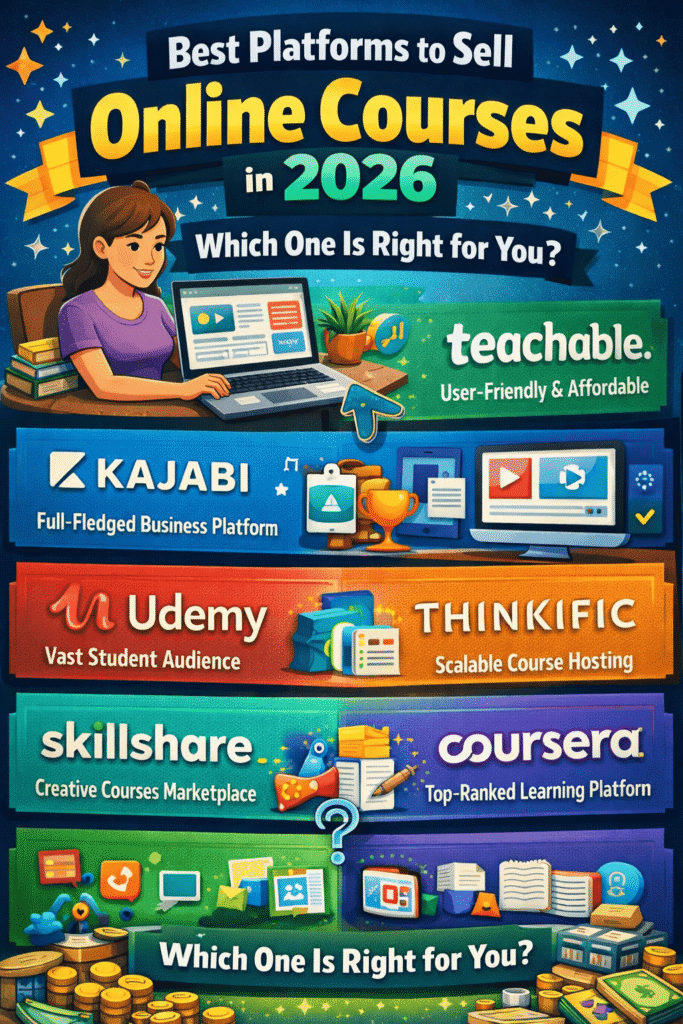
Best platforms to sell online courses in 2026
How to choose the right platform
Common mistakes beginners make
Pro tips for success
Real-life examples
Beginner-friendly tips
Conclusion
FAQ
“I’ve been teaching this skill for 12 years, but I’m still broke.” That was me — sitting at a kitchen table at 2 AM, wondering if my knowledge was worth anything online.
Sound familiar? You’re brilliant at what you do. Maybe you’re a graphic designer, a language tutor, a fitness coach, or a budgeting expert. But you’ve been giving it away for free — in blogs, YouTube videos, Instagram posts — without a dollar to show for it.
Here’s the truth no one tells beginners: the knowledge economy is booming. The global e-learning market is projected to exceed $1 trillion by 2032. People are paying every single day to learn things you already know.
The problem? Most beginners don’t know where to start selling. They get overwhelmed by the sheer number of platforms, pricing models, and tech choices. That’s exactly why I wrote this guide.
In this post, you’ll discover the best platforms to sell online courses in 2026 — broken down simply, honestly, and with real guidance for absolute beginners. No fluff. No tech jargon. Just the information you need to pick your platform and get started.
What Is an Online Course Platform?
An online course platform is a tool — usually a website or software — that lets you create, host, market, and sell your courses to students around the world. Think of it as your digital classroom and storefront, rolled into one.
Some platforms act like marketplaces (they bring the students to you). Others are self-hosted tools (you build your own audience). And some are a hybrid of both. Understanding this difference is the most important first step.
- Marketplace platforms: Udemy, Skillshare — built-in audience, less control
- Self-hosted platforms: Teachable, Thinkific, Kajabi — your branding, your pricing
- All-in-one tools: Kajabi, Podia — courses + email + community in one place
Why 2026 Is the Perfect Year to Start Selling Online Courses
If you’ve been on the fence, stop waiting. Here’s why 2026 is actually a golden window:
- AI tools have made course creation faster than ever — scripts, slides, and videos in hours, not weeks
- Consumer trust in digital education has never been higher after the pandemic shift to remote learning
- Platforms now offer free plans, making the barrier to entry nearly zero
- Short-form content on TikTok and Instagram funnels curious learners into paid courses every day
- Niche markets are thriving — you don’t need millions of followers, just a few hundred loyal buyers
Did you know
The average online course creator earns between $1,000–$10,000/month once they find their audience. Some niches earn 10x that with the right platform and positioning.
Benefits of Selling Online Courses
Before we dive into the platforms, let’s get clear on why this model is worth your time and energy.
- Passive income: Build once, sell forever
- Location freedom: Work from anywhere — a café in Bali or your spare bedroom
- Scale without limits: 1 student or 10,000 — the same course serves them all
- Authority building: A published course makes you the expert in your field
- Diversified income: Combine with coaching, consulting, or memberships
- Low overhead: No inventory, no shipping, no physical products
Best Platforms to Sell Online Courses in 2026
Here’s an honest, beginner-friendly breakdown of the top platforms — what they’re best for, their pricing, and who they suit.
1. Teachable
Teachable
Great for beginners Free plan available
Teachable is one of the most beginner-friendly platforms on the market. You can build a beautiful course page without any coding, and it handles payments, student management, and certificates out of the box.
- Free plan with transaction fees (paid plans from ~$39/month)
- Built-in affiliate program on higher plans
- Drag-and-drop course builder
- Best for: coaches, educators, solopreneurs
2. Thinkific
Thinkific
Generous free plan No transaction fees
Thinkific’s free plan is one of the most generous in the space — no transaction fees, ever. It’s clean, professional, and lets you launch your first course without spending a cent.
- Free plan: 1 course, unlimited students
- Paid plans from $36/month (billed annually)
- Community features built-in on paid plans
- Best for: bloggers launching their first course
3. Udemy
Udemy
Largest marketplace Free to publish
Udemy brings the traffic. With 60+ million students already on the platform, you don’t need to build an audience. But the trade-off is steep discounts and revenue sharing (you keep 37% when Udemy drives the sale).
- Free to list; Udemy takes a commission
- Keep 97% of revenue from your own coupon promotions
- Courses must meet content quality standards
- Best for: beginners who have no audience yet
4. Kajabi
Kajabi
Premium ($) All-in-one powerhouse
Kajabi is the Rolls-Royce of course platforms. Courses, email marketing, landing pages, communities, and podcasts — all under one roof. The price reflects it, starting at $149/month, but many creators find it replaces 4–5 separate tools.
- Plans from $149/month (14-day free trial)
- Zero transaction fees, ever
- Automation workflows, funnels, and CRM built in
- Best for: established entrepreneurs scaling fast
5. Podia
Podia
Simple & clean Free plan
Podia is incredibly simple — almost too simple, which is exactly what overwhelmed beginners need. It handles courses, digital downloads, memberships, and webinars with a minimal learning curve.
- Free plan available (8% transaction fee); paid from $33/month
- Sell courses, downloads, and memberships in one place
- Built-in email marketing on paid plans
- Best for: creators who want simplicity above all
6. Skillshare
Skillshare
Subscription model
Skillshare works differently — students pay a subscription fee and access all content. You earn royalties based on minutes watched. It’s great for creative topics (design, illustration, writing, photography).
- Free to publish; earn per minute watched
- Built-in creative audience of millions
- Less control over pricing or student data
- Best for: creative professionals in design, art, writing
How to Choose the Right Platform for You
With so many options, here’s a simple decision framework based on where you are right now:
- No audience yet? → Start with Udemy or Skillshare (they bring the traffic)
- Have an email list or social following? → Use Teachable or Thinkific (keep more revenue)
- Want everything in one place? → Kajabi or Podia
- Tight budget? → Thinkific free plan is the best zero-cost start
- Creative niche? → Skillshare’s subscription model works well
Pro reminder
Don’t let platform choice paralyze you. A “B+” platform you launch on is worth more than an “A+” platform you’re still researching six months from now.
Common Mistakes Beginners Make
I’ve seen hundreds of first-time course creators make the same avoidable errors. Here are the big ones:
- Waiting until the course is “perfect”: Launch a beta version first. Perfection kills momentum.
- Choosing a platform based on hype alone: What works for a 7-figure influencer may not suit a beginner with 200 Instagram followers.
- Skipping validation: Sell before you build. Pre-sell your course idea to 5–10 people before recording a single video.
- Ignoring email list building: Your email list is your biggest asset. Don’t rely solely on the platform’s audience.
- Underpricing out of fear: A $97 course often sells better than a $9 one. Price signals quality.
- Too much content: A focused 2-hour course often outperforms a bloated 20-hour one.
Pro Tips for Success in 2026
Tip 1 — Start narrow, go deep
“How to lose weight” is too broad. “How women over 40 can lose belly fat without giving up wine” is a course people will buy. Niching down increases conversion.
Tip 2 — Use short-form content as a funnel
Post 60-second tips on TikTok, Reels, or YouTube Shorts. End every video with “Full course link in bio.” This funnel costs nothing and converts remarkably well.
Tip 3 — Collect testimonials from day one
Give 5–10 people free or discounted access in exchange for an honest review. Social proof is the #1 conversion driver for online courses.
Tip 4 — Bundle for higher average order value
Offer a course + templates bundle or a course + group coaching add-on. Bundles can double your revenue per customer without finding new buyers.
Tip 5 — Automate with email sequences
Set up a welcome sequence, a course launch sequence, and an abandoned-cart email. Platforms like Kajabi and Podia have this built in — use it.
Real-Life Examples That Will Inspire You
Sarah, a yoga instructor from Ohio: Started on Teachable with a $47 course on morning yoga routines. Built her email list to 3,000 subscribers in 8 months using free YouTube content. Revenue: $8,000/month.
Raj, a data analyst from Bangalore: Published a Python for beginners course on Udemy. No social following, no blog. Just a well-produced course with good reviews. Earns $2,000–$4,000/month passively.
Maria, a pastry chef from Spain: Used Skillshare to reach a global creative audience for her macaron masterclass. Built brand recognition that led to a Thinkific store earning €60,000/year.
These are real people — not influencers, not tech geniuses — who decided to package what they knew and share it with the world.
Beginner-Friendly Tips to Get Started This Week
- Write your course idea in one sentence. If you can’t, it needs more focus.
- Sign up for a free plan on Thinkific or Teachable — no credit card needed.
- Record your first module with your phone or a free tool like Loom. Don’t buy equipment yet.
- Post about your course idea on Instagram or LinkedIn — test the reaction before you invest heavily.
- Set a launch date. A real date. Two weeks from now. Tell someone. Accountability works.
Conclusion: Your Knowledge Is a Business Waiting to Happen
You’ve been sitting on a goldmine and calling it “just something I know.” Stop doing that.
The best platforms to sell online courses in 2026 — Teachable, Thinkific, Udemy, Kajabi, Podia, and Skillshare — are all designed to help regular people turn their expertise into income. The tech is simple. The market is hungry. The only thing missing is you hitting “publish.”
Pick one platform. Build one module. Launch imperfectly. You can always improve it — but only once you start.
Your future students are out there right now, Googling exactly what you already know how to do.
Frequently Asked Questions
1. What is the best platform to sell online courses for beginners in 2026?
For absolute beginners, Thinkific and Teachable are the top choices. Both offer free plans, beginner-friendly interfaces, and no upfront cost. If you have zero audience, Udemy’s marketplace is also a great starting point.
2. Can I sell online courses for free without paying for a platform?
Yes! Thinkific’s free plan lets you publish one course with no transaction fees. Teachable and Podia also offer free plans (with transaction fees). Udemy and Skillshare are free to publish on — they take a revenue share instead.
3. How much money can I realistically make selling online courses?
Earnings vary widely. Beginners typically earn $500–$2,000/month in their first year. With a loyal audience and good marketing, $5,000–$20,000/month is achievable. Some creators earn six figures annually from a single flagship course.
4. What is the difference between Teachable and Kajabi for selling courses?
Teachable is focused primarily on courses and is more affordable (free plan available). Kajabi is an all-in-one platform that includes email marketing, sales funnels, and community features — but starts at $149/month. Teachable suits beginners; Kajabi suits scaling businesses.
5. Do I need a website to sell online courses in 2026?
No! Most platforms — including Teachable, Thinkific, and Kajabi — give you a hosted course page and checkout, so you don’t need a separate website to get started. A personal website is helpful later for SEO and branding, but it’s not a requirement on day one.
Tutorial Guide:
How to Do Keyword Research for Beginners in 2026: Find Keywords That Actually Rank
How to Start a Blog and Make Money in 2026: The Complete Beginner’s Guide
How Artificial Intelligence is Changing Our Daily Lives in 2025