
I’ve never run a paid ad in my life. My blog gets 80,000+ organic visitors a month. Here’s every strategy I used — ranked by what actually moved the needle.
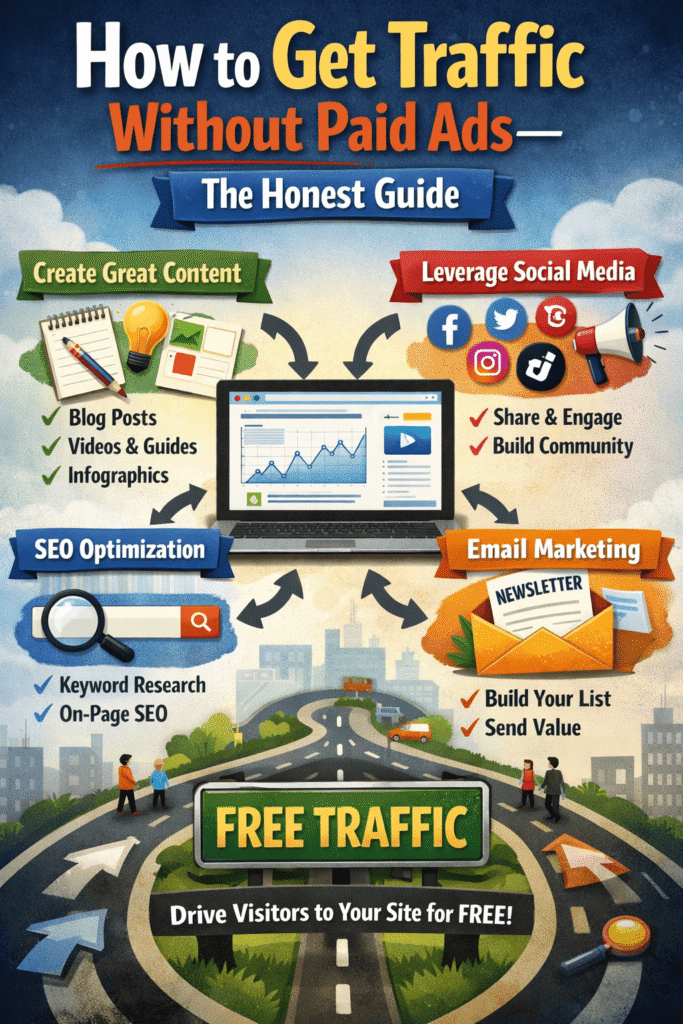
If you’ve been Googling how to get traffic without paid ads, you’re probably at that frustrating stage where you’ve got great content, a decent-looking site, and absolutely no visitors coming through the door. The good news? Free organic traffic strategies in 2026 are more accessible than ever — and they pay dividends that no Google Ads campaign ever will. Unlike paid advertising where traffic stops the moment your budget runs out, organic blog traffic compounds over time. One well-ranked post, one viral Pinterest pin, one YouTube video that hits the algorithm — any of these can send thousands of visitors to your site every month, for months or years, without spending a single rupee. This guide covers every proven method to drive website traffic without advertising, ranked by effort versus return, so you know exactly where to spend your time first.
In 2021, I made a promise to myself: I would never pay to send someone to my blog.
Not because I was broke — although I was — but because something about paying Google to show my content felt philosophically wrong to me. Like bribing a teacher to give your essay a read.
My first month? 43 visitors. My first year? Embarrassing. But month 18? Something shifted. The SEO started compounding, the content started ranking, the email list started growing — and suddenly I had a site making real money from traffic that cost me exactly zero rupees p
- Why paid ads are a treadmill — and organic traffic is an investment
- Strategy 1: SEO — the slow burn that pays forever
- Strategy 2: Pinterest — the most underrated traffic source for bloggers
- Strategy 3: YouTube — video search is where the buyers are
- Strategy 4: Email list — the traffic you actually own
- Strategy 5: Reddit and online communities — traffic hiding in plain sight
- Strategy 6: Guest posting — borrowing someone else’s audience
- Strategy 7: Social media — organic reach that still works
- The 5 mistakes that keep bloggers stuck at zero traffic
- Your realistic 6-month traffic timeline
Why paid ads are a treadmill — and you should get off
Here’s the honest comparison nobody wants to make. With paid ads, your traffic equation looks like this: money in = visitors out. The moment you stop paying, the visitors stop coming. There’s no compounding. No residual return. You’re essentially renting an audience you’ll never own.
With organic traffic, the equation flips. Work in = asset created. A blog post that ranks on Google page one keeps sending traffic for years. A Pinterest pin can circulate for 18 months. A YouTube video sits there earning views long after you’ve moved on to other projects. You’re building, not renting.
“Paid ads are a leaking bucket. Organic traffic is a well you dig once and drink from forever.”
Now — I’m not saying paid ads are evil. For certain businesses, at certain stages, they make complete sense. But if you’re a blogger, content creator, or affiliate marketer just starting out? You need an audience before you need ads. And the only way to build a real audience without a big budget is through organic traffic strategies. Let’s get into them.
68% of all online experiences begin with a search engine
53% of website traffic comes from organic search
6x higher conversion rate for organic vs paid for content sites
3–6 months until SEO starts compounding for new sites
The 7 strategies that actually drive free traffic in 2026
Strategy 1 — SEO: The Slow Burn That Pays Forever
Highest long-term ROI Passive income traffic
3–6 months Years Medium Google + Bing
To see real results How long results last Effort level Traffic sources
SEO is still — in 2026 — the single most powerful free traffic source for bloggers. I know everyone’s excited about short-form video and social media algorithms, but here’s the thing: when someone types a question into Google, they have intent. They want an answer. They want a recommendation. They’re ready to take action. That is the highest-quality traffic that exists on the internet. And you can get it for free.
The foundation is keyword research — finding the specific phrases people type when they’re looking for content in your niche. Target long-tail keywords with low competition (keyword difficulty under 30) and decent volume (100–2,000 searches/month). Write the most comprehensive, genuinely useful answer to that query. Optimise your title tag, meta description, and headings. Build internal links between your posts. Repeat consistently for 6–12 months.
That’s it. I know people sell courses on this for ₹50,000. The strategy isn’t complicated — the execution just requires patience most bloggers don’t have. The ones who stay patient are the ones who win.
Where to start: Install Google Search Console today (free), submit your sitemap, and check which queries your existing pages already appear for. Then optimise those pages first — you’re closer to ranking than you think.
Strategy 2 — Pinterest: The Most Underrated Traffic Source
Fastest early wins Visual search engine
2–8 weeks 465M+ Low–Medium Lifestyle, Finance, Food
To see initial traffic Monthly active users Effort level Best niches
I’m going to say something that might surprise you: when I was a new blogger with zero domain authority and no Google rankings, Pinterest was what kept my site alive. And I still use it today.
Here’s what makes Pinterest different from every other social platform: it’s a visual search engine, not a social media feed. People go to Pinterest to plan, research, and discover. A well-designed pin with a keyword-optimised description can drive traffic to your blog for 12–18 months after you created it. That’s not how Instagram works. That’s not how TikTok works. Pinterest is closer to SEO than it is to social media.
For new bloggers especially — people in niches like personal finance, food, home decor, parenting, travel, DIY, and lifestyle — Pinterest is the fastest legitimate path to meaningful free traffic. Design 3–5 pins per post using Canva, write keyword-rich descriptions, pin consistently to relevant boards, and join a few group boards in your niche. Results come faster than SEO and require less technical knowledge.
Hot tip for 2026: Pinterest Idea Pins (their short video format) are getting disproportionate reach right now. Repurpose your YouTube Shorts or Instagram Reels as Idea Pins and you’re essentially getting double the distribution from the same content.
Strategy 3 — YouTube: Where the Buyers Are
Highest purchase intent Search + social hybrid
1–3 months 2.7B+ High Tech, Finance, Reviews
To see results Monthly active users Effort level Best niches
YouTube is the second largest search engine in the world — and most bloggers completely ignore it. That’s your opportunity. When someone searches “how to set up Shopify store” on YouTube, they are not casually browsing. They are about to open their laptop and do the thing. That is buying-ready traffic, and a YouTube video description linking to your blog post or affiliate product is one of the most powerful free traffic funnels that exists.
You don’t need a camera crew. You don’t need a studio. A smartphone, decent lighting, and something genuinely useful to say is enough to get started. The videos that drive the most traffic to blogs are review videos (“Is X worth it?”), tutorial videos (“How to use X”), and comparison videos (“X vs Y — which should you buy?”). All three have high search volume and high purchase intent. All three are easy to link back to longer written content on your blog.
The blog-YouTube flywheel: Write a detailed blog post → Make a YouTube video summarising it → Link to the blog post in the description → The blog post ranks on Google, the video ranks on YouTube — two traffic sources from one piece of work.
Strategy 4 — Email List: The Traffic You Actually Own
Algorithm-proof Highest conversion rate
Immediate 40x ROI Medium Every niche
Traffic on send day vs social media Effort level Works universally
This is the one traffic source I wish I had taken seriously from day one. Your email list is the only audience you truly own. Google can change its algorithm. Instagram can tank your reach. Pinterest can update its spam policies. But nobody can take away your email subscribers except them — and if you’ve been providing genuine value, they’re not going anywhere.
Every single blog post you publish should go out to your email list on publish day. That immediate traffic spike signals to Google that your content is fresh and engaging. Over time, a list of even 1,000 highly engaged subscribers can send you 500–800 visits every time you hit send — for free, forever.
Start building your list from day one. Offer a lead magnet — a free checklist, a short ebook, a template relevant to your niche — in exchange for an email address. Use a free tool like MailerLite or ConvertKit’s free tier. Add an opt-in form to your most-visited pages. Then nurture that list like it’s the most valuable asset your blog has. Because it is.
What actually converts: Lead magnets that solve one specific, immediate problem work 3–5x better than generic “subscribe to my newsletter” prompts. “Get my free 7-day meal plan” beats “subscribe for recipes” every single time.
Strategy 5 — Reddit and Online Communities
Traffic hiding in plain sight Highly targeted
Immediate 100K+ Low Any niche
Traffic potential Active subreddits Effort level Works broadly
Reddit gets a bad reputation among marketers because so many people have tried to spam it with links and got burned. But used correctly — genuinely, helpfully, with actual participation in communities — Reddit is one of the most targeted free traffic sources available anywhere.
The strategy is simple and it requires you to actually care about the community. Find 3–5 subreddits in your niche. Spend 2–3 weeks genuinely participating — answering questions, contributing to discussions, being a real member. Then, when someone asks a question that your blog post answers perfectly, share the link in context: “I actually wrote a detailed post about this — might help.” That’s it. Done naturally, this sends highly targeted, warm traffic that converts beautifully.
The same approach works on Facebook Groups, Quora, LinkedIn communities, and niche-specific forums. Wherever your target reader already hangs out online, you should be there — genuinely contributing, not broadcasting.
Quora is especially underrated: Answers to popular questions rank in Google Search. Write a genuinely helpful Quora answer that links to a relevant blog post and you’re essentially getting Google traffic through a back door — often faster than waiting for your own site to rank.
Strategy 6 — Guest Posting: Borrow an Audience
Backlinks + traffic Authority building
1–2 weeks Dual benefit Medium–High Blogging, Tech, Finance
Per post to traffic Traffic + SEO Effort level Best niches
Guest posting gets dismissed as an “old strategy.” It’s not. It still works beautifully in 2026 — because it does two things simultaneously that no other strategy does: it sends referral traffic from an established audience, and it earns you a backlink that improves your own site’s authority in Google’s eyes.
The key is targeting the right blogs. You want sites in your niche with a real, engaged audience — not just high domain authority scores. Pitch them a specific, original idea that genuinely serves their readers. Write the absolute best post you’re capable of. Include one natural link back to a relevant, high-value page on your own site. Then promote the guest post on your own channels like it’s your own content.
Finding guest post opportunities: Search Google for “[your niche] write for us” or “[your niche] guest post guidelines.” You’ll find hundreds of sites actively inviting contributors. Start with smaller blogs (where you’ll actually get accepted) and work your way up to the bigger ones as you build your portfolio.
Strategy 7 — Organic Social Media: What Still Works
Brand building Community growth
Ongoing Low to Medium Varies by platform
Consistent effort needed Conversion rate Best niches differ
Audience owned? No
I’ll be honest with you here: organic social media in 2026 is harder than it’s ever been for driving direct blog traffic. Platforms like Instagram and Facebook actively suppress outbound links. Reach for new accounts is limited unless you pay. The algorithms are designed to keep people on the platform, not send them to your blog.
That said — social media still has a role. It’s just a different one. Use it for brand building and audience warming, not direct traffic generation. Share snippets of your content. Build a recognisable voice. Get people to know, like, and trust you. Then when you do have something to promote — an email opt-in, a new post, a product — you’re talking to a warm audience, not cold strangers.
The platforms where organic reach is still genuinely alive in 2026: LinkedIn (for B2B and professional niches), TikTok (for entertainment and education niches), and Twitter/X threads (for tech, finance, and marketing niches). Go where your audience actually is — not where you think you should be.
The compound content move: Write one long blog post → extract 5 short insights → make 5 social posts → use the best-performing one as a short-form video script → make a Pinterest pin from the graphic. One piece of content, seven distribution points. Zero extra research.
How the strategies compare — effort vs reward
SEO / Blog – Long-term payoff / Best ROI over 12+ months
Email list- Immediate on send day / Highest conversion rate
Pinterest-2–8 weeks to kick in / Best for visual niches
YouTube- 1–3 months setup / Highest purchase intent
Reddit / Quora– Immediate when done right / Highly targeted readers
Guest posting- 1–2 weeks per post / Traffic + SEO authority
5 mistakes keeping bloggers stuck at zero traffic
A. Publishing without a keyword strategy
- Writing about topics you find interesting, without checking whether anyone actually searches for them, is the most common — and costly — beginner mistake. Every post you publish should be targeting a specific search query someone is typing right now.
B. Trying to be on every platform simultaneously
SEO blog + Pinterest + YouTube + Instagram + TikTok + email list. All at once. All mediocrely. Pick two traffic channels, do them well for 6 months, then add a third. Depth beats breadth every time when you’re starting out.
C. Quitting at month 3 when nothing has happened yet
This is the traffic graveyard. Months 1–3 on a new site feel like shouting into a void. It’s not failure — it’s the normal curve. The bloggers who push through to month 6–12 are the ones who see the compounding begin. Most people quit one month before the breakthrough.
D. Never updating old content
Publishing and forgetting is a slow traffic killer. Old posts get stale, rankings drop, competitors overtake you. A monthly content audit — updating your top 5 posts with fresh information and better optimisation — can recover rankings faster than writing 10 new posts.
E. Ignoring internal linking completely
Internal links connect your content, help Google crawl your site, and keep readers on your pages longer. Every post you publish should link to at least 2 existing posts. Every old post should eventually link to new relevant content. It’s free SEO juice most bloggers completely forget about.
Your realistic 6-month traffic timeline
Let’s set real expectations. Here’s what a typical journey looks like when you combine SEO + Pinterest + email list from day one:
Month 1–2
The silent phase — foundation building
0–200 visitors/month. Google is still crawling and indexing your content. Pinterest pins are gaining early impressions. Publish 2–4 well-optimised posts per month. Set up Google Search Console. Start your email list. This phase feels pointless — it isn’t.
Month 3–4
First green shoots
200–1,000 visitors/month. Your first few posts start appearing on page 2–3 of Google. Pinterest traffic trickles in. A Reddit or Quora answer brings a small spike. Your email list has 50–150 subscribers. Keep publishing. Keep optimising. Do not panic.
Month 5–6
The compound effect begins
1,000–5,000 visitors/month. 2–3 posts hit page one for their target keywords. Pinterest is consistently driving 20–30% of your traffic. Email list at 200–400 subscribers. This is where the momentum starts to feel real. One viral pin or one page-one ranking can change everything.
Month 7–12
The flywheel turns on its own
5,000–30,000+ visitors/month depending on niche and consistency. Multiple page-one rankings. Pinterest as a reliable daily traffic channel. Email list at 500–2,000 subscribers. Revenue starting from affiliate commissions. The compounding is now visible — and it doesn’t stop here.
The honest disclaimer: These numbers assume you’re publishing quality content consistently, doing proper keyword research, and actively working your traffic channels. Results vary by niche — a blog in a niche like personal finance will move faster than one in a highly competitive space like digital marketing. But the curve exists in every niche. The timeline just differs.