


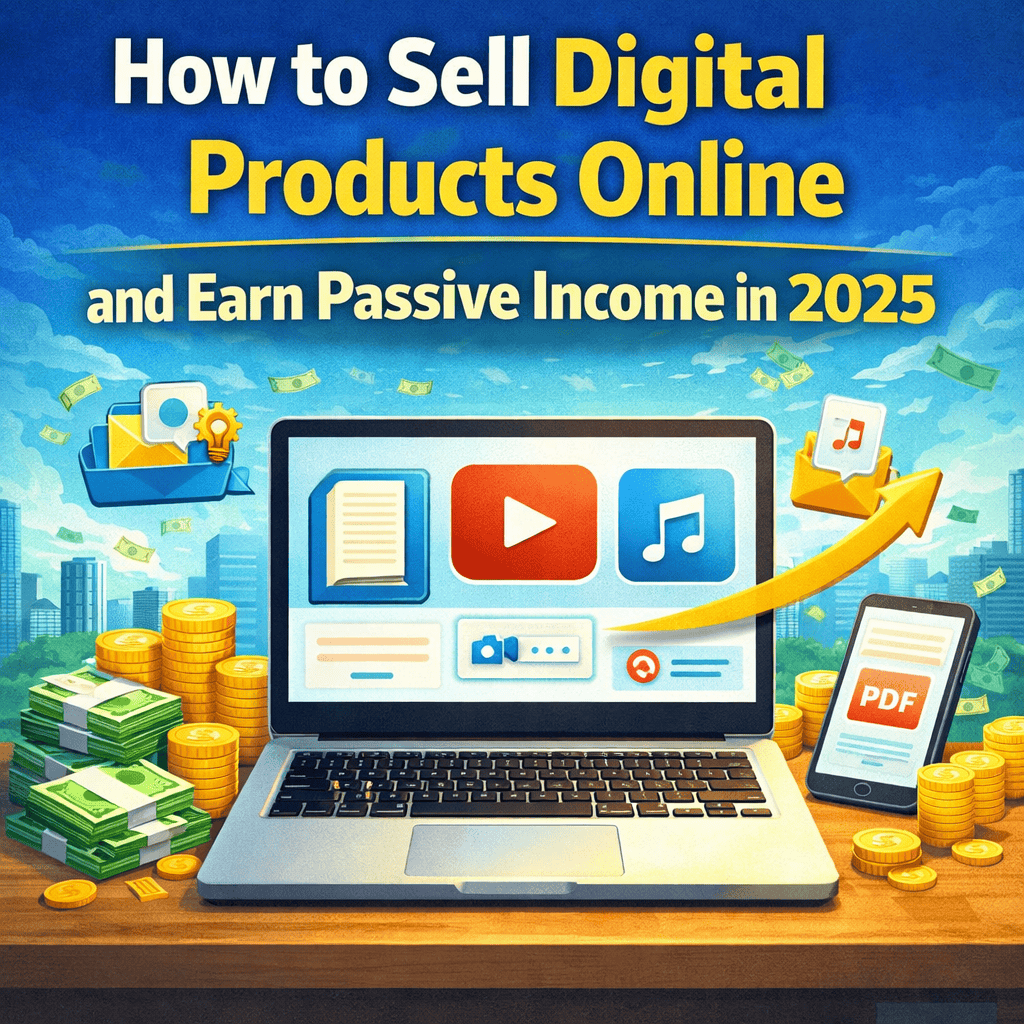
Learn how to sell digital products online and earn passive income in 2026. A beginner-friendly, step-by-step guide with the best platforms, product ideas, and real success stories.
Table of Contents
- Introduction — The notification that changed everything
- What are digital products and why do they create passive income?
- Why selling digital products matters more than ever in 2026
- Key benefits of selling digital products online
- Best digital product ideas for beginners in 2026
- Step-by-step guide: how to sell digital products online
- Best platforms to sell digital products
- Best tools to create and sell digital products
- Real-life success stories
- Common mistakes beginners make
- Pro tips for passive income success
- Conclusion
- FAQ
Introduction — The notification that changed everything
Tariq woke up on a Tuesday morning to three notifications on his phone. Not alarms. Not texts. Sales notifications. While he slept, three strangers on the other side of the world had purchased his PDF guide about freelancing for $27 each. He made $81 overnight — from a document he’d written six months ago during a slow week. That was the moment Tariq understood, deep in his bones, what passive income from digital products actually feels like.
If that story makes you feel something — a flicker of hope, a pang of “I want that” — then keep reading. Because learning how to sell digital products online and earn passive income in 2026 is one of the most realistic, accessible paths to financial freedom available to anyone with a laptop and a skill to share.
You don’t need a warehouse. You don’t need inventory. You don’t need startup capital or a business degree. You create something once, list it online, and it earns money for you every single day. This guide walks you through every step — from choosing your product to getting your first sale — in plain, beginner-friendly language.
What are digital products and why do they create passive income?
A digital product is any product that exists in digital form — it has no physical weight, requires no shipping, and can be delivered to a buyer instantly anywhere in the world. Examples include e-books, PDF guides, online courses, templates, presets, printables, stock photos, music, software, and more.
Here’s why they’re so powerful for passive income: you create the product once and sell it unlimited times. There’s no cost of goods, no restocking, no manufacturing delays. Every sale is nearly 100% profit. A $27 template you design in an afternoon can sell 500 times over two years — earning $13,500 from a single creation.
The global digital products market is projected to reach $331 billion by 2030 (Grand View Research). The infrastructure, trust, and platforms needed to sell digital products have never been more accessible to individual creators — regardless of background, budget, or technical skill.
Why selling digital products matters more than ever in 2026
$331B -Digital products market by 2030 (Grand View Research)
100% -Profit margin — no cost of goods or shipping
24/7 -Your product sells while you sleep, travel, or rest
$0 -Inventory cost — create once, sell forever
In 2026, the creator economy is mature, trusted, and expanding rapidly. Buyers are completely comfortable purchasing digital goods — they buy Kindle books, Udemy courses, Canva templates, and Notion dashboards without hesitation. The cultural shift has already happened. The question is simply whether you’re on the selling side or the buying side of that transaction.
For entrepreneurs and side-hustlers, digital products solve one of the biggest problems with traditional business models: the time-for-money trap. When you freelance or work a job, your income stops when you stop working. Digital products break that pattern permanently — once published, they earn independently of your time.
Key benefits of selling digital products online
- Zero inventory, zero shipping — your product is delivered automatically the moment someone pays.
- Near-100% profit margins — your only ongoing cost is platform fees, typically 3–10%.
- True passive income — your products work while you sleep, travel, or spend time with family.
- Global reach — sell to anyone in any country without logistical complexity.
- Scalability without hiring — one person can sell to 10 or 10,000 customers with the same effort.
- Creative freedom — build products around your skills, knowledge, and passions.
- Easy to update and improve — unlike physical products, you can release version 2.0 in hours.
- Low startup cost — many creators launch their first digital product for under $50 total.
Best digital product ideas for beginners in 2026
E-books and PDF guides
In-depth knowledge on any topic, from budgeting to baking to business strategy
Notion templates
Dashboards, planners, habit trackers, business systems — high demand in 2026
Canva templates
Social media kits, pitch decks, resumes, Instagram story packs
Online courses
Video-based teaching on any skill you’ve mastered — cooking, coding, copywriting
Printables
Planners, journals, checklists, wall art — huge Etsy market with steady demand
Digital photography
Stock photos, presets, Lightroom filters sold on Etsy, Creative Market, or Gumroad
Music and audio
Royalty-free tracks, sound effects, meditation recordings, podcast intros
Spreadsheet tools
Budget trackers, business calculators, content calendars in Google Sheets or Excel
The best digital product to create is the one that sits at the intersection of what you know well, what someone else urgently needs, and what you can package clearly. You don’t need to be a world-class expert — you just need to be a few steps ahead of the person you’re helping.
Step-by-step guide: how to sell digital products online
1. Choose your product and validate the idea
Before creating anything, validate that people actually want what you’re planning to make. Search for your product idea on Etsy, Gumroad, and Google. If similar products exist and have reviews and sales, that’s proof of demand — not competition to fear. Check Reddit threads, Facebook groups, and forums where your target audience hangs out. What questions are they asking repeatedly? That’s your product idea.
2. Create your digital product
Use the tools that match your product type. Canva for templates and printables. Google Docs or Notion for e-books and guides. Teachable or Thinkific for online courses. Descript or Loom for video content. Focus on creating something genuinely useful, well-designed, and clearly organized. First impressions matter enormously in the digital products world — buyers judge quality by visual presentation as much as content.
3. Set your price strategically
Pricing psychology matters. Research competitor pricing first. Don’t race to the bottom — low prices signal low value and attract refund-prone buyers. A well-positioned $37 template often outsells a $5 one because it feels premium and trustworthy. Consider tiered pricing: a basic version at $17 and a deluxe bundle at $47. Bundles dramatically increase your average order value without extra product creation effort.
4. Choose your selling platform
Your platform choice determines your reach, fees, and how much control you have over your brand. Etsy gives you a built-in audience but takes a cut. Gumroad and Payhip let you keep more of each sale. Teachable and Kajabi work best for courses. Your own website via Shopify or WooCommerce gives maximum control and branding but requires you to drive all your own traffic. Many successful sellers use two or three platforms simultaneously.
5. Write a compelling product listing
Your listing is your salesperson — it needs to work hard without you present. Write a headline that names the exact problem your product solves. Use bullet points to describe specific benefits (not just features). Include high-quality mockup images showing your product in use. Add social proof as soon as you have it — even one glowing review transforms conversion rates. Optimize your title and description with keywords your buyers are searching for.
6.Drive traffic to your listing
On marketplaces like Etsy, internal SEO drives significant organic traffic. On your own site, you need to build it yourself. Share your product on Pinterest (still one of the highest-converting platforms for digital products). Create short-form video on TikTok or Instagram Reels showing your product in action. Write blog posts targeting keywords your buyers search. Build an email list and notify subscribers on every new launch.
7. Automate delivery and build your passive income system
Set up automatic delivery so every buyer receives their product instantly without any action from you. Platforms like Gumroad, Etsy, and Payhip handle this natively. Connect your listing to an email marketing tool like ConvertKit — every buyer automatically enters a post-purchase sequence that delivers value, builds loyalty, and eventually introduces them to your next product. This automation stack is what transforms a one-time sale into a lifetime customer relationship.
Best platforms to sell digital products in 2026
Gumroad
Best for creators just starting out
Free to start, takes a flat 10% per sale. Simple, creator-friendly, trusted by buyers globally. Ideal for e-books, guides, templates, and courses.
Etsy
Best for printables and templates
Massive built-in buyer audience. Huge demand for planners, printables, and Canva templates. Listing fee of $0.20 plus transaction fees per sale.
Payhip
Best free alternative to Gumroad
Free plan with 5% transaction fee. Supports e-books, courses, memberships. Clean storefront with built-in affiliate program support.
Teachable
Best for online courses
Purpose-built for course creators. Handles video hosting, student management, and payments. Free plan available with limited features to start.
Lemon Squeezy
Best for software and SaaS
Handles tax compliance automatically — a major advantage for global sellers. Growing fast in 2026 as a modern Gumroad alternative with lower fees.
Your own website
Best for full control and branding
Shopify + Digital Downloads or WooCommerce. Keep 97%+ of each sale. Requires building your own traffic — ideal once you have an audience.
Best tools to create and sell digital products
1.Canva Pro
Design e-books, templates, printables, mockups
Canva is the go-to design tool for digital product creators in 2026. It’s beginner-friendly, drag-and-drop simple, and produces professional results. Use it to create your actual products and your marketing materials. Canva’s built-in mockup feature lets you showcase your templates in a realistic, attractive way that dramatically boosts listing click-through rates.
2.Notion
Create and sell Notion template products
Notion templates are one of the fastest-growing digital product categories in 2026. Business dashboards, content calendars, client management systems, and personal productivity templates sell consistently on Gumroad and Etsy. Notion is free to use, and if you’re already a Notion user, you’re probably sitting on sellable template ideas right now.
3.ConvertKit (Kit)
Email marketing and product launch automation
Your email list is your most powerful sales channel for digital products. ConvertKit lets you build automated email sequences that welcome new buyers, deliver value, and promote future products — all without any ongoing effort from you. A list of 1,000 engaged subscribers can generate thousands in revenue on each new product launch.
4. Descript
Create course videos and audio products
Descript makes video and audio content creation accessible to complete beginners. Edit video by editing text, remove filler words automatically, and produce polished course content without any video editing experience. If you’re creating an online course in 2026, Descript dramatically reduces the time and technical skill required to produce professional results.
5. Placeit / Smartmockups
Create professional product mockups for listings
Buyers can’t touch or feel your digital product before purchasing — so your mockup images do the selling for you. Placeit and Smartmockups let you place your e-book cover, template screenshot, or course preview into realistic device and print mockups in seconds. Professional visuals can increase conversion rates by 30–50% on marketplace listings.
Real-life success stories
“I’m a high school art teacher. During summer break, I made a pack of 40 Canva social media templates for small businesses. I listed it on Etsy for $19 and forgot about it. Six months later, I’d earned $3,200 from that single listing — completely passively. I’ve since added 12 more products. My Etsy shop now earns more than my teaching salary.” — Yemi A., London, digital template creator
“I’m a nurse who knew a lot about managing night shifts and staying healthy working odd hours. I packaged that knowledge into a $37 PDF guide with schedules, meal plans, and recovery tips. I shared it in three nursing Facebook groups and sold 140 copies in two weeks — $5,180 from a Word document I wrote in a weekend. I still get sales every week without doing anything.” — Monica D., Toronto, healthcare professional turned digital creator
Common mistakes beginners make
These are the traps that stop beginners from ever making their first digital product sale. Awareness is your best defense.
- Creating a product nobody wants — validate demand before you spend time creating anything.
- Underpricing out of fear — low prices repel buyers as often as they attract them. Trust your value.
- Skimping on product visuals — your mockup and listing images are your storefront. Invest time in them.
- Listing once and disappearing — products need to be shared, promoted, and updated to maintain sales momentum.
- Ignoring your existing knowledge — the things you know that feel ordinary to you are often extraordinary to someone else.
- Not building an email list from day one — your list lets you launch future products to warm buyers immediately.
- Giving up after slow initial sales — most digital product success comes from months of compounding, not overnight virality.
- Trying to sell everything to everyone — the most successful digital products serve one specific person with one specific problem.
Pro tips for passive income success in 2026
- Create product bundles — three related products sold together at a discount dramatically increase your average order value.
- Use buyer reviews strategically — reach out to early customers personally and ask for feedback and reviews. One authentic five-star review doubles conversion rate.
- Repurpose one idea across formats — turn your e-book into a course, your course outline into a template, your template into a printable. One idea, multiple revenue streams.
- Build on platforms your audience already trusts — Etsy buyers already have payment info saved and buying habits established. That’s priceless friction reduction.
- Add an affiliate program — let your buyers promote your product for a 20–30% commission. Your happiest customers become your best salespeople.
- Update products annually — a refreshed “2026 Edition” of your guide can reignite sales, justify a slight price increase, and win back past buyers.
- Treat your first product as a learning project — your tenth product will be five times better. Ship it, learn from it, iterate fast.
Beginner tip: Start with exactly one product. Not a whole shop, not a full course library — one PDF, one template, one checklist. Get it live, get feedback, make your first sale. The confidence from that first sale will fuel everything that follows. Progress, not perfection, is the goal in the early days.
Conclusion
The ability to sell digital products online and earn passive income in 2026 is not reserved for tech geniuses, marketing PhDs, or people with large followings. It’s available to anyone — a nurse who knows about shift work recovery, a teacher who can design beautiful Canva templates, a parent who has figured out family budgeting, a freelancer who has learned to land clients consistently.
You are already sitting on knowledge, skills, and experience that someone else desperately needs. Digital products are simply the packaging that lets you share that knowledge with thousands of people — and get paid for it every single time, long after you’ve moved on to something else.
Create something once. Sell it forever. That’s the promise of digital products — and in 2026, it has never been easier to keep that promise. Your first product doesn’t need to be perfect. It just needs to exist. Start this week. Future-you will be profoundly grateful that you did.
FAQ — Frequently Asked Questions
1. What is the easiest digital product to sell for beginners in 2026?
PDF guides and Canva templates are widely considered the easiest entry points. Both can be created with free tools (Canva has a generous free plan, and any word processor creates PDFs), require no technical skills, and have consistent demand on platforms like Etsy and Gumroad. A useful checklist or resource list on a topic you know well can be created in a day and listed for sale within hours.
2. How much money can you realistically make selling digital products online?
Income varies enormously based on niche, product quality, platform, and marketing effort. Many beginners earn their first $100–$500 within the first 1–3 months. Consistent creators in strong niches commonly reach $1,000–$5,000 per month within their first year. Top digital product creators earn $10,000–$50,000+ per month. There is no ceiling — your income grows as your product library and audience expand.
3. Do I need a website to sell digital products online?
Not at all — especially when starting out. Platforms like Gumroad, Etsy, Payhip, and Teachable provide everything you need: a storefront, payment processing, and automatic product delivery. A personal website becomes valuable once you’ve validated your products and want to build your own brand with more control and higher margins. Many successful sellers run six-figure businesses entirely through Etsy or Gumroad without a standalone website.
4. How do I protect my digital products from being stolen or pirated?
No digital product is 100% piracy-proof, but several steps reduce the risk significantly. Add your brand name and website to every page. Use PDF permissions to restrict editing and copying. Platforms like Gumroad generate unique download links per buyer. For high-ticket courses, password-protected membership platforms like Teachable or Kajabi add meaningful protection. The reality is that most buyers are honest — focus your energy on creating and marketing rather than piracy prevention.
5. How do I get my first digital product sale with no audience?
Getting your first sale without an audience requires going where your audience already exists. Share your product genuinely in relevant Facebook groups, subreddits, and online communities (always following community rules). Use Pinterest to drive organic traffic to your listing — it works quickly even for brand-new accounts. Optimize your Etsy listing title and tags with exactly what buyers are searching. Offer a launch discount for early buyers and ask them directly for reviews. Your first three sales are the hardest — after that, social proof begins to do the selling for you.
Tutorial Guide:
How to Build an Email List from Zero and Make Money with It in 2025
Best Platforms to Sell Online Courses in 2026: Which One Is Right for You?
Affiliate Marketing for Beginners: How to Earn Your First $1,000 Online in 2026