


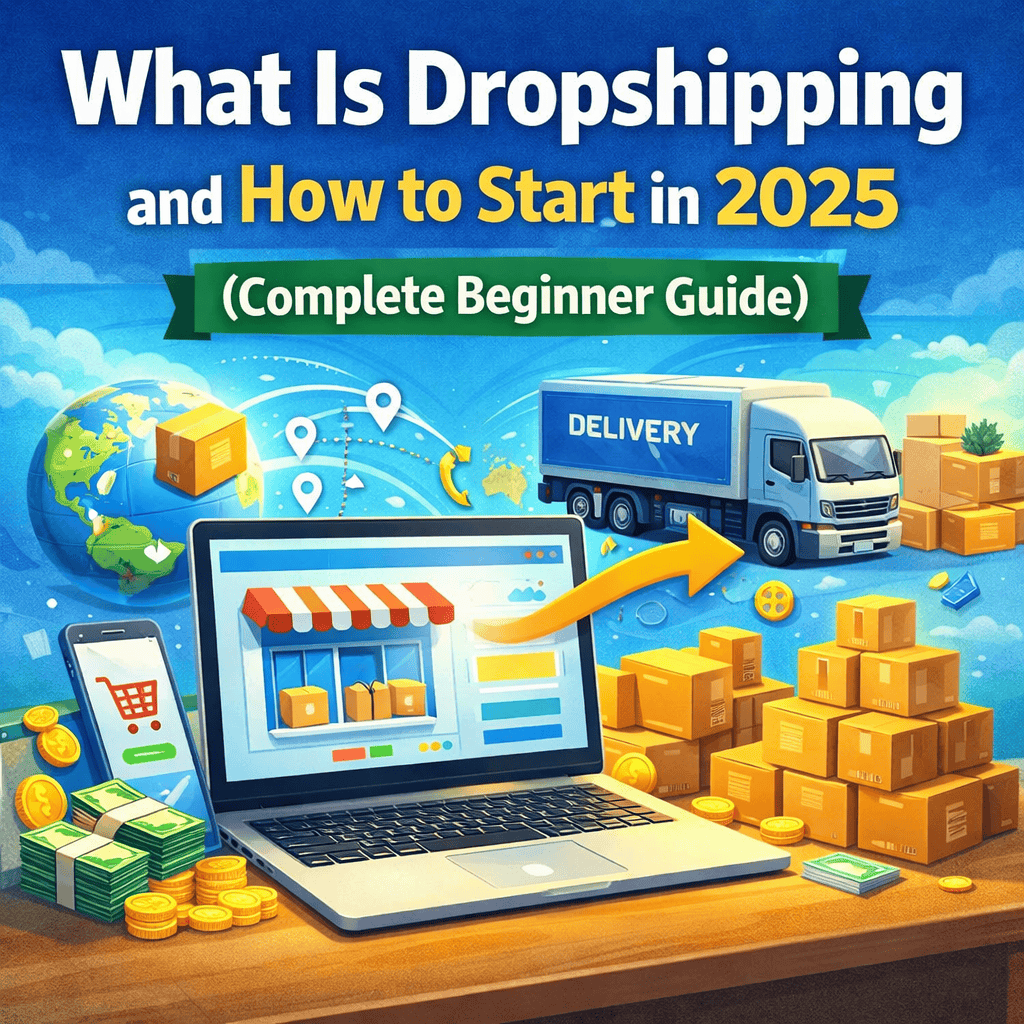
Learn what dropshipping is and how to start a profitable dropshipping business in 2025. Step-by-step beginner guide with tools, tips, and strategies.
Table of Contents
- Introduction — The $4,000 month with no warehouse and no inventory
- What is dropshipping?
- How dropshipping actually works — the full order flow
- Why dropshipping matters in 2025
- Key benefits of dropshipping for beginners
- Best niches for dropshipping in 2025
- Step-by-step guide: how to start dropshipping in 2025
- Best tools for dropshipping beginners
- Real-life success stories
- Common mistakes beginners make
- Pro tips for dropshipping success
- Conclusion
- FAQ
Introduction — The $4,000 month with no warehouse and no inventory
James was 24, living in a one-bedroom apartment, and tired of watching his paycheck disappear before the month ended. He had no savings, no business experience, and no idea what “e-commerce” really meant. One Sunday afternoon, he stumbled across dropshipping while watching YouTube. Six months later, he was running an online pet accessories store that made $4,200 in a single month — and he had never once touched a single product he sold. No warehouse. No packing tape. No shipping labels. Just a laptop, a Shopify store, and a supplier doing all the physical work for him.
If that story sounds too good to be true, I understand the skepticism. But dropshipping is a very real, very legitimate business model — and in 2025, it remains one of the most beginner-friendly ways to start an online business with almost no upfront capital. Learning what dropshipping is and how to start it correctly is one of the most valuable things you can invest your time in this year.
This complete guide breaks down everything — from the exact mechanics of how dropshipping works, to choosing your niche, finding suppliers, building your store, and making your first sale. No fluff, no filler, just the real roadmap for beginners who are serious about starting.
What is dropshipping?
Dropshipping is a retail business model where you sell products online without ever stocking or owning them physically. When a customer places an order in your store, you purchase that item from a third-party supplier — who then ships it directly to your customer. You never see the product. You never touch it. You simply facilitate the transaction and collect the profit margin between what your customer pays you and what you pay the supplier.
Think of it this way: you build the storefront and handle the marketing. The supplier is your invisible warehouse and shipping department. The customer thinks they’re buying from your brand — because they are. You’re the business owner. The supplier is your operational backbone working quietly behind the scenes.
Dropshipping is not a get-rich-quick scheme. It’s a legitimate business model with real margins, real customers, and real challenges. The people who succeed treat it like a proper business — with strategy, patience, and a customer-first mindset.
How dropshipping actually works — the full order flow


Here’s a simple example: You sell a yoga mat in your store for $45. Your supplier charges you $18 for that mat, including shipping. Your profit per sale is $27, before advertising costs. Sell 100 mats a month, and you’re looking at $2,700 in gross profit — from products you never physically held.
Why dropshipping matters in 2025


In 2025, the e-commerce landscape has matured dramatically — which is actually good news for beginners. Buyers are completely comfortable purchasing from independent online stores. Payment trust is established. Shipping expectations are clear. The tools available to build a professional dropshipping store are cheaper, faster, and more powerful than ever before.
The business model has also evolved. The most successful dropshippers in 2025 don’t just list random products and hope for sales. They build niche brands, create strong customer experiences, and work with reliable suppliers who deliver quality products with consistent shipping times. The “wild west” era of dropshipping is over — the era of professional, brand-focused dropshipping stores is now.
Key benefits of dropshipping for beginners
- Zero inventory cost — you only pay for a product after you’ve already been paid by your customer.
- Low startup capital — a professional dropshipping store can be launched for $100–$300 total.
- Work from anywhere — your business lives in your laptop and runs from any internet connection.
- Test products without risk — add and remove products instantly to find what your audience actually wants.
- No shipping or logistics headaches — your supplier handles packing, labeling, and shipping for every order.
- Scalability — going from 10 orders a day to 100 orders a day requires no warehouse expansion or additional staff.
- Huge product selection — access millions of products across every niche imaginable through platforms like AliExpress, Zendrop, and CJ Dropshipping.
- Easy to get started — with platforms like Shopify, you can have a live store within a single weekend.
Best niches for dropshipping in 2025
Your niche is the category of products your store focuses on. Niche selection is one of the most important decisions you’ll make — and the most common mistake beginners make is going too broad. “General stores” are hard to market and build no brand loyalty. A focused niche store is easier to advertise, easier to optimize for SEO, and far easier to turn into a trusted brand.


When picking your niche, ask yourself three questions: Are people actively searching for or buying these products? Are there passionate communities around this topic? Can you build a brand story around it? If yes to all three, you’ve found a strong starting point.
Step-by-step guide: how to start dropshipping in 2025
1.Choose your niche and validate product demand
Before building anything, validate that people actually want what you plan to sell. Search your product ideas on Google Trends to confirm steady or growing interest. Browse AliExpress and Amazon bestseller lists to see what’s already selling. Check Facebook Ads Library for brands running ads in your niche — if competitors are spending money on ads, there’s a market. Choose 3–5 hero products to lead your store with, rather than listing hundreds of products hoping something sticks.
2.Find reliable suppliers
Your supplier is your most critical business partner. For beginners, AliExpress integrated with DSers is the most accessible starting point — millions of products, global reach, and direct Shopify integration. For faster shipping and better product quality, explore Zendrop, Spocket (for US/EU suppliers), or CJ Dropshipping. Always order product samples before selling. A bad supplier with poor product quality or slow shipping is the number-one reason dropshipping stores fail in their first three months.
3.Build your online store
Shopify is the industry standard for dropshipping stores in 2025 — and for good reason. It’s beginner-friendly, deeply integrated with every major dropshipping tool, and designed for conversion. Choose a clean, fast-loading theme. Install a dropshipping integration app (DSers, AutoDS, or Zendrop). Write compelling product descriptions that focus on customer benefits, not just features. Upload high-quality product images. Set up payment processing with Shopify Payments or PayPal. Your store needs to look trustworthy — buyers judge professionalism instantly.
4.Price your products for profit
A common formula for dropshipping pricing: cost of product + shipping + a 2–3x markup = retail price. If your supplier charges $12 including shipping, price the product at $28–$36. Factor in your expected advertising cost per sale when calculating real profit margins. Always check what competitors are charging for similar products on Amazon and Google Shopping — your price needs to be competitive while still leaving room for profitable ad spend.
5.Drive traffic with paid and organic marketing
Getting visitors to your store is where most beginners stumble. The two fastest traffic channels for new dropshipping stores are Facebook and Instagram ads (for immediate, targeted traffic) and TikTok organic content (free, high-potential viral reach). For longer-term, lower-cost traffic, write blog content targeting product-related search keywords and optimize your product pages for Google Shopping. Start with one traffic channel, master it, then expand.
6.Manage orders and customer experience
When orders come in, your dropshipping app automatically routes them to your supplier. Your job shifts to customer communication — confirming orders, handling tracking inquiries, and resolving any issues quickly and professionally. Fast, friendly customer service is what separates thriving dropshipping brands from stores that get one-star reviews. Set up automated email sequences for order confirmations, shipping updates, and post-purchase follow-ups from day one.
7.Analyze, optimize, and scale
Use Shopify Analytics and Google Analytics to track which products sell, which ad campaigns are profitable, and where customers drop off in your store. Kill underperforming products and double down on winning ones. Test different ad creatives, headlines, and landing pages. Once you find a profitable product-ad combination, scale your ad budget incrementally — 20% increases every few days — to grow revenue without destabilizing performance.
Best tools for dropshipping beginners in 2025
1.Shopify
Store building platform — the industry standard
Shopify is the backbone of most professional dropshipping businesses in 2025. It handles your storefront, cart, payments, and order management. It integrates natively with every major dropshipping app. Plans start at $39/month, and a 3-day free trial lets you build your store before paying a cent. For serious dropshippers, Shopify is non-negotiable.
2.DSers / AutoDS
Supplier integration and order automation
DSers is AliExpress’s official dropshipping partner, offering free plan automation for new stores. AutoDS is more powerful for scaling — it automates pricing, inventory tracking, and order fulfillment across multiple suppliers simultaneously. Both eliminate the manual work of processing orders one by one, which becomes critical as your volume grows.
3.Zendrop
US-based suppliers with faster shipping times
One of the biggest dropshipping challenges is slow shipping from overseas suppliers. Zendrop solves this with curated US and international suppliers offering 5–10 day shipping times. It also offers custom branding, private labeling, and product bundling — giving your store a more premium brand feel from the start. Ideal for stores targeting US customers who expect Amazon-like delivery speed.
4.Minea / AdSpy
Product research and ad intelligence
Finding winning products is the lifeblood of a dropshipping business. Minea analyzes millions of Facebook, TikTok, and Pinterest ads to show you what products are actively being advertised and generating engagement — a reliable signal of what’s selling. AdSpy offers similar insights across Facebook specifically. These tools save months of guessing and help you launch with products that already have proven demand.
5.Klaviyo
Email marketing and abandoned cart recovery
The average e-commerce store loses 70% of customers who add products to their cart but never complete the purchase. Klaviyo’s automated abandoned cart email sequences recover a significant portion of those sales — often adding 15–25% more revenue with zero extra ad spend. Klaviyo integrates seamlessly with Shopify and starts free for smaller stores.
Real-life success stories
“I was a university student with £300 and a lot of free evenings. I built a Shopify store selling minimalist desk accessories — cable organizers, laptop stands, small LED lamps. I spent £150 on TikTok ads in the first month and made £780 in sales. By month four, I was earning more from dropshipping than my part-time job paid me in an entire semester.” — Kwame A., Birmingham, student turned e-commerce entrepreneur
“After my second child, going back to an office felt impossible. I spent three weeks learning dropshipping through YouTube, built a store selling outdoor family gear, and launched with $200 in Facebook ads. Month one was rough — $240 in sales, $195 in costs. But I kept testing. Month six: $8,400 in sales, $3,100 profit. I now work from home every single day while my kids are at school.” — Samantha P., Oregon, stay-at-home parent turned dropship store owner
Common mistakes beginners make
These are the exact mistakes that cause most beginner dropshipping stores to fail within 90 days. Read them once, then don’t make them.
- Choosing products they like instead of products the market wants — always follow data, not personal taste.
- Working with suppliers they’ve never tested — always order samples before selling any product in your store.
- Choosing shipping times that are too long — 30-day delivery times destroy customer trust and invite chargebacks.
- Ignoring product page quality — generic supplier descriptions, blurry photos, and no social proof repel buyers instantly.
- Giving up after the first losing ad campaign — every successful dropshipper has a graveyard of failed tests. Testing is the job.
- Not building an email list — every visitor who leaves without buying is permanently lost without email capture and retargeting.
- Opening a general store instead of a niche store — harder to market, lower conversion rates, zero brand identity.
- Ignoring customer service — one angry customer who doesn’t get a response can torpedo your store’s reviews and reputation overnight.
Pro tips for dropshipping success in 2025
- Start with 3–5 hero products, not 50 — deep focus on a small product line builds brand trust and simplifies marketing.
- Test with small budgets first — spend $20–$30 per product testing ads before scaling anything.
- Build a brand from day one — a branded store with a real logo, cohesive colors, and a clear niche outperforms generic “general stores” in every metric.
- Use UGC (user-generated content) in your ads — authentic customer videos and photos convert far better than polished stock imagery.
- Offer a clear, confidence-building return policy — it reduces purchase hesitation dramatically even if few customers actually return items.
- Install a live chat widget — stores with live chat see 15–40% higher conversion rates because buyers get instant answers to their hesitations.
- Follow seasonal trends — pet accessories surge before Christmas, outdoor gear peaks in spring, fitness products spike every January. Plan launches accordingly.
Beginner tip: Your goal for the first 30 days is not profit — it’s information. Every dollar you spend on ads is buying you data about your products, your audience, and your messaging. Treat early losses as tuition, not failure. The store that keeps testing and learning wins. The store that quits after two bad weeks loses everything.
Conclusion
Dropshipping in 2025 is not a shortcut to riches — but it is a genuine, proven path to building an online business with minimal risk and maximum flexibility. A student in Birmingham, a mother in Oregon, a corporate escapee in Manila — ordinary people from every background are building real income streams through dropshipping every single day.
What they all had in common when they started was not a big budget, a business degree, or a pre-existing audience. They had curiosity, a willingness to learn from failure, and the discipline to keep showing up. Those qualities are already inside you — or you wouldn’t have read this far.
Pick your niche today. Choose your first three products this week. Build your store this weekend. Launch your first ad next Monday. The only thing standing between you and your first dropshipping sale is the decision to start. Make it today.
FAQ — Frequently Asked Questions
1. What is dropshipping and is it still worth it in 2025?
Dropshipping is an e-commerce model where you sell products online without holding any inventory — your supplier ships directly to your customers. It is absolutely still worth it in 2025, with the global market projected to reach $476 billion by 2026. The model has matured, meaning the stores that succeed are more professional and brand-focused than early-era dropshippers — but the barrier to entry remains remarkably low for beginners willing to learn and execute consistently.
2. How much money do you need to start a dropshipping business?
You can start a dropshipping business for $100–$300. This typically covers one month of Shopify ($39), a domain name ($10–$15), a dropshipping app subscription (many have free tiers), and a small initial ad test budget ($50–$200). Unlike traditional retail, you don’t need to purchase inventory upfront — you only pay for products after customers have already paid you. This makes dropshipping one of the lowest-risk online business models available to beginners in 2025.
3. How long does it take to make money with dropshipping?
Most beginners make their first sale within 2–4 weeks of launching with paid ads. Consistent profitability typically develops over 2–6 months of testing, optimizing, and scaling winning products. Dropshipping rewards patience and persistence — the stores that survive their first 90 days of testing almost always reach profitability within six months. Treat month one as a learning phase, not a profit phase, and set realistic expectations from the start.
4. What is the best platform to start a dropshipping store in 2025?
Shopify remains the undisputed best platform for dropshipping in 2025. It integrates seamlessly with all major supplier apps (DSers, AutoDS, Zendrop, Spocket), has the best conversion-optimized checkout available, and offers excellent support for beginners. WooCommerce (WordPress-based) is a strong free alternative with more technical flexibility, but requires more setup knowledge. For pure beginners, Shopify’s ease of use and ecosystem depth make it the clear first choice.
5. Is dropshipping legal and how do I avoid scams?
Yes — dropshipping is completely legal and practiced by thousands of legitimate businesses worldwide. To avoid scams: always verify suppliers by ordering product samples before selling, never pay large upfront fees to access a supplier directory (legitimate platforms like Spocket and Zendrop have transparent subscription models), check supplier reviews and order history on AliExpress, and avoid any “guaranteed profit” dropshipping programs or “done for you” store sellers charging thousands of dollars. Build your own store from scratch using established, vetted platforms and suppliers.
Tutorial Guide:
How to Sell Digital Products Online and Earn Passive Income in 2026
7 Best AI Tools to Make Money Online in 2026 (Beginner-Friendly Guide)
How to Build an Email List from Zero and Make Money with It in 2025