Why Trust This Guide
This list is built from publicly available product documentation, pricing pages, and hands-on trials of the free/low-cost tiers of each tool, cross-checked against user feedback from small business communities. We're not a lab that runs month-long benchmark studies — we're a small, independent site, and we're upfront about that.
Some of the links below are affiliate links, which means we may earn a small commission if you sign up through them, at no extra cost to you. This never affects which tools we choose to feature — a tool only makes this list if we'd genuinely recommend it to a friend running a small business. Where we haven't personally run a tool for weeks at a time, we say so rather than pretend otherwise.
Rather than a single "best" score, we evaluated each tool against six practical criteria that matter for a small business, based on free/low-cost tier trials and public documentation:
| Tool | Ease of Use | Free-Tier Limits | Output Quality | Fits Marketing Workflow | Export/Integration |
|---|---|---|---|---|---|
| ChatGPT | Very easy | Generous | Strong, general-purpose | Good — needs manual copy/paste into other tools | Limited native integrations |
| Canva AI | Very easy | Generous | Good for standard formats | Strong — built for social/ad content | Direct export to major platforms |
| HubSpot AI | Moderate — more setup | Limited on free tier | Good, grounded in your CRM data | Strong — lives inside your pipeline | Deep integration by design |
| Jasper | Easy once configured | Trial only | Strong, brand-voice consistent | Good for content teams | Integrates with several marketing stacks |
| Surfer SEO | Moderate — data-heavy UI | None | Not a writer — an optimizer | Strong when paired with a writing tool | Integrates with Google Docs, WordPress |
These are qualitative impressions from limited hands-on use plus published documentation, not lab-grade benchmark scores — treat them as a starting point, not the final word.
🎁 Free Online Income Starter Kit (2026)
Get our free starter kit with checklists and templates for building an online income stream — straight to your inbox.
Get The No-Portfolio Client Playbook and learn how to choose a service, create practice samples, find prospects, write outreach, and take your first steps with confidence.
👉 Get it hereWhy Small Businesses Are Turning to AI Marketing Tools
Most small business owners don't have a marketing budget that stretches to a full agency retainer, and they don't have eight free hours a week to write blog posts, cut video, and build email sequences by hand. AI tools for small business marketing close that gap by handling the first 80% of the work — the blank-page problem, the rough edit, the first draft of a subject line — so the owner's time goes toward the 20% that actually needs a human: strategy, voice, and relationships.
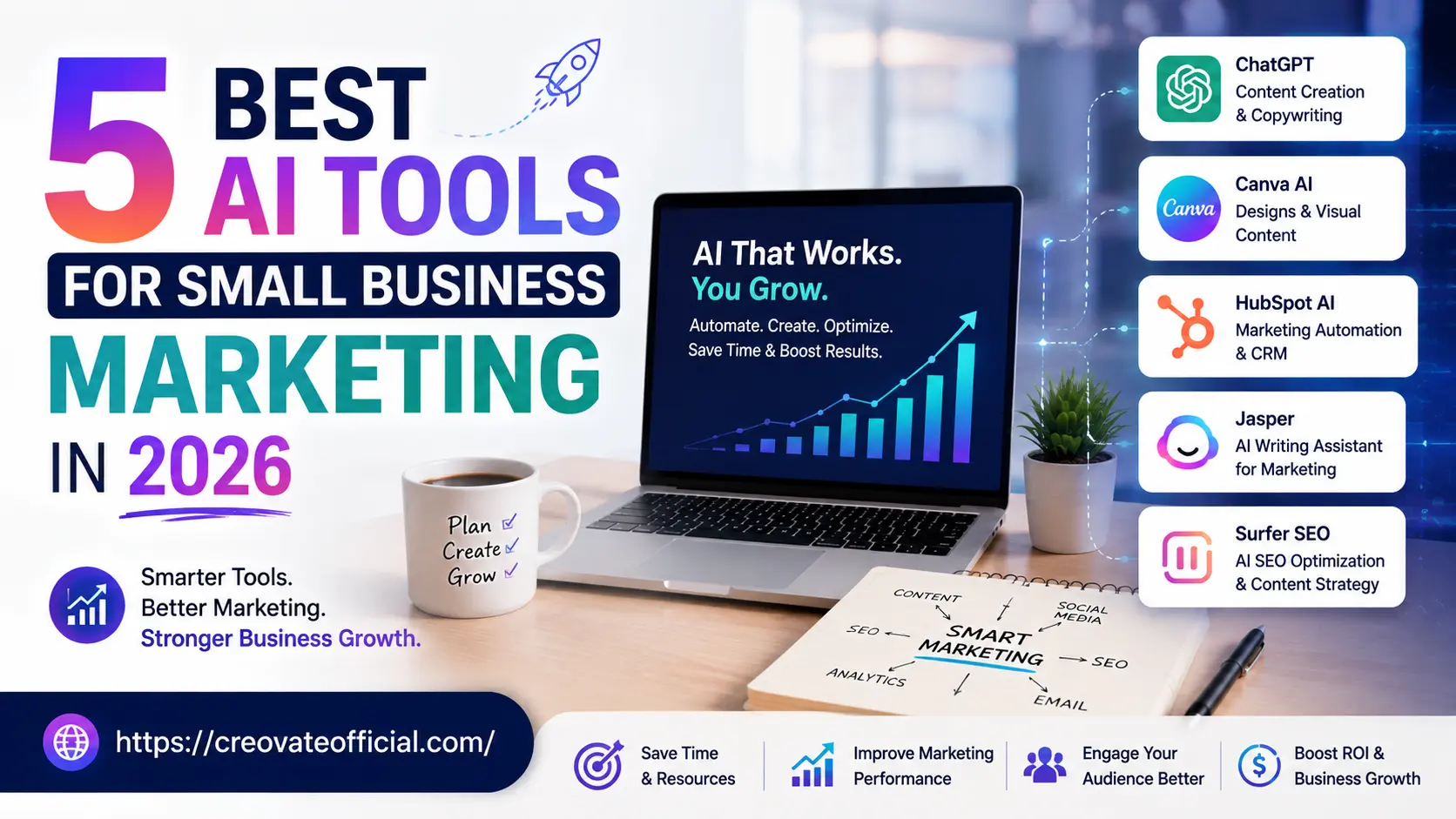
That said, not every AI tool for business growth is worth paying for. Some solve a real bottleneck; others are a novelty you'll stop opening after week two. The five tools below were chosen because they map to common small-business marketing bottlenecks: content creation, design, CRM and automation, brand-focused copywriting, and SEO.
Comparison Table
| Tool | Best For | Free Tier | Pricing Model | Best For Business Type |
|---|---|---|---|---|
| ChatGPT | Content & idea generation | Yes | Free + paid tiers | Any small business, especially solo owners |
| Canva AI | Design & visual content | Yes (generous) | Free + Pro add-ons | Social-first, ecommerce, local businesses |
| HubSpot AI | CRM & marketing automation | Yes (limited) | Free + tiered paid plans | Service businesses managing leads/pipeline |
| Jasper | Brand-voice long-form copy | Trial only | Monthly/annual plans | Content teams, agencies, growing brands |
| Surfer SEO | Content & SEO optimization | No | Monthly/annual plans | Businesses investing in organic traffic |
Pricing changes often — always confirm current pricing on the provider's site before you buy.
Individual Product Reviews
1. ChatGPT Best for Content & Ideas
Overview: ChatGPT is the general-purpose starting point for most small business marketing work — brainstorming campaign angles, drafting social captions, writing first-pass emails, and summarizing customer feedback. Its strength is flexibility: one tool, dozens of use cases.
Advantages
- Free tier is genuinely useful for day-to-day marketing tasks
- Handles brainstorming, drafting, and editing in one place
- Fast to learn — no templates or setup required
Drawbacks
- Not purpose-built for marketing — no built-in brand voice memory across sessions on lower tiers
- Output still needs fact-checking and a human editing pass
Best for: Any small business owner who wants one flexible tool for writing, planning, and problem-solving.
Pricing: Free tier available; paid tiers add higher usage limits and more capable models. Check current pricing on OpenAI's site.
Try ChatGPT →2. Canva AI Best for Design
Overview: Canva's AI features — Magic Design, background remover, text-to-image — sit inside its drag-and-drop editor, so a non-designer can produce social graphics, flyers, and ad creative without touching design software.
Advantages
- No design experience needed
- Huge template library tailored to social platforms
- Generous free tier for small teams
Drawbacks
- AI-generated designs can look templated if not customized
- Advanced brand-kit features are gated behind Canva Pro
Best for: Small businesses producing regular social posts, flyers, or ad creative without a designer on staff.
Try Canva AI →3. HubSpot AI Best for CRM & Automation
Overview: HubSpot bakes AI into its CRM and marketing hub — drafting emails, summarizing customer interactions, and suggesting next steps in your pipeline — so lead follow-up and campaign automation live in the same place as your contact data.
Advantages
- CRM and marketing automation in one system, not two
- Free CRM tier is a real starting point, not just a trial
- AI suggestions are grounded in your actual contact and deal data
Drawbacks
- Full automation features require paid Marketing Hub tiers
- More setup time than a standalone writing or design tool
Best for: Service businesses managing an actual sales pipeline, not just a mailing list.
Try HubSpot AI →4. Jasper Best for Brand-Voice Copy
Overview: Jasper is built specifically for marketing content, with brand-voice training so output sounds consistent across blog posts, ads, and emails — a step beyond general-purpose AI chat tools.
Advantages
- Brand voice and style settings keep output consistent
- Built-in templates for common marketing formats
- Team collaboration features for multi-person marketing efforts
Drawbacks
- No free ongoing plan — trial only
- Pricier than general AI writing tools for solo users
Best for: Growing brands or small agencies producing high volumes of on-brand content.
Try Jasper →5. Surfer SEO Best for AI SEO Optimization
Overview: Surfer SEO analyzes top-ranking pages for a target keyword and gives you data-backed guidance — structure, word count, terms to include — so content you (or ChatGPT/Jasper) write actually has a shot at ranking.
Advantages
- Turns "write good SEO content" into a concrete checklist
- Works well paired with any AI writing tool
- Content audit features help fix underperforming pages
Drawbacks
- No free plan — a real cost even at the entry tier
- A tool for optimizing content, not generating a full strategy
Best for: Businesses actively investing in blog or SEO content and wanting it to rank, not just exist.
Try Surfer SEO →Tools With Special Offers
These didn't make the featured five, but they're worth knowing about — and we do have current offers or free downloads for them:
- Rytr — a budget AI writing tool if ChatGPT or Jasper feel like more than you need. Try Rytr
- CapCut — a free video editor with AI captioning, useful alongside Canva for short-form video. Get CapCut Free
- GetResponse — email marketing and funnels, a lighter alternative to HubSpot's Marketing Hub. Explore GetResponse
- Systeme.io — a budget all-in-one platform if you want funnels, email, and courses under one roof. See Systeme.io
- Synthesia — AI avatar video for explainers and training content. Try Synthesia
- CustomGPT.ai — a chatbot trained on your own business content for customer support. Try CustomGPT.ai
- FastPixel — image optimization and site-speed tooling if slow pages are hurting conversions. See FastPixel
- Fiverr — when a task needs a human (logo design, voiceover, ad creative), Fiverr fills the gap AI tools can't. Browse Fiverr
Pros & Cons Summary
Where AI marketing tools win
- Cut first-draft time on writing and video dramatically
- Lower the skill barrier for non-designers and non-editors
- Free or low-cost tiers make testing risk-free
Where they fall short
- Still need human editing for brand voice and accuracy
- Can create sameness if overused without customization
- Subscriptions add up if you don't audit usage regularly
Buying Guide: How to Choose the Right AI Marketing Tool
What to look for
- A free or low-cost tier so you can test before committing
- A feature set that matches your actual bottleneck, not a long list of extras you won't use
- Export/integration options so your content isn't locked inside one platform
Common mistakes
- Subscribing to overlapping tools that do the same job
- Publishing AI output without editing for your brand voice
- Choosing the most expensive plan before you've validated the tool fits your workflow
Budget considerations
Start with free tiers or the cheapest paid plan for 30 days. If a tool genuinely saves you hours each week, upgrading pays for itself. If you're not opening it after two weeks, cancel before the next billing cycle.
Who should buy vs. who should wait
Buy now if: you're spending multiple hours a week on writing, video editing, or repetitive email tasks.
Wait if: you don't yet have a consistent content or email cadence — fix the process first, then automate it.
Frequently Asked Questions
What is the best AI tool for small business marketing in 2026?
It depends on your bottleneck. Writing-heavy businesses benefit most from ChatGPT or Jasper; design-heavy businesses benefit most from Canva AI.
Can AI tools really replace a marketing team?
No — they speed up execution, but strategy, brand voice, and judgment calls still need a human.
Are AI marketing tools worth it for a very small business?
Usually yes. Most have low-cost or free tiers, and the time saved often outweighs the subscription cost within the first month.
Do I still need to edit AI-generated content?
Yes — treat it as a first draft. Fact-check, add your own examples, and edit for your voice before publishing.
Which AI tool is best for someone with zero marketing experience?
ChatGPT and Canva AI are the easiest starting points — both work well with no prior marketing or design background.
Do any of these tools have a genuinely free plan?
Canva AI's free tier is the most generous on this list. ChatGPT and HubSpot AI also offer real free tiers; Jasper and Surfer SEO are paid-only.
Final Verdict
If you only add one tool this year, match it to your actual bottleneck: ChatGPT for writing and ideas, Canva AI for design, HubSpot AI for CRM and automation, Jasper for on-brand content at scale, or Surfer SEO to make your content rank. None of these tools will build your business for you — but they will buy back hours every week that you can put toward the parts of marketing only you can do.
Ready to save your first hour this week?
Pick the tool that matches your biggest bottleneck and try its free tier today.
Compare the Tools Again