Quick Answer
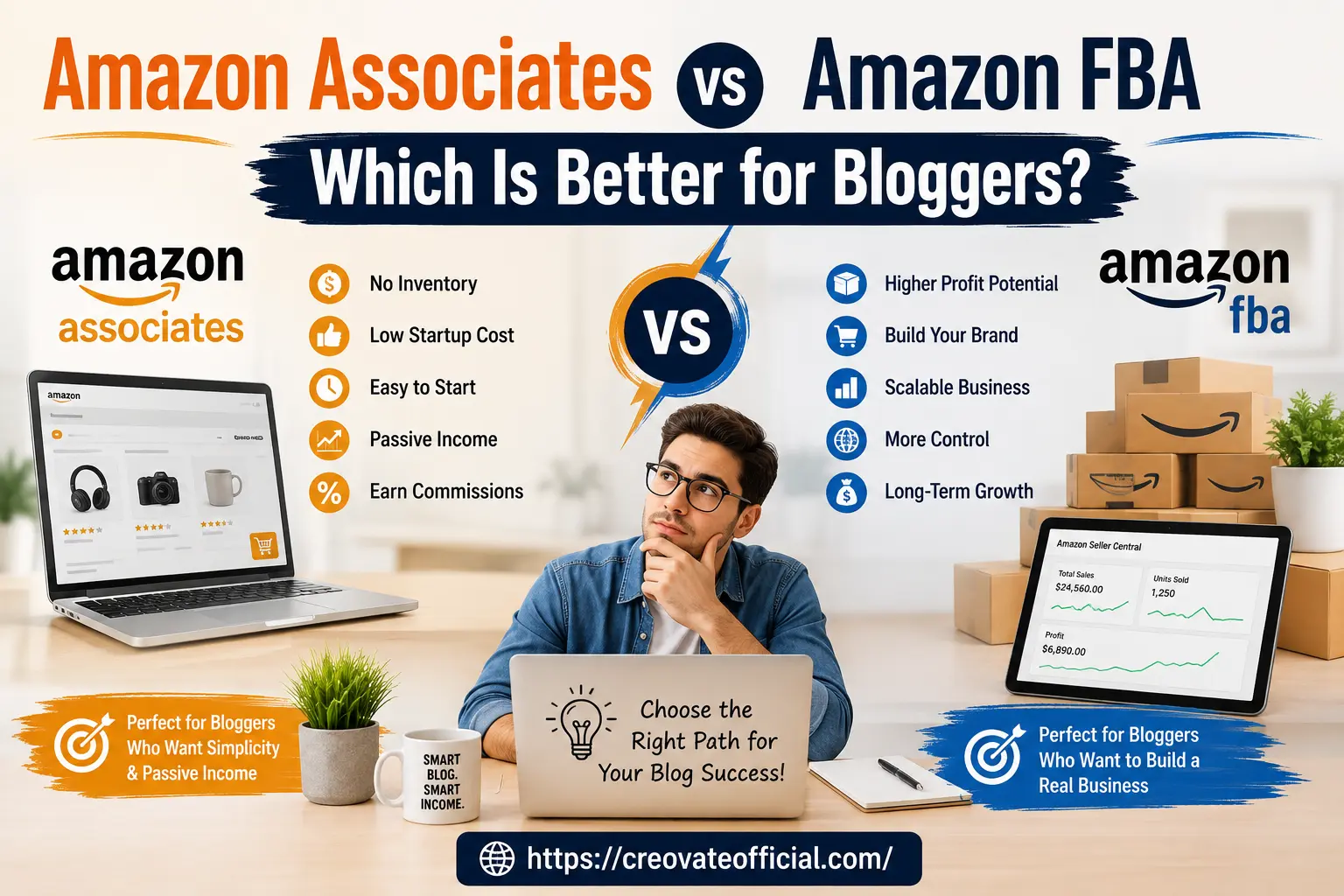
For most bloggers, Amazon Associates is the better starting point — it costs nothing to join, pairs naturally with content you're already writing, and pays out within a normal blogging workflow. Amazon FBA is the better long-term wealth builder if you have capital to invest, because you control pricing and margin instead of earning a small commission. Many bloggers eventually run both: Associates for cash flow now, FBA for equity later.
🎁 Free Online Income Starter Kit (2026)
Grab the same checklist we use to decide between affiliate income and product-based income — plus templates for tracking commissions and profit margins.
Why Trust This Guide
This guide was built by comparing publicly available Amazon Associates commission structures and Amazon Seller Central fee schedules against real blogger and seller income reports, then stress-testing the numbers against common startup budgets. We're not neutral observers — Creovate Official earns commissions from some of the tools linked below — but our recommendations are based on what actually works for content creators, not on which program pays the highest referral fee.
1. What Is Amazon Associates?
Amazon Associates is Amazon's affiliate program. You link to products from your blog, and when a reader clicks your link and buys something within 24 hours, you earn a commission. You never touch the product, never handle shipping, and never deal with a customer complaint. Your job is entirely upstream: write the content that convinces someone to click.
For bloggers, this fits naturally into formats you're likely already producing — buying guides, "best of" roundups, product comparisons, and tutorial posts that mention specific gear. If you review kitchen tools, hiking gear, tech accessories, or baby products, Amazon affiliate marketing is often the fastest way to monetize that content without asking readers to buy anything from you directly.
How Amazon Associates commission rates work
Commission rates vary by category, typically ranging from around 1% to 10%, with categories like luxury beauty and Amazon-branded products at the higher end, and categories like video games and electronics near the bottom. This is worth planning around before you build a whole content strategy on one product category.
Common mistakes with Amazon Associates
2. What Is Amazon FBA?
Fulfillment by Amazon (FBA) is Amazon's program where you send physical inventory to their warehouses, and Amazon handles storage, packing, shipping, and customer service on your behalf. You're not recommending someone else's product anymore — you're sourcing, branding, and selling your own.
For a blogger, this usually means turning audience insight into a physical product. If your readers keep asking for a specific type of planner, supplement, tool, or accessory that doesn't exist in the market the way they want it, FBA is how you build and sell that thing at scale, with Amazon handling logistics.
How Amazon FBA fees work
FBA has two main fee types: referral fees (a percentage of the sale price, similar in structure to Associates commissions) and fulfillment fees (based on the product's size and weight for picking, packing, and shipping). On top of that, there are storage fees, and long-term storage fees kick in for inventory that sits too long. These fees compound, so the "profit" number on your sales dashboard is never the number that lands in your bank account — always calculate net margin after all fees.
Common mistakes with Amazon FBA
3. Key Differences Bloggers Should Know
Both programs run through Amazon, but the business model underneath is completely different. Associates is a service business — you're paid for influence and content. FBA is a product business — you're paid for margin on something you own. That single distinction explains almost every other difference in cost, risk, and effort.
Ownership and control
With Associates, Amazon controls the price, the product page, and whether that item is even in stock — you have zero say. With FBA, you control your price, your branding, your listing copy, and your product itself. That control is valuable, but it also means every mistake is yours to fix.
Time to first dollar
Associates can start earning the moment a reader clicks and buys — no inventory, no waiting on a shipment. FBA typically takes weeks between ordering product, shipping it to Amazon's warehouse, and your first listing going live.
Scalability
Associates income scales with traffic and content volume, which has a ceiling tied to how much you can realistically publish. FBA income scales with product line expansion and can, in theory, grow well beyond what any single blogger could earn from commissions alone — but it requires reinvested capital to do it.
At a Glance: Effort, Cost & Ceiling
Bars show relative comparison on a 0–100 scale for illustration, not measured units.
4. Comparison Table
| Feature | Amazon Associates | Amazon FBA |
|---|---|---|
| Startup cost | $0 to join; only your website/hosting costs | A common starting budget is around $2,000–$5,000+, depending on product, inventory, shipping, fees and advertising — not an Amazon-mandated minimum |
| Pricing control | None — Amazon sets the price | Full control over your product's price |
| Time to first payout | Days to weeks after your first sale | Weeks to months after sourcing and shipping inventory |
| Ongoing work | Content creation, link updates, SEO | Inventory management, listing optimization, ads, customer service |
| Risk level | Low — no inventory to lose money on | Higher — unsold or returned stock ties up cash |
| Income ceiling | Capped by traffic and commission rate (1–10%) | Capped mainly by demand and reinvestment |
| Best for | Bloggers with content and an engaged audience | Bloggers with capital and a validated product idea |
| Overall recommendation | Best first step for most bloggers | Best next step once you have income to reinvest |
5. Earnings Potential: What the Numbers Actually Look Like
Amazon Associates earnings
Realistic Amazon Associates earnings depend heavily on niche, commission category, and traffic quality. A blog with a few thousand monthly visitors and strong buyer-intent content (think "best X for Y" posts) can realistically earn anywhere from a modest side-income to several thousand dollars a month once it matures. The honest answer: it's rarely "passive income" in the beginning — it's front-loaded work that pays out later as old posts keep ranking and converting.
Amazon FBA profit margin
Many sellers target a 20–30% net margin after all costs, although actual margins vary substantially by product, category, and competition — some products land well outside that range in either direction. The upside is that margin scales with volume — sell twice as many units, and (fee structures aside) you roughly double the profit. That's the core appeal over affiliate income, where your "margin" is fixed at whatever commission rate Amazon assigns.
6. Pros & Cons Summary
Amazon Associates — Pros
- Free to join, no inventory risk
- Fits directly into existing blog content
- Fast to launch and test niches
- Low learning curve for beginners
Amazon Associates — Cons
- Low commission rates in many categories
- No control over price or stock
- 24-hour cookie window limits conversions
- Income ceiling tied to traffic growth
Amazon FBA — Pros
- You control price, brand, and margin
- Higher long-term income ceiling
- Builds a sellable business asset
- Amazon handles storage and shipping
Amazon FBA — Cons
- Significant upfront capital required
- Inventory and cash-flow risk
- Steeper learning curve
- Ongoing fees can erode margin fast
7. Decision Guide: Which One Fits You?
What to look for before choosing
Be honest about three things: how much capital you can risk without stress, how much time you can invest weekly, and whether your audience already trusts your product recommendations. Those three answers point you toward one model far more clearly than income potential alone.
Budget considerations
If losing your starting capital would meaningfully hurt you financially, start with Amazon Associates. It lets you learn audience behavior, content SEO, and conversion copywriting with essentially no downside risk — skills that make you a better FBA seller later if you choose to go that route.
Who should choose Amazon Associates
Bloggers just starting out, writers with an established content habit but no product idea yet, and anyone who wants monetization without operational overhead. If you're also exploring affiliate marketing for beginners broadly, Associates is a natural entry point alongside programs compared in our Amazon Associates vs ShareASale vs CJ Affiliate breakdown.
Who should choose Amazon FBA
Bloggers who've already validated a product idea through their audience's repeated requests, have savings they can afford to risk, and want to build equity rather than trade time for commission checks.
Who should avoid FBA for now
Anyone without a cash buffer beyond their starting inventory budget, or anyone who hasn't yet tested whether their audience will actually buy a specific product — guessing at demand is the single most common way new sellers lose money.
8. Tools That Support Either Path
Whichever model you choose, the surrounding systems — writing, email, video, and customer support — matter almost as much as the Amazon side. A few tools that pair well with either path:
GetResponse
Build the email list that turns one-time blog readers into repeat buyers of your affiliate recommendations or your own FBA product launches.Explore GetResponse →
Rytr
Speed up product description drafts, comparison posts, and Amazon listing copy without losing your voice.Try Rytr →
CapCut
Turn product reviews or unboxing content into short-form video for social proof and traffic to your Amazon links.Download CapCut →
Synthesia
Create talking-head style explainer videos for product comparisons without filming yourself on camera.Try Synthesia →
Systeme.io
Package what you learn into a course or funnel once your Amazon income proves the niche is worth building on.See Systeme.io →
CustomGPT
Set up an AI assistant trained on your product FAQs to handle repetitive buyer questions as your FBA store grows.Explore CustomGPT →
And if you want a simple way to track commissions or FBA profit month over month, our Monthly Budget Planner is built for exactly that kind of side-income tracking.
9. Frequently Asked Questions
Can I do Amazon Associates and Amazon FBA at the same time?
Yes. Many bloggers start with Amazon Associates to build an audience and cash flow, then reinvest that income into an Amazon FBA product line once they understand what their readers actually buy.
Which makes more money, Amazon Associates or Amazon FBA?
Amazon FBA has a higher income ceiling because you set the price and keep the margin, but it also carries more upfront cost and risk. Amazon Associates has a lower ceiling but a much lower floor, so most bloggers see profit sooner.
Do I need a lot of traffic to make money with Amazon Associates?
You need consistent, buyer-intent traffic more than huge traffic. A small blog with a few thousand monthly visitors searching for product recommendations can outearn a much bigger blog with casual readers.
How much money do I need to start Amazon FBA?
There's no Amazon-mandated minimum, but a common starting budget is around $2,000–$5,000+, depending on your product, inventory quantity, shipping, fees, and advertising. It's possible to start smaller with careful product selection and a small test order.
Is Amazon Associates still worth it in 2026?
Yes, for bloggers who publish genuinely helpful, specific content. Commission rates are lower than they were years ago, so it works best as one income stream alongside display ads, email marketing, and digital products rather than the only plan.
What is the biggest risk with Amazon FBA?
Tying up cash in inventory that does not sell. Storage fees, returns, and slow-moving stock can erode margins quickly if you have not validated demand before ordering in bulk.
Can a beginner blogger really succeed with Amazon FBA?
It is possible, but it is a steeper learning curve than affiliate marketing. Beginners usually do better starting with Amazon Associates to learn what their audience wants before investing in physical inventory.
10. Final Verdict
If you're weighing Amazon Associates vs Amazon FBA as a blogger, start where the risk is lowest and the skills transfer forward: Amazon Associates. It's free, it fits your existing content, and it teaches you exactly what your audience wants to buy. Once that income and insight build up, Amazon FBA becomes a genuine next step — not a gamble, but a calculated move backed by data you already own.
Join Amazon Associates →