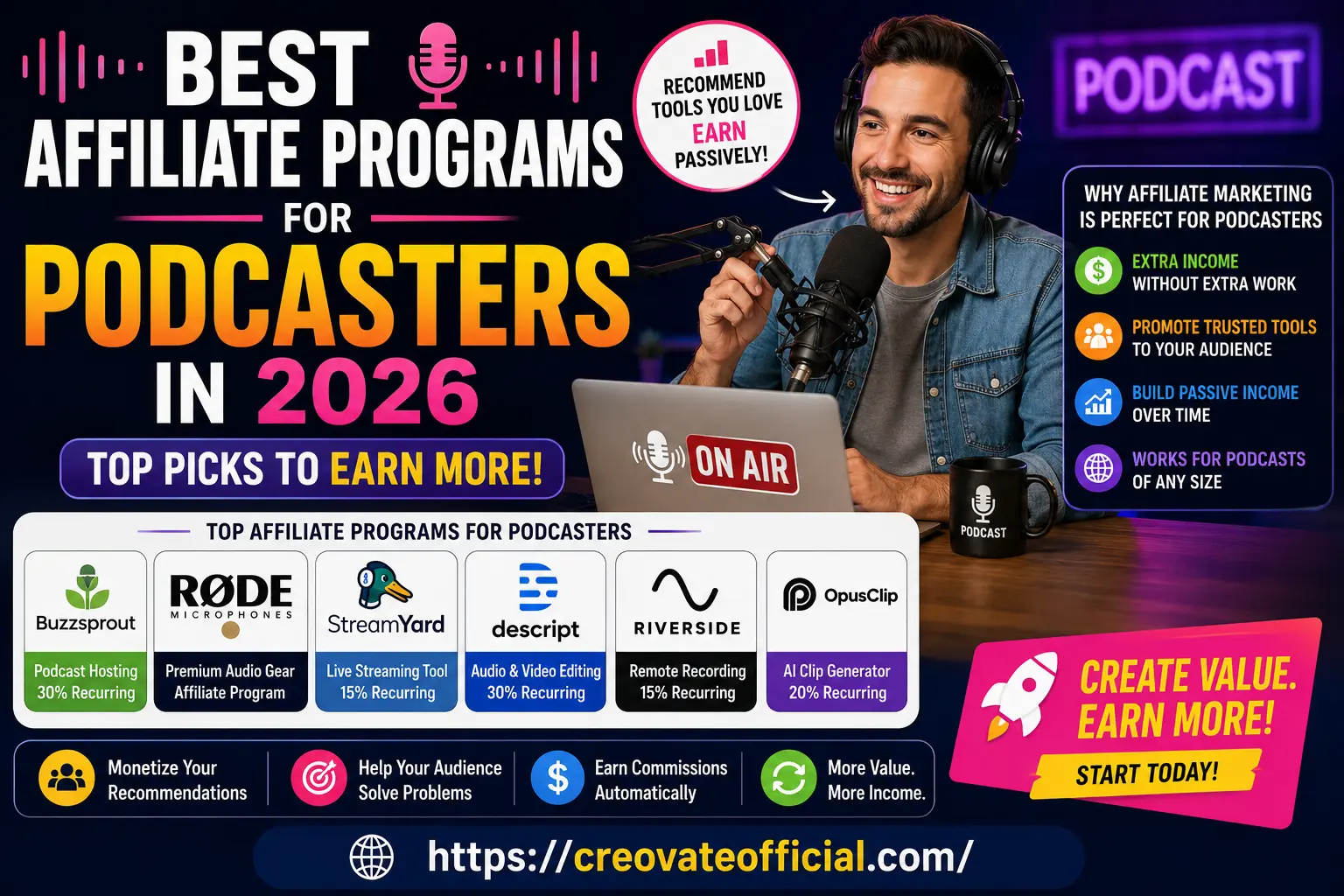
01Why Affiliate Marketing Fits Podcasting Better Than You'd Think
Sponsorships are the first monetization method most podcasters chase, and for good reason — a mid-roll read pays whether or not anyone acts on it. But sponsorships have a floor: most networks won't even talk to you under 5,000 downloads an episode, and the rate you're offered is tied entirely to audience size, not to how much your recommendation is actually trusted.
Affiliate marketing flips that. You don't need scale, you need relevance. A 300-listener show about home studio setups can out-earn a 30,000-listener general-interest show if the first one recommends a mic or an editing tool its audience was already about to buy. The listener was going to purchase something anyway; you're just the reason they know which one.
It also compounds in a way ad reads don't. A sponsorship pays once, for that one episode, once. An affiliate link in your show notes keeps earning every time someone finds that episode through search, a podcast app recommendation, or a friend's share — six months or three years later.
02How Podcast Affiliate Marketing Actually Works
The mechanics are simple, even if audio is a strange medium for it. Since nobody can click a link mid-episode, the link itself always lives somewhere outside the audio:
- Show notes. Every podcast host lets you write notes under an episode — this is affiliate real estate that never expires.
- A dedicated resources page. "Tools I use" or "/gear" pages convert well because visitors arrive already curious.
- Your newsletter. If listeners subscribe for episode recaps, that email is a second, more direct shot at the same recommendation.
- The audio mention itself. You still say the link out loud or point to "the link in the show notes" — that's what drives people to actually go look.
Behind the scenes, a cookie or a tracked link (through networks like PartnerStack, Impact, or Rewardful) attributes the sale back to you, usually for a set window — anywhere from 30 to 90 days depending on the program. Some programs pay once per sale; the better ones for podcasters pay recurring, meaning you keep earning every month your referral stays subscribed.
03What to Look For in a Podcast Affiliate Program
1. Do you actually use the product?
This is the single biggest predictor of whether a recommendation converts. Listeners can tell the difference between "I use this every week" and "I read the affiliate page." Start with your own toolkit before browsing affiliate directories for the highest number.
2. Recurring vs. flat commission
A flat $25 per sale is simple and predictable. A 20% recurring commission on a $19/month tool pays less upfront but keeps paying for as long as the customer stays — often years. Neither is automatically better; it depends on whether you want steady drip income or bigger one-time payouts.
3. Cookie duration
Podcast listeners rarely buy the second they hear a mention — they finish the episode, forget, and sign up two weeks later while doing something else. A 60–90 day cookie window protects you from losing credit for a slow decision. A 24-hour window basically only rewards impulse buyers.
4. Payout threshold and method
Check the minimum payout ($50–$100 is typical) and whether it pays via PayPal, bank transfer, or store credit. A $200 threshold on a program that converts slowly can mean months before your first check.
5. Refund and chargeback policy
Every program reverses commissions on refunds. That's normal. What's worth checking is whether a single refund also flags your account — some smaller programs are stricter than others about that.
04Comparison Table: Best Affiliate Programs for Podcasters
With that said, here's the snapshot as it stood when this guide was researched:
| Program | Category | Commission | Cookie | Best For |
|---|---|---|---|---|
| Buzzsprout | Podcast hosting | $25 flat or 20% recurring (lifetime) | Lifetime | New & growing podcasters |
| Riverside | Remote recording | Up to 20% recurring | 60 days | Interview-format shows |
| StreamYard | Live streaming | 25% recurring | 30 days | Video podcasters |
| Descript | Audio/video editing | $25 flat per sale | 30 days | Editing-heavy workflows |
| Rytr | AI writing | 30% recurring (12 mo.) | 60 days | Show notes & scripts |
| GetResponse | Email marketing | Up to 60% recurring or $100 flat | 120 days | Newsletter-driven shows |
| CapCut | Video editing/clips | 20%–35% recurring | 30 days | Repurposing to Shorts/Reels |
| FastPixel | Site speed / WordPress | 30% recurring | — | Podcasters running a WP blog |
05Individual Program Reviews
Buzzsprout
Editor's Pick — HostingBuzzsprout is where most new podcasters end up hosting their show, and its affiliate program mirrors that reputation: it's straightforward, and the lifetime cookie means you're not racing a clock. You can pick a flat payout or a recurring cut, which is unusual — most programs force one model on you.
Advantages
- Choice between flat and recurring payout
- Lifetime attribution cookie
- Well-known, easy trust with new podcasters
Drawbacks
- Recurring rate (20%) is solid but not the highest on this list
- Payout requires two months of the referral's subscription first
Riverside
Best for InterviewsRiverside records each guest locally in the browser and uploads separate high-quality tracks, which is why it's become the default for interview shows that also want a clean video version. If your podcast leans on guest interviews, this is one of the easiest recommendations to make honestly, because it solves a real, specific pain (bad Zoom audio) rather than being a generic "editing tool" pitch.
Advantages
- Recurring commission with no payout cap
- Product genuinely differentiated for interview podcasts
- 60-day window covers slower decision-makers
Drawbacks
- Less relevant if you record solo
- Free tier limits may mean smaller first-month commissions
StreamYard
Best for Video PodcastersIf your podcast is also a livestream — a growing habit as more shows go video-first for YouTube and Spotify Video — StreamYard is the tool most creators land on for multi-guest broadcasts. The commission is a flat 25% recurring on any plan, which is refreshingly simple compared to tiered programs.
Advantages
- Flat 25% recurring rate, no tiers to chase
- Well-recognized brand, easy to recommend
Drawbacks
- $100 minimum payout threshold
- Only pays via PayPal
Descript
Editing & TranscriptionDescript edits audio and video by editing a text transcript — delete a word, the corresponding clip disappears. Worth flagging: Descript moved away from its older 15% recurring model to a flat $25-per-sale structure in 2026, so if you've seen older reviews quoting a recurring rate, that's outdated. The flat rate still works well if you produce content that walks through editing workflows, since Descript demos strongly on screen.
Advantages
- Genuinely time-saving tool, easy to demo authentically
- Simple, predictable per-sale payout
Drawbacks
- No longer recurring for new referrals — one-time only
- 30-day cookie is tighter than some competitors
Rytr
AI Writing AssistantRytr helps write show notes, episode descriptions, newsletter recaps, and social captions faster — the unglamorous writing work every podcast needs after the mic turns off. A 30% recurring rate on a low-cost AI tool adds up quickly if your audience skews toward other creators, freelancers, or small business owners writing their own content.
Advantages
- High recurring percentage relative to price point
- Free plan gives listeners a real reason to click through
Drawbacks
- Recurring window caps at 12 months, not lifetime
- Only relevant if your audience creates content too
GetResponse
Email MarketingIf a chunk of your monetization strategy is building a newsletter alongside the podcast, GetResponse's affiliate program is one of the most generous on this list — the commission scales up through Bronze, Silver, and Gold tiers as your referral volume grows over 12 months. The 120-day cookie is the longest here, which matters because email tool decisions tend to happen slowly.
Advantages
- Highest ceiling commission on this list
- Long 120-day attribution window
- Choice between recurring and flat bounty
Drawbacks
- Top-tier rates require sustained referral volume
- Only makes sense if your audience actually runs email marketing
CapCut
Clips & RepurposingTurning long-form episodes into short clips for TikTok, Reels, and Shorts is now a core podcast growth channel, and CapCut is the tool most creators reach for first — largely because ByteDance's backing means it's tightly integrated with exactly the platforms clips are made for. The commission climbs as you refer more Pro subscribers, with a stated bonus pool for high-volume US, UK, Germany, and France traffic.
Advantages
- Recurring commission that scales with volume
- Free base app makes referrals low-friction
Drawbacks
- 30-day cookie is on the shorter side
- Tier bonuses are geo-restricted to a few countries
FastPixel
Site Speed / WordPressThis one's a little different — FastPixel isn't a podcasting tool, it's a WordPress performance plugin (caching, image optimization, CDN) built by the ShortPixel team. It earns a spot here because most podcasters eventually run a WordPress show-notes site, and a slow site quietly kills search rankings for exactly the episode pages you want ranking. It's a natural mention inside any "how I built my podcast website" content.
Advantages
- Flat 30% recurring rate, no tiers
- Relevant to nearly every self-hosted podcast site
Drawbacks
- Only relevant to WordPress-based sites
- Requires a bit more technical framing to recommend well
06How to Promote Affiliate Links Without Sounding Like an Ad
Talk about the problem before the product
"I used to spend three hours cleaning up interview audio every week" lands better than "Riverside is a great recording tool." Name the actual frustration your audience recognizes, then introduce the fix.
Put the link where the intent already is
A tools page on your site converts better than a link buried in episode 47's show notes, because visitors land there already looking to buy something. Build one page, link to it from every episode.
Use your own numbers
"This cut my editing time in half" is a stronger claim than a generic feature list, and it's honest — you're reporting your own experience, not repeating marketing copy.
Repeat the mention, don't repeat the pitch
Mentioning a tool across three episodes over two months, in slightly different contexts, converts better than one long ad read. Familiarity does more work than repetition of the same script.
07Other Mistakes That Quietly Kill Affiliate Income
- Not disclosing. Beyond being an FTC requirement, an undisclosed link that gets noticed damages trust fast — and trust is the entire mechanism affiliate marketing runs on.
- Letting links go stale. Programs change URLs and terms. A dead affiliate link is a lost sale and a broken user experience.
- Recommending tools you've never opened. Listeners can tell. It also means you can't answer the one follow-up question that actually closes the sale.
- Ignoring the show notes. If your only mention is spoken mid-episode, you're relying on someone pausing to type a URL from memory. The written link does the real work.
08Pros & Cons Summary
✓ Why podcast affiliate marketing works
- No minimum audience size required
- Income keeps compounding after publish day
- Recurring programs build a small monthly floor
- Easy to start alongside sponsorships, not instead of them
✗ What to watch out for
- Income is uneven early on — it takes months to build
- Requires a place to put links (site or show notes)
- Over-promoting damages listener trust quickly
- Commission terms change without much warning
09Decision Guide: Which Programs Should You Actually Join?
10Frequently Asked Questions
Can a small podcast really make money with affiliate marketing?
Yes. Affiliate income doesn't depend on download numbers the way sponsorships do. A show with a few hundred engaged listeners can out-earn a show with ten times the audience if the recommendations are relevant and trusted.
How many listeners do I need before brands accept me as an affiliate?
Most affiliate programs have no minimum audience requirement at all, unlike sponsorships which often want 5,000+ downloads per episode. You can apply on day one.
Where do I put affiliate links in a podcast?
Show notes, a dedicated resources page, mid-roll mentions, and your newsletter all work. The link itself lives outside the audio, since listeners can't click anything mid-episode.
Do I need a website to run podcast affiliate marketing?
It helps a lot, but it's not mandatory on day one. A simple link-in-bio page or show notes hosted by your podcast platform can carry your links while you build a full site.
Should I disclose affiliate links on my podcast?
Yes, always. FTC guidelines require a clear disclosure whenever you have a financial relationship with a brand you're recommending, both in the audio and in the show notes.
Is affiliate marketing better than sponsorships for podcasters?
They solve different problems. Sponsorships pay a flat rate regardless of results; affiliate income scales with how well your recommendation actually converts, and it keeps paying long after the episode airs.
What's the difference between a recurring and a flat-rate commission?
A flat rate pays once per sale, no matter how long the customer stays subscribed. A recurring rate pays a percentage every billing cycle, for as long as the referral remains a paying customer — usually the better long-term option for subscription tools.
Can I stack affiliate income with podcast sponsorships?
Yes, and most established podcasters do exactly that. Sponsorships and affiliate links serve different segments of your audience and don't compete with each other inside the same episode.