🎁 Free Online Income Starter Kit (2026)
Get our free checklist for launching a niche affiliate site — keyword templates, a content calendar, and a launch checklist included. Drop your email below.
We'll only use your email to send the Starter Kit and occasional related updates. No spam, unsubscribe anytime.
Why Trust This Guide
This guide is written from hands-on experience running affiliate content, not recycled theory. Here's what backs it:
- Real experience: Strategies here reflect what has actually moved rankings and clicks on niche affiliate sites, not just what Google's documentation says in theory.
- Industry-tested tools: Every tool mentioned below has been used directly for content creation, video, funnels, or SEO — not picked from a random "best tools" list.
- Transparency: Some links in this guide are affiliate links, meaning we may earn a small commission if you purchase through them, at no extra cost to you. This never affects which tools we recommend — see the full disclosure at the bottom of this page.
- Kept current: This guide is reviewed and updated for 2026 search trends, including AI-powered search and evolving EEAT signals.
Get The No-Portfolio Client Playbook and learn how to choose a service, create practice samples, find prospects, write outreach, and take your first steps with confidence.
👉 Get it hereTable of Contents
1. What Is Affiliate Marketing SEO (and Why It's Different)
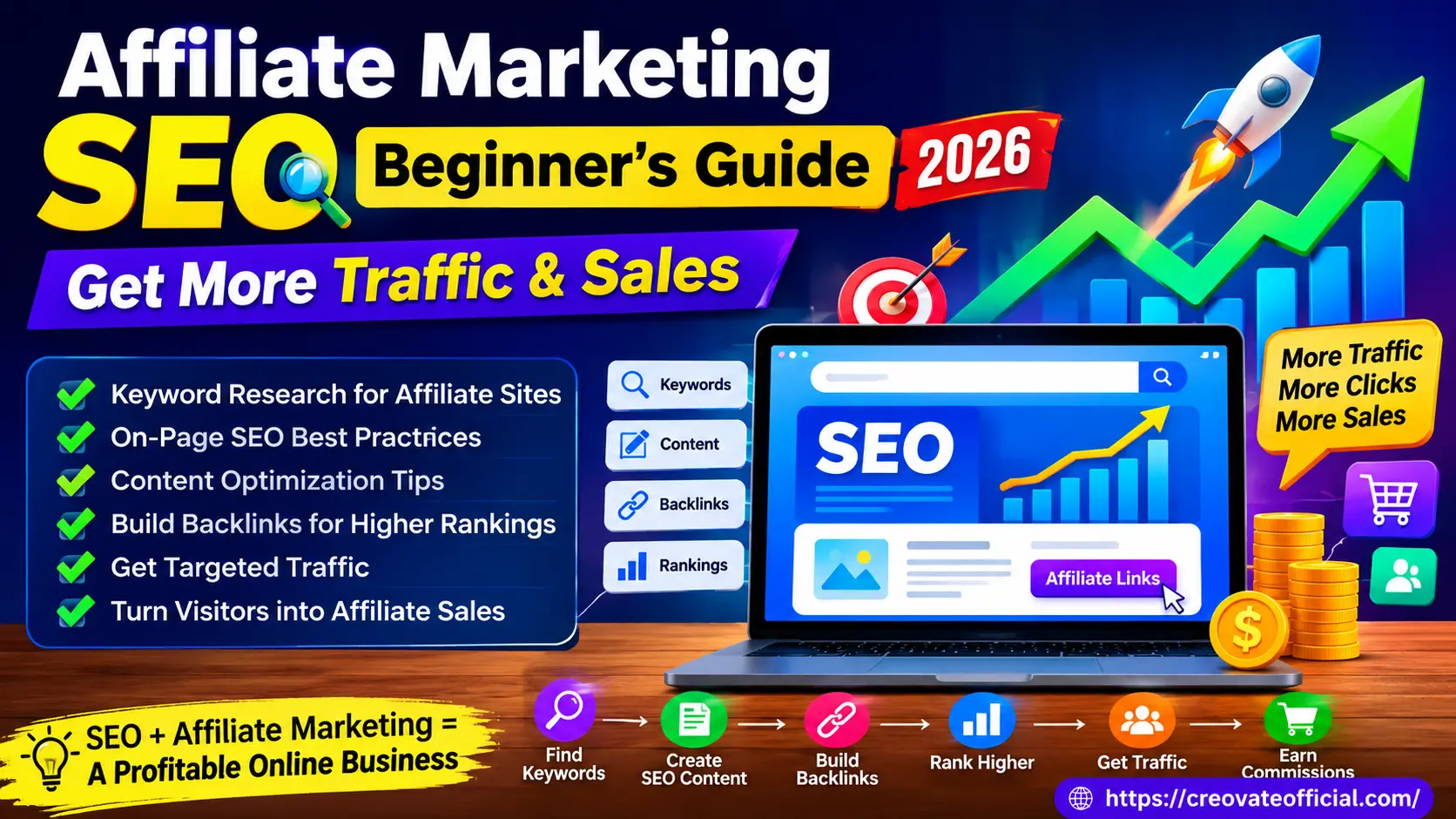
Affiliate marketing SEO is search engine optimization applied specifically to content designed to sell — through recommendations rather than a direct storefront. Regular SEO tries to rank any page. Affiliate SEO has a narrower goal: rank pages that lead a reader from "I have a problem" to "I trust this recommendation enough to click and buy."
That distinction matters because affiliate SEO strategy has to balance two things most bloggers don't: search intent and buying intent. A page can rank #1 and still generate zero commissions if it attracts the wrong kind of visitor — someone researching, not ready to purchase.
In 2026, this balance matters even more. Google's algorithms and AI-powered search results increasingly reward content that demonstrates real experience with a product, not just a summary of its features pulled from the sales page.
2. Affiliate Keyword Research: Finding Keywords People Actually Buy From
Good affiliate keyword research isn't about search volume alone. It's about matching keywords to where someone is in their buying journey.
The Three Keyword Intent Buckets
- Informational — "what is affiliate marketing," "how does SEO work." Good for building topical authority, weak for direct conversions.
- Commercial investigation — "best [product] for beginners," "[product A] vs [product B]." This is the sweet spot for affiliate marketing SEO — the reader is comparing options before buying.
- Transactional — "[product] discount code," "buy [product]." High intent, lower volume, but converts fast.
Long-Tail Keywords Win Early
New affiliate sites almost never rank for broad head terms like "affiliate marketing SEO" in month one. Long-tail variations — "affiliate marketing SEO strategy for beginners" or "how to get traffic to affiliate website with no backlinks" — have less competition and still capture real search demand. As your site earns authority, you naturally start ranking for the shorter, higher-volume terms too.
Where to Find Keyword Ideas
- Google's "People Also Ask" and "related searches" boxes
- Competitor content gaps — what are top-ranking pages missing?
- Amazon and product review sites for buyer language
- Reddit and forum threads in your niche for real questions people ask
- AI writing assistants like Rytr for generating topic and content angle ideas quickly
3. On-Page SEO for Affiliate Content
On-page SEO is where most beginners either overdo it (keyword stuffing) or underdo it (forgetting the basics entirely). Here's what actually matters.
Title Tags and Meta Descriptions
Your title tag should include the primary keyword near the front and give the reader a reason to click — a number, a year, or a clear benefit works well. Keep it under 60 characters so it doesn't get cut off in search results.
Heading Structure
Use one H1 per page, then organize the body with H2s for major sections and H3s for subsections. This isn't just about SEO — it helps readers scan the page, which directly affects how long they stay and whether they click through to your affiliate links.
Internal Linking
Every affiliate post should link to at least 3–5 related pages on your own site. This spreads authority across your content and keeps readers exploring instead of bouncing. For example, a guide like this one naturally connects to a beginner's guide to affiliate marketing or a breakdown of the best affiliate programs for beginners.
Image Optimization
Compress images before uploading — large images are one of the most common reasons affiliate sites load slowly, and slow pages can hurt both rankings and conversions. A tool like FastPixel can help automate image compression and page performance optimization without you touching code.
4. Content Strategy That Ranks AND Converts
Ranking without converting wastes traffic. Converting without ranking means nobody sees your page. Your content strategy needs both.
Content Formats That Perform Best
- Comparison posts ("X vs Y") — match commercial investigation intent directly
- "Best of" listicles — capture broad commercial searches and let you feature multiple affiliate links naturally
- In-depth single product reviews — best for lower-competition, higher-conversion long-tail terms
- How-to guides that naturally lead to a tool recommendation (like this one)
Building Topical Authority
Instead of publishing random one-off posts, build content clusters — a pillar page (like an SEO for beginners guide) surrounded by supporting posts on specific subtopics, all internally linked together. This structure signals to Google that your site has depth on a topic, not just scattered content.
5. Technical SEO Essentials for Affiliate Sites
You don't need to be a developer, but a handful of technical basics protect all the content work you put in.
- Page speed: Aim for a load time under 2.5 seconds. Compressed images and a caching plugin fix most of this.
- Mobile-friendliness: A large share of web traffic is mobile, so test every page on a phone before publishing.
- Clean URL structure: Use short, descriptive slugs like
/best-affiliate-programs-for-beginnersinstead of auto-generated strings. - XML sitemap and robots.txt: Make sure both exist and are submitted in Google Search Console so new pages get discovered faster.
- HTTPS and no broken links: Basic trust signals that also protect the user experience.
6. Link Building for Affiliate Sites
Relevant, authoritative backlinks can help search engines discover and assess the prominence of your content, and they remain a widely-cited factor in competitive niches. For beginners, focus on approaches that don't require a huge budget or outreach team.
- Guest posting on niche-relevant blogs with a natural link back to your content
- Digital PR — original data, surveys, or unique angles that journalists and bloggers want to cite
- Broken link building — find dead links on relevant sites and suggest your content as a replacement
- Digital PR and expert source requests — quick expert quotes offered to journalists and publishers in exchange for a credit or link
- Internal linking — not a backlink, but it multiplies the value of every external link you do earn
7. Tools That Make Affiliate SEO Easier
You don't need every tool on this list. Pick based on where your bottleneck actually is — content production, video, funnels, or design — rather than buying everything at once.
8. Comparison Table: Best Tools at a Glance
| Tool | Best For | Pricing Model | Overall Rating |
|---|---|---|---|
| Rytr | AI content drafts & blog outlines | Free plan + paid tiers | Good for beginners |
| FastPixel | Page speed & image optimization | Subscription | Strong technical SEO fix |
| CapCut | Short-form video content | Free (with paid add-ons) | Great free entry point |
| GetResponse | Email list building & automation | Free trial + paid tiers | Solid all-in-one |
| Systeme.io | Sales funnels for affiliate offers | Free plan + paid tiers | Best budget funnel builder |
| Synthesia | AI video for reviews & tutorials | Subscription | Best for scaling video content |
| CustomGPT | AI chatbots trained on your content | Subscription | Niche, but powerful |
| Fiverr | Outsourcing design, writing, backlinks | Pay-per-project | Flexible for any budget |
9. Individual Tool Reviews
Rytr — AI Writing Assistant
Rytr helps you move past a blank page fast, generating blog outlines, intro paragraphs, and product description drafts you can then edit into your own voice. It's not a replacement for genuine experience-based writing, but it speeds up the first-draft stage significantly.
Advantages
- Generous free tier to start
- Fast draft generation
- Multiple tone and format templates
Drawbacks
- Needs human editing for EEAT-quality content
- Free tier has monthly word limits
Pricing: Free plan available; paid tiers unlock higher word limits. Check the current pricing page for exact figures, as these change periodically.
Try Rytr →FastPixel — Image & Speed Optimization
FastPixel automatically compresses and optimizes images and page assets, which can help improve image delivery and page performance without touching code — particularly on image-heavy affiliate sites loaded with product photos and screenshots.
Advantages
- Set-and-forget automation
- Can noticeably improve load times
- Works alongside most CMS platforms
Drawbacks
- Ongoing subscription cost
- Best value shows on image-heavy sites
Pricing: Subscription-based; see the current plans for up-to-date pricing.
Try FastPixel →CapCut — Free Video Editor
CapCut is a solid entry point for affiliate marketers repurposing blog content into short-form video for social platforms, which increasingly feed traffic back to affiliate sites. It's approachable for beginners without prior editing experience.
Advantages
- Free to start (USA)
- Beginner-friendly interface
- Built-in templates and effects
Drawbacks
- Some advanced features are paid
- Availability varies by region
Pricing: Free download with optional paid features.
Get CapCut Free →GetResponse — Email Marketing & Automation
Since organic traffic can fluctuate with algorithm updates, building an email list is one of the smartest hedges an affiliate marketer can make. GetResponse combines email automation, landing pages, and basic funnel tools in one place.
Advantages
- All-in-one email + landing page tool
- Free trial to test workflows
- Automation sequences for nurturing leads
Drawbacks
- Learning curve for advanced automation
- Pricing scales with list size
Pricing: Free trial, then tiered subscription plans based on subscriber count.
Try GetResponse →Systeme.io — Funnel & Course Builder
Systeme.io lets you build opt-in pages, sales funnels, and even simple online courses without a developer. For affiliate marketers who also sell digital products, like a budget planner or lead magnet, it bridges the gap between traffic and conversion.
Advantages
- Genuinely usable free plan
- Combines funnels, email, and course hosting
- Simple drag-and-drop builder
Drawbacks
- Fewer design customizations than dedicated builders
- Advanced automation is limited on lower tiers
Pricing: Free plan available; paid tiers unlock more funnels and contacts.
Try Systeme.io Free →Synthesia — AI Video Generator
Synthesia turns a script into a presenter-led video using AI avatars, which is useful for affiliate marketers who want video reviews or tutorials without appearing on camera themselves. It won't replace authentic hands-on demos, but it's efficient for explainer-style content.
Advantages
- No camera or studio needed
- Multiple languages and avatars
- Fast turnaround for explainer videos
Drawbacks
- Premium price point
- Feels less authentic than real product testing footage
Pricing: Subscription-based; check current plans for exact pricing.
Try Synthesia →CustomGPT — AI Chatbot Builder
CustomGPT lets you train a chatbot on your own site content, useful for answering visitor questions instantly. It can help visitors find answers faster and improve the overall user experience on your site. It's a more niche tool than the others on this list.
Advantages
- Trains directly on your existing content
- Can reduce support/FAQ workload
- Embeds easily on most websites
Drawbacks
- Overkill for very small sites
- Requires some setup time
Pricing: Subscription-based; see current plans for details.
Try CustomGPT →Fiverr — Freelance Marketplace
When you'd rather buy back your time, Fiverr connects you with freelancers for logo design, article writing, backlink outreach, and more. Quality varies by seller, so vetting reviews and requesting samples matters more here than on any other tool in this list.
Advantages
- Huge range of services and price points
- Reviews help vet quality upfront
- Good for one-off or recurring tasks
Drawbacks
- Quality inconsistent across sellers
- Requires clear briefs to get good results
Pricing: Pay-per-project, set by individual freelancers.
Browse Fiverr →10. Pros & Cons Summary
Why affiliate SEO is worth it
- Free, compounding traffic once content ranks
- Higher trust than paid ads for many buyers
- Scales without linear cost increases
- Builds a durable, sellable business asset over time
What to watch out for
- Slower results than paid traffic (months, not days)
- Algorithm updates can shift rankings
- Requires consistent content production
- Competitive niches need real backlink effort
11. Buying Guide: Which Tools Should You Actually Buy
What to look for: Match the tool to your actual bottleneck. If you struggle to write consistently, an AI writing assistant helps more than a video tool. If your site loads slowly, fix that before buying anything else — speed affects both rankings and conversions.
Budget considerations: Start with free plans (Rytr, Systeme.io, CapCut all offer them) before upgrading. Reinvest early affiliate commissions into paid tiers once you've validated that a tool actually improves your workflow.
Who should buy premium tools early: Marketers who already have some traffic or an email list and want to scale content production faster.
Who should wait: Complete beginners with no published content yet — get 10–15 solid articles live using free tools before spending on automation.
12. Common Mistakes to Avoid
13. Frequently Asked Questions
Does SEO actually work for affiliate marketing in 2026?
Yes. SEO remains one of the most reliable long-term traffic sources for affiliate sites because it targets people who are already searching for a solution. It's slower to start than paid ads, but the traffic keeps compounding without ongoing spend.
How long does it take for an affiliate site to rank on Google?
Some new affiliate sites begin seeing meaningful organic traffic within several months, but timelines vary significantly by niche, competition, site authority, and content quality — there's no fixed timeline.
Do I need backlinks for affiliate SEO to work?
In competitive niches, relevant and authoritative backlinks can help search engines discover and assess your content. In low-competition, long-tail niches, strong on-page content can rank without much link building, though backlinks still tend to help over time.
What is the best content type for affiliate SEO?
Comparison posts, "best of" listicles, individual product reviews, and how-to guides that lead naturally to a recommendation tend to perform best because they match commercial and transactional intent.
How many affiliate links is too many on one page?
There's no fixed number, but link density that feels pushy hurts both rankings and conversions. Link naturally where a product is genuinely relevant, not in every sentence.
Can I do affiliate SEO without a big budget?
Yes. Keyword research and a handful of free tools are enough to start. Budget mainly speeds things up through paid tools, faster hosting, or outsourced content and backlinks.
14. Final Verdict
Affiliate marketing SEO isn't a quick win — it's a compounding asset. The core loop is simple even if the execution takes work: research keywords that match real buying intent, write genuinely helpful content around them, fix the technical basics so pages load fast, and earn backlinks over time. Tools like Rytr and Systeme.io can speed up specific parts of that process, but they don't replace the underlying strategy.
Next step: Pick one long-tail keyword from your niche today, outline a comprehensive post around it, and publish it this week. Momentum beats perfection when you're starting out.
Ready to organize your content and income goals? Grab our Monthly Budget Planner to track affiliate earnings alongside your expenses as your site grows.