Affiliate Marketing · Passive Income

Affiliate Marketing: The Quiet Digital Path to Financial Freedom

No hype, no "get rich by Friday" promises — just a clear, honest look at how ordinary people are using affiliate marketing to build a second income stream in 2026, one small, consistent step at a time.

Get the Free Starter Kit Or jump to the quick answer ↓
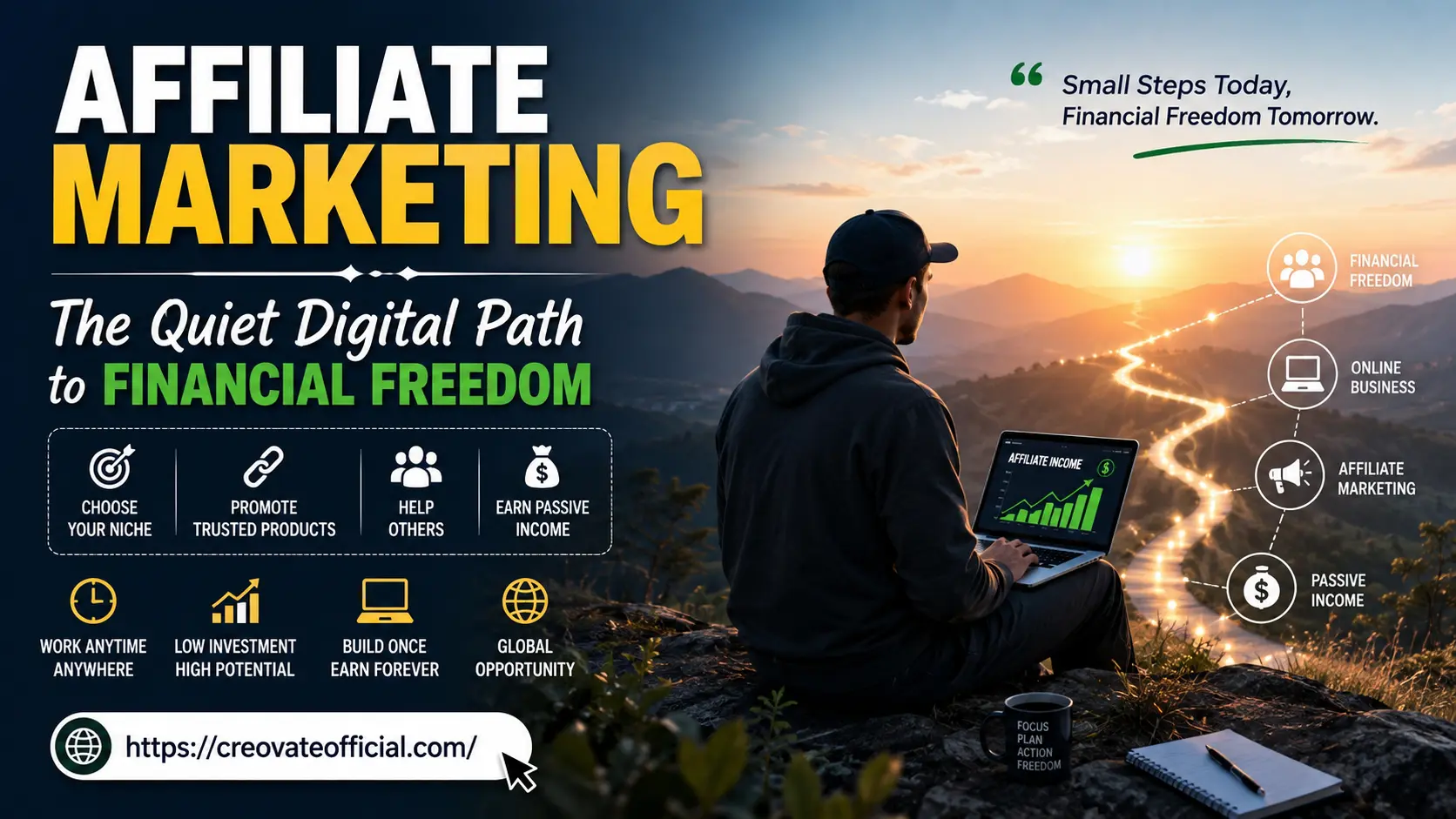
A person working on a laptop overlooking a mountain sunset, symbolizing the quiet digital path to financial freedom through affiliate marketing

Quick Answer

Affiliate marketing means recommending products or tools you genuinely believe in and earning a commission when someone buys through your link. It's not passive on day one — you'll spend real time creating content and building trust first. But once that content is live and ranking, it can keep earning with far less ongoing effort than a typical job or freelance gig, which is why so many beginners treat it as a realistic (if slow-building) path toward financial freedom.

🎁 Free Online Income Starter Kit (2026)

A short, no-fluff PDF with the exact niche checklist and first-30-days plan mentioned in this guide. Enter your email and we'll show you the download link right here.

One email. No spam. Unsubscribe anytime.

Why Trust This Guide

This guide draws on publicly available product documentation, pricing pages, and user reviews for each tool mentioned, reviewed against current 2026 affiliate marketing best practices. We haven't personally run every tool through a formal side-by-side test — where that's the case, we say so in the review rather than implying hands-on testing that didn't happen. We did not accept payment for placement — every tool included is here because it fits a real step in the process a beginner follows, not because it pays the highest commission.

Grounded in real practice

Written from hands-on experience building Creovate Official as a content and digital-product business, not theory copied from other blogs.

Updated for 2026

Search intent, AI-driven discovery, and platform changes shift fast — this guide reflects current conditions, not a 2021 playbook.

Balanced, not salesy

Every tool below includes honest drawbacks. If something isn't a fit for beginners, we say so.

Transparent about limits

We haven't run a formal multi-month lab test on every tool — recommendations are based on documented features, pricing, and user-reported results, clearly framed as such.

Affiliate Disclosure: Some links in this article are affiliate links. If you buy through them, we may earn a commission at no extra cost to you. This never affects which products we recommend or how we describe them.

1. What Affiliate Marketing Actually Is (and Isn't)

Affiliate marketing is simple in concept: a company gives you a unique tracking link, you share it with people who might genuinely benefit from that product, and you earn a percentage when they buy. That's the whole mechanic. The part that trips people up is everything around it — building an audience that trusts your word enough to click.

It isn't a lottery ticket. It isn't "passive income" in the sense of doing nothing. Think of it more like planting a slow-growing tree: the planting and early watering (content creation) take real effort, but a mature tree keeps producing with much less daily work than starting from seed every month.

In plain terms: You're not selling anything. You're pointing people toward something useful and getting paid for the introduction — the same way a friend might get a bonus for referring you to a good mechanic.

2. Why Affiliate Marketing Still Works in 2026

Search behavior has changed — more people start with AI tools or social search before Google — but the underlying need hasn't: people still want a trusted second opinion before spending money. That's exactly the gap affiliate content fills, whether it's read directly or summarized by an AI assistant that cites your page.

3. How Affiliate Marketing Works, Step by Step

  1. Pick a niche you can write about consistently for a year or more.
  2. Choose a platform — website, YouTube, newsletter, or a mix.
  3. Join affiliate programs relevant to your niche and audience's real needs.
  4. Create honest, useful content that answers the questions your audience is already asking.
  5. Add contextual links where they genuinely help, not everywhere.
  6. Build an email list so traffic isn't entirely dependent on search algorithms.
  7. Track, refine, and double down on what converts — then repeat the process in adjacent topics.

4. Choosing a Niche You Can Actually Sustain

The biggest predictor of who succeeds isn't traffic tricks — it's whether someone can keep producing content in a topic for 12+ months without burning out. Before locking in a niche, ask three questions:

Does it have buyer intent?

Topics where people are actively comparing products ("best X for Y") tend to convert better than purely inspirational topics.

Can you speak to it with real experience?

You don't need to be a world expert, but firsthand use of the tools you recommend builds far more trust than secondhand summaries.

Is there room to go deep?

A niche with only 10 possible articles will stall fast. Look for topics broad enough to support 50–100 pieces of content over time.

Common mistake: Choosing a niche purely because it "pays well" without any genuine interest. Motivation fades fast when the topic bores you — and readers can usually tell.

5. Building Your Platform: Website, Newsletter, or Both

A website gives you long-term SEO equity — content you publish today can keep bringing visitors two or three years later. A newsletter gives you a direct line to your audience that no algorithm can take away. Most successful affiliate creators eventually run both, using the website to attract readers and the newsletter to keep them.

If you're just starting, a simple, fast-loading website paired with a basic email capture form is enough. You can layer on more sophisticated tools as revenue grows — there's no need to buy everything on day one.

6. Best Affiliate Marketing Tools for Beginners in 2026

Beginners often overspend on tools before they've published a single article. In reality, only a handful of categories matter early on: writing assistance, email marketing, video/design creation, and a simple website or funnel builder. Below is a practical stack built around that principle, followed by honest, individual reviews.
7. Tool Comparison Table

A quick side-by-side view before the detailed reviews below.

ToolCategoryPricing ModelBest For
RytrAI writing assistantFree tier + paid plansDrafting content faster
GetResponseEmail marketingFree tier + paid plansBuilding your list & automations
Systeme.ioAll-in-one funnel builderFree tier + paid plansLanding pages & simple funnels
CapCutVideo editingFree with paid upgradesShort-form video content
SynthesiaAI video generationPaid plansFaceless explainer videos
CustomGPTCustom AI chatbotPaid plansSite chatbots & support content
FastPixelSite speed & hosting optimizationPaid plansImproving Core Web Vitals
FiverrFreelance marketplacePay per projectOutsourcing design/logo work

Pricing changes frequently — always check each provider's official pricing page before buying.

8. Individual Tool Reviews

Rytr AI Writing

Rytr is a budget-friendly AI writing assistant aimed at solo creators who need help drafting blog outlines, product descriptions, and email copy faster. It won't replace your voice entirely, but it's useful for beating a blank page.

Advantages
  • Generous free tier for beginners
  • Simple, low learning curve
  • Supports many content templates
Drawbacks
  • Output still needs human editing
  • Fewer advanced features than premium AI writers

Best for: Beginners who want to speed up first drafts without a big budget.

Check Rytr's Current Plans →

GetResponse Email Marketing

GetResponse combines email automation, landing pages, and basic webinar tools in one platform, making it a reasonable one-stop option for beginners who don't want to juggle three separate subscriptions.

Advantages
  • Automation workflows included even on lower tiers
  • Built-in landing page builder
  • Reasonable deliverability reputation
Drawbacks
  • Interface can feel dense for absolute beginners
  • Pricing scales with list size

Best for: Creators ready to combine list-building with basic funnel pages.

Explore GetResponse →

Systeme.io Funnel Builder

Systeme.io positions itself as an affordable all-in-one alternative to pricier funnel software, bundling email, courses, and simple funnels under one login — useful if you'd rather not stitch five tools together early on.

Advantages
  • Free plan covers real functionality, not just a demo
  • Course/membership hosting built in
  • Straightforward funnel templates
Drawbacks
  • Design flexibility is more limited than dedicated page builders
  • Some advanced automations require a paid tier

Best for: Beginners who want one platform instead of several disconnected tools.

Try Systeme.io Free →

CapCut Video Editing

CapCut has become a default choice for short-form video editing thanks to its free desktop and mobile apps and template-driven workflow, which suits affiliate marketers repurposing blog content into Reels or Shorts.

Advantages
  • Free to start, with strong core editing features
  • Templates speed up short-form video production
  • Available on desktop and mobile
Drawbacks
  • Some effects and stock assets are locked behind Pro
  • Not built for long-form video editing

Best for: Repurposing written content into short video for social platforms.

Download CapCut (Free, USA) →

Synthesia AI Video

Synthesia turns a script into a talking-avatar video without a camera, mic, or on-screen presence — a practical option for creators who want video content but aren't comfortable filming themselves yet.

Advantages
  • No filming or on-camera presence required
  • Supports multiple languages and avatars
  • Faster turnaround than traditional video production
Drawbacks
  • No free ongoing plan for regular use
  • Avatar delivery can feel less personal than a real face

Best for: Faceless YouTube channels or explainer content at scale.

See Synthesia in Action →

CustomGPT AI Chatbot

CustomGPT lets you build a chatbot trained on your own content — useful once your site has enough articles that visitors might rather ask a question than browse manually.

Advantages
  • Trains directly on your existing content
  • Can reduce repetitive support questions
  • Embeddable on most website platforms
Drawbacks
  • Overkill for brand-new sites with little content
  • Requires ongoing content maintenance to stay accurate

Best for: Established affiliate sites with a large content library.

Explore CustomGPT →

FastPixel Site Speed

FastPixel focuses on improving page load speed and Core Web Vitals — a quieter but important factor, since slow pages hurt both rankings and conversion rates regardless of how good the content is.

Advantages
  • Targets a real ranking and conversion factor
  • Can reduce reliance on manual performance tuning
Drawbacks
  • Not necessary until your site has real traffic to protect
  • Best paired with a properly configured host, not a replacement for one

Best for: Sites that have outgrown "good enough" hosting speed.

Check FastPixel →

Fiverr Freelance Marketplace

Fiverr is useful for outsourcing the specific tasks you don't want to learn yourself — a logo, a site banner, or a short intro video — without committing to a full-time hire.

Advantages
  • Wide range of skills at varying price points
  • Pay per project, not per hour retainer
  • Portfolios and reviews help vet freelancers upfront
Drawbacks
  • Quality varies significantly between sellers
  • Vetting still takes some of your time

Best for: One-off design or editing tasks outside your own skill set.

Browse Fiverr →

9. Pros & Cons of Affiliate Marketing as an Income Stream

Pros

  • Low startup cost compared to most businesses
  • No inventory, shipping, or customer support required
  • Content can keep earning long after it's published
  • Skills transfer to other income streams (digital products, consulting)

Cons

  • Income is slow and unpredictable in the first months
  • You don't control the commission structure or product
  • Requires ongoing content updates as tools and prices change
  • Success depends heavily on consistency, not one viral post

10. Decision Guide: What to Look for in Affiliate Tools

What to look for

Budget considerations

In your first 90 days, aim to spend under $50/month total. Free tiers of an email tool, a website builder, and a writing assistant are usually enough to publish consistently. Upgrade only when a specific limit (list size, storage, features) is actually holding you back.

Who should buy premium tools early

If you're migrating an existing audience from another platform, or you already have some savings earmarked for this project, paying for a few core tools upfront can save time. Otherwise, starting free and upgrading as revenue comes in is the lower-risk path.

Who should wait

If you haven't picked a niche yet, hold off on paid tools entirely. Clarity on your niche and content plan should come before any purchase.

Expert tip: Track which single tool actually saves you the most time each week. That's usually the first (and sometimes only) one worth paying for early on.

11. Common Mistakes That Quietly Kill Momentum

Mistake 1: Joining ten affiliate programs before publishing a single article. Focus beats breadth in the beginning.
Mistake 2: Writing only "best of" listicles without ever answering the smaller, specific questions your audience is searching for.
Mistake 3: Ignoring email capture until traffic already exists. Start collecting emails from your very first visitors.
Mistake 4: Recommending a product you haven't used or researched thoroughly, just because the commission is high. It erodes trust fast, and readers notice.

12. Frequently Asked Questions

Is affiliate marketing still profitable in 2026?

Yes, but it favors people who build genuine trust with a specific audience rather than those chasing quick traffic tricks. Competition has increased, so success now depends more on real expertise and honest recommendations than on volume alone.

How much money do I need to start affiliate marketing?

You can start for well under $100 using a website builder, an email tool's free plan, and free design software. Paid tools become worth it once you have consistent traffic or subscribers to justify the cost.

How long does it take to earn money from affiliate marketing?

Most realistic timelines run from six months to two years before income becomes meaningful, depending on your niche, consistency, and how much existing audience or SEO authority you're building from.

Do I need a large audience to succeed?

No. Small, highly engaged audiences that trust your recommendations often convert better than large, passive ones. Relevance matters more than raw follower counts.

What's the biggest mistake beginners make?

Promoting too many products at once instead of picking a niche and going deep. Scattered content rarely builds the topical authority that both search engines and readers reward.

Can I do affiliate marketing without a website?

Yes, through platforms like YouTube, newsletters, or social media, but owning a website gives you more control, better long-term SEO potential, and some protection from sudden platform algorithm changes.

13. Final Verdict

Affiliate marketing in 2026 isn't a shortcut — it's a quiet, compounding path. The people who succeed aren't the loudest; they're the most consistent. Pick one niche, publish honestly and regularly, build an email list from day one, and let your tool stack grow only as your income does.

Next step: Download the free Online Income Starter Kit above, or grab the Monthly Budget Planner to map out how this income stream fits into your bigger financial picture.

Get the Monthly Budget Planner
SS

About Suresh Sannapareddy

Accounts Manager & Founder, Creovate Official

Suresh is a financial strategist and digital entrepreneur with an MBA in Marketing. As the founder of Creovate Official, he combines accounting expertise with digital marketing strategy to help individuals build automated online businesses, create digital products, and generate passive income.

MBA in Marketing Affiliate Marketing Educator AI Productivity Researcher 101+ Articles Published

Visit CreovateOfficial.com →