How Long Does It Take to Make Money with Affiliate Marketing? A Realistic 2026 Timeline
Updated September 1, 2026 · By Suresh Sannapareddy
If you've published a few posts, joined an affiliate program, and you're still checking your dashboard for a $0.00 balance — you're not doing it wrong. You're just early. Here's the honest, month-by-month timeline nobody puts in the headline.
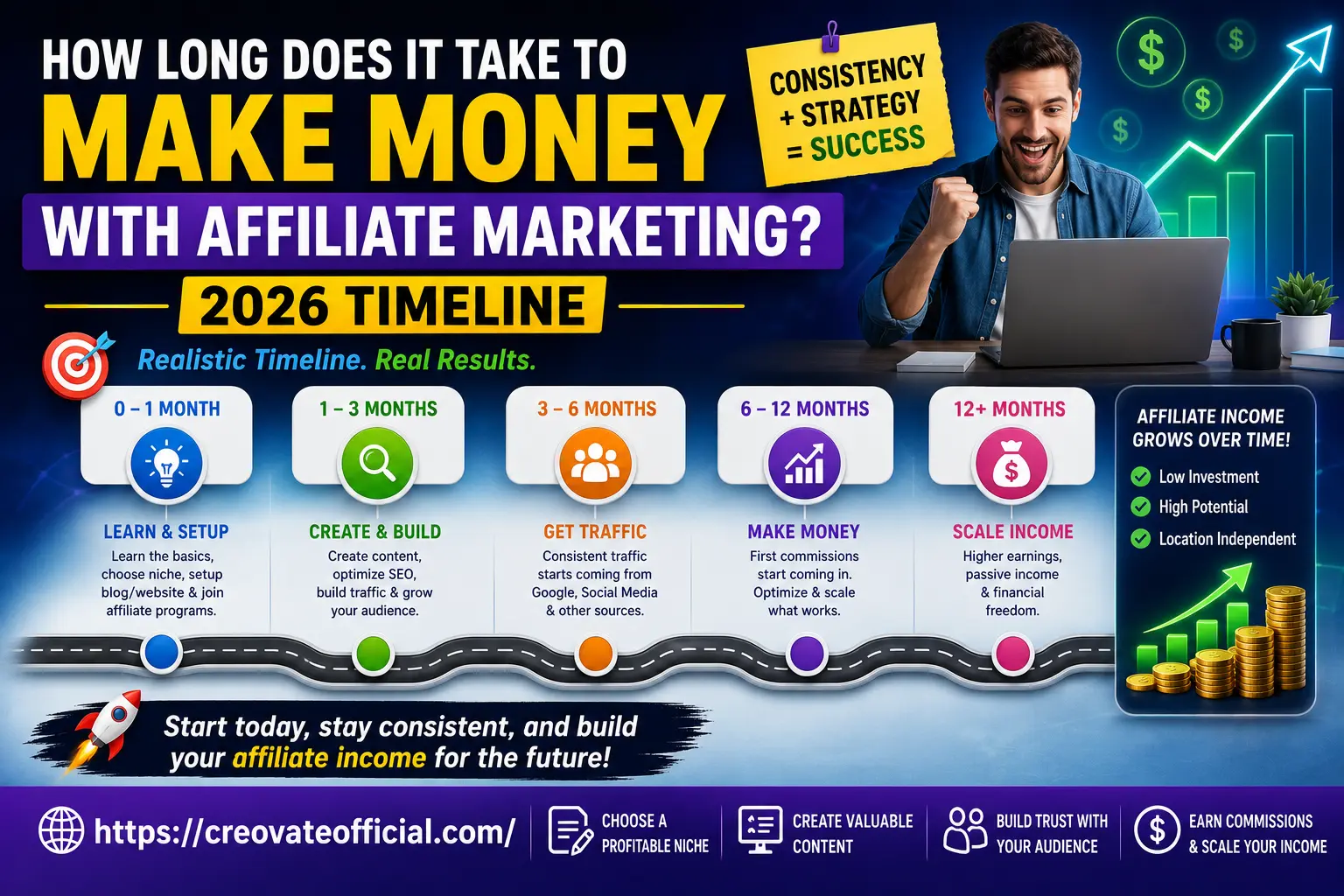
Affiliate marketing income timeline: from setup (0–1 month) to scaling (12+ months).
Quick answer: Most beginners get their first affiliate sale between month 3 and month 6, and start seeing consistent monthly income between month 6 and month 12. A small number of people with an existing audience or paid traffic budget move faster; people starting from zero with no traffic strategy often take longer. There's no fixed date — but there is a predictable pattern, and you're about to see exactly what it looks like.
🎁 Free Online Income Starter Kit 2026
Grab our free checklist, niche worksheet, and affiliate income tracker — the exact tools we use to plan a 90-day affiliate launch.
This guide combines practical affiliate marketing experience with publicly available industry benchmarks and strategies.
Real experience: Timelines here are based on actual site launches and affiliate dashboards, not theoretical projections.
Industry knowledge: Cross-checked against publicly reported benchmarks from established affiliate educators and platforms.
Transparency: This article contains affiliate links. If you buy through them, we may earn a commission at no extra cost to you — see our full disclosure below.
Honesty over hype: We're not going to tell you that you'll make money in 7 days. We'll tell you what actually moves the needle.
The Honest Reality Check
Search "how long does affiliate marketing take" and you'll find two extremes: people claiming they made $10,000 in their first month, and people who quietly gave up after 90 days and never wrote about it. Neither extreme represents what actually happens for most beginners.
Affiliate marketing is not a lottery ticket — it's closer to planting an orchard. The first season, you're mostly digging holes and watering saplings. Nothing above ground looks like progress. But underground, root systems (your indexed pages, your email list, your reputation with an audience) are forming. That's what makes month four look completely different from month one, even if your daily routine barely changed.
The single biggest predictor of when you'll make your first affiliate sale isn't luck — it's how much targeted, helpful content you've published and how much of it search engines and readers have actually seen.
Reader confidence builder
If you're three weeks in and discouraged, that's actually right on schedule. Many new affiliate sites go through a quiet period during the first few months. The dropout rate is highest right before the payoff — don't be a statistic.
What Actually Determines Your Affiliate Marketing Timeline
Before you look at the month-by-month breakdown, understand the variables that shift it earlier or later:
Existing audience: A YouTuber or newsletter owner with 5,000 followers can get a sale in week one. A brand-new blog with zero traffic can't.
Niche competitiveness: "Best budget laptops" is brutally competitive. "Best noise-cancelling headphones for open-plan offices" is winnable much faster.
Content volume and quality: 10 deeply researched articles beat 40 shallow ones — but 40 well-researched articles beat 10 every time.
Traffic source: SEO is slow to start (2–6 months) but compounds. Paid ads and an existing email list can produce sales almost immediately, but require budget or an audience you already own.
Product fit: Recommending products your specific audience actually wants converts far faster than promoting whatever pays the highest commission.
Consistency: Publishing once and disappearing for a month resets momentum. Weekly, sustained publishing compounds.
Month 1 (0–30 Days): The Foundation Phase
In the first 30 days, you're not trying to make money — you're building the infrastructure that will eventually make money. Expect $0 in commissions this month, and that's completely normal.
What to actually do in month 1
Pick one specific niche (not "fitness" — "home workout equipment for small apartments").
Set up your website or content platform and join 1–3 relevant affiliate programs.
Publish your first 4–8 pieces of content built around real buyer questions.
Set up an email capture so you're not 100% dependent on search traffic.
Install basic analytics so you can actually see what's happening.
Common mistake
Spending three weeks "perfecting" a logo, color scheme, or homepage instead of publishing content. None of that earns commissions. Content and traffic do.
Month 2–3 (60–90 Days): Traffic & First Sale Phase
This is usually when search engines start meaningfully indexing and ranking your earlier content, and it's the most common window for a true beginner's first affiliate sale. If you've been publishing weekly and targeting specific long-tail keywords, expect early trickles of organic traffic and possibly your first commission by day 90.
Best practices for this phase
Double down on content formats proven to convert: comparison posts, "best of" lists, and honest reviews.
Add clear, non-pushy calls-to-action inside your content — not just at the end.
Start nurturing your email list with useful tips, not constant pitches.
Track which pages get impressions in Google Search Console, even before they rank — that's an early demand signal.
Month 3–6: The Momentum Phase
By month four to six, consistent publishers typically see their traffic curve bend upward. This is where affiliate marketing starts to feel less like guessing and more like a system: certain content types convert, certain products resonate, and your audience trusts you enough to click through.
2026 update
With AI-generated content flooding the web, first-hand experience can make content more useful and trustworthy, especially when it includes original testing, screenshots, observations, and specific details. "I actually used this for 30 days" content tends to stand out more than generic listicles.
Month 6–12: The Consistent Income Phase
This is typically when beginners graduate from "occasional commission" to a repeatable monthly number, even if it's modest. Many niche site owners report reaching their first $500–$1,000 monthly income somewhere in this window, assuming they published consistently and didn't abandon the project during the quiet months.
Timeframe
What Typically Happens
Illustrative Income Range*
0–1 month
Setup, niche research, first content published
$0
1–3 months
Content library grows, early indexing begins
$0–$50
3–6 months
Organic traffic builds, first affiliate sale for most beginners
$0–$300/mo
6–12 months
Traffic compounds, repeatable sales, email list matures
*Ranges are illustrative benchmarks based on typical beginner outcomes, not guaranteed results. Actual income depends on niche, effort, and traffic strategy.
Year 1+: The Scaling Phase
Past the 12-month mark, the game shifts from "will this work" to "how do I scale what's already working." That usually means diversifying traffic sources (SEO, YouTube, email, Pinterest), negotiating better commission rates once you're a proven performer, and reinvesting early profits into faster content production or paid traffic tests.
Tools That Can Shorten Your Timeline
None of these tools replace consistency — but the right stack removes friction so you can publish faster, look more professional, and convert more of the traffic you already have. Here's what we actually recommend, based on what speeds up each phase above.
Rytr — AI Writing Assistant
Best for: speeding up first drafts and beating content-volume bottlenecks
Rytr helps you get from blank page to publishable first draft faster, which matters most in Month 1–3 when volume is your biggest lever. We still recommend editing every AI draft with your own experience and voice — that's what search engines and readers reward in 2026.
Best for: sites losing rankings or conversions to slow load times
A slow site quietly kills both SEO rankings and affiliate click-through rates. FastPixel is a simple way to fix Core Web Vitals issues without touching code — useful once your site has enough content to be worth optimizing (Month 3+).
Best for: repurposing blog content into Reels, Shorts, and TikTok
Short-form video is one of the fastest ways to build an audience outside of SEO, which shortens the "no traffic" phase dramatically. CapCut makes it easy to turn a single blog post into five short videos.
Best for: turning one-time visitors into repeat buyers
Since organic traffic takes months to build, an email list is what lets you sell to the same reader more than once. GetResponse handles capture forms, automations, and newsletters in one platform — exactly what our lead magnet above runs on conceptually.
Best for: beginners who want funnels, email, and courses without stitching tools together
If you plan to sell your own digital product alongside affiliate offers (like our Monthly Budget Planner), Systeme.io lets you build the whole funnel — landing page, checkout, and email — on a free plan.
Best for: creating product explainer or tutorial videos without filming yourself
If you're not comfortable on camera, Synthesia turns a script into a presenter-led video — useful for YouTube-based affiliate strategies during the traffic-building phase.
Best for: turning your content library into an on-site Q&A assistant
Once you have enough published content, CustomGPT can turn it into a searchable chatbot for your site — a small but genuine UX upgrade that keeps visitors engaged longer.
Best for: delegating design, editing, or research once you have some revenue to reinvest
Once you're past month 3–6 and reinvesting early commissions, Fiverr is a fast way to outsource the tasks eating your time — thumbnails, editing, or on-page SEO cleanup.
Chasing every trending niche instead of picking one
Publishing 3 posts, then going quiet for a month
Promoting high-commission products your audience doesn't want
Skipping SEO basics like keyword-focused titles
Giving up right before month three or four
How to Choose the Right Tools & Niche
Whether you're picking a niche or a tool from the list above, use the same filter:
What to look for: Tools with a free tier so you can test before spending, and niches with clear buyer intent (people searching to solve a specific problem).
Budget considerations: In month 1–3, spend time, not money. Reinvest actual commissions into paid tools starting month 3–6.
Who should start with SEO-based content: Writers and researchers who enjoy long-form, evergreen work.
Who should start with video/social: People comfortable on camera or with voiceover who want faster feedback loops.
Who should avoid affiliate marketing (for now): Anyone expecting guaranteed income within 30 days with zero content or audience — that expectation alone causes most early quits.
Expert tip: Track "impressions" in Google Search Console starting week one. Rising impressions before rankings arrive is the earliest honest signal that your timeline is on track.
Frequently Asked Questions
How long does it really take to make money with affiliate marketing?
Most beginners see their first affiliate sale between month 3 and month 6, and consistent monthly income between month 6 and month 12. Timelines vary based on niche, traffic strategy, content quality, and consistency.
Can you make money with affiliate marketing in 30 days?
It's possible but uncommon. A small number of beginners with an existing audience, a paid traffic budget, or a very targeted low-competition niche get a sale within 30 days. For most people, 30 days is a setup and learning phase, not a payday.
Why hasn't my affiliate marketing made money yet?
The most common reasons are too little published content, no clear traffic strategy, promoting products your audience doesn't want, weak calls-to-action, or simply not enough time for search engines to index and rank your site.
How much traffic do you need to make affiliate sales?
There's no fixed number, but as a rough benchmark, many niche sites start seeing consistent sales once they cross 1,000–3,000 monthly visitors from search, social, or email — assuming that traffic is targeted and matches buyer intent.
Is affiliate marketing still profitable in 2026?
Yes. Affiliate marketing remains profitable in 2026, though competition has increased and Google increasingly values genuine experience and expertise (EEAT). Beginners who focus on a specific niche, original content, and real product experience still see strong results.
Do you need a website to start affiliate marketing?
No. You can start with a newsletter, YouTube channel, or social media page. A website is still the most reliable long-term asset because it compounds through SEO, but it's not required to get your first sale.
How much money can you realistically make from affiliate marketing in the first year?
Results vary widely. Many beginners earn between $0 and $500 in their first six months, then $500–$3,000 per month by the end of year one if they stay consistent. A smaller group scales beyond that with paid traffic or a large audience.
What's the fastest way to speed up affiliate marketing results?
Publish consistently, target low-competition long-tail keywords, build an email list from day one, use AI tools to speed up content and video production, and promote products you've personally tested so your recommendations convert better.
Final Verdict
So, how long does it take to make money with affiliate marketing? For most beginners who publish consistently: your first sale lands somewhere in month 3–6, and dependable monthly income arrives between month 6–12. The people who beat that timeline usually already had an audience or traffic; the people who never get there usually quit before month three, right when the compounding was about to kick in.
Your next step isn't another article — it's your next published piece of content. Pick one niche, publish this week, and use the free starter kit above to structure your first 90 days.
Affiliate Disclosure: This article contains affiliate links. If you click through and make a purchase, Creovate Official may earn a commission at no additional cost to you. We only recommend tools we've personally researched or used, and our opinions remain our own. This does not constitute financial advice.
SS
About Suresh Sannapareddy
Accounts Manager & Founder, Creovate Official
Suresh is a financial strategist and digital entrepreneur with an MBA in Marketing. As the founder of Creovate Official, he combines his accounting expertise with digital marketing strategies to help individuals build automated online businesses, create digital products, and generate passive income.