Quick Answer
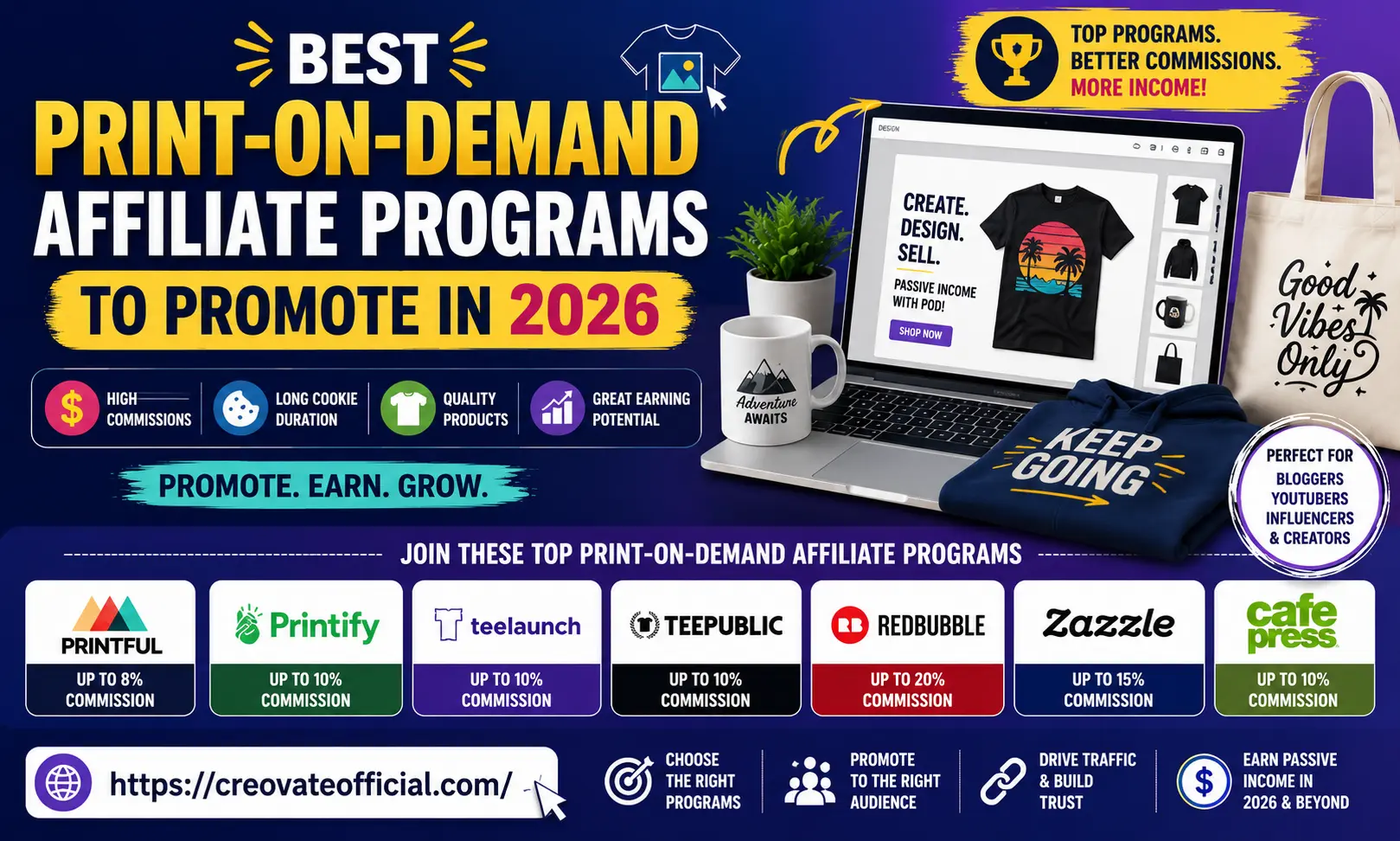
The strongest print-on-demand affiliate programs to promote in 2026 are Printful, Printify, Redbubble, Zazzle, TeePublic, Teelaunch, and CafePress. On verified commission strength, Printful (10% + a $25 Growth bonus) and Zazzle (15% of net referral sales) currently lead the pack, while Printify's 90-day cookie is the longest window in this niche. Redbubble, TeePublic, and CafePress work well for content aimed at casual gift-buyers because they run on a marketplace model with built-in traffic, even though their base commission is lower. If you only have room for one, start with whichever program matches how your audience actually shops: "I want to build a store" content should point to Printful or Printify, while "cool gift ideas" content should point to the marketplaces.
01Why Trust This Guide
This guide is based on hands-on affiliate marketing research, direct review of each program's official terms, and side-by-side comparison of the platforms covered here. Print-on-demand is one of the categories we actively cover on Creovate Official. This guide is built from actually applying to these programs, reading their affiliate terms line by line, and tracking which ones pay reliably versus which ones look good on paper but convert poorly.
Hands-on researchEvery program listed here was reviewed directly through its official affiliate page or network listing (ShareASale, Impact, Awin, or in-house dashboards).
No pay-to-rankPrograms are not ranked by commission size alone — placement also factors in payout reliability, cookie length, and how easy the product is to actually sell.
Updated regularlyCommission rates and terms change often. We revisit this guide as programs update their rates so you're not working off stale numbers.
Affiliate Disclosure: Creovate Official participates in affiliate marketing programs, which means we may earn a commission on qualifying purchases made through links on this page, at no extra cost to you. We only recommend tools and programs we believe genuinely help our readers. This does not affect our editorial opinions.
02What Is a Print-on-Demand Affiliate Program?
A print-on-demand (POD) affiliate program pays you a commission for referring new sellers or buyers to a print-on-demand platform — companies like Printful or Printify that let anyone design and sell custom products (t-shirts, mugs, hoodies, posters, tote bags) without holding inventory. The platform handles printing, packing, and shipping; the seller handles design and marketing.
As an affiliate, you're not selling t-shirts yourself. You're pointing your audience toward the platform they'd use to start their own POD store, or toward a marketplace where they can buy print-on-demand products directly. Two very different audiences, two very different types of content.
Key distinction: "Seller-facing" programs (Printful, Printify) pay you for referring people who want to start a business. "Marketplace" programs (Redbubble, Zazzle, TeePublic, CafePress) pay you for referring people who want to buy a product. Match your content to the right type before picking a program.
03How Print-on-Demand Affiliate Commissions Actually Work
Commission structures
Most POD programs pay a percentage of the referred sale, though the base changes depending on what's being tracked:
- Percentage of order value — common on marketplaces like Redbubble and Zazzle, where you earn a cut of whatever the buyer spends.
- Flat fee per signup — some seller-facing platforms pay a fixed amount when a referred user creates an account and places their first order.
- Hybrid models — a smaller ongoing percentage plus a signup bonus, used by a few platforms to reward affiliates who send serious sellers rather than window shoppers.
Cookie duration
This is the window during which you still get credit for a sale after someone clicks your link. POD cookie windows typically run anywhere from 30 to 90 days. A longer cookie matters a lot in this niche, because most people don't sign up for a POD platform the same day they read a blog post about it — they bookmark it, think it over, and come back later.
Common mistakes affiliates make
Promoting every POD program at once instead of picking two or three that genuinely fit your content — this dilutes trust and confuses readers about which one to actually use.
Ignoring the program's promotional guidelines (some restrict paid search bidding on brand terms) and getting flagged or removed from the program entirely.
Only linking in a "resources" page instead of weaving links into genuinely useful, specific content — comparison posts and tutorials convert far better than static link lists.
05Individual Program Reviews
1. Printful Affiliate Program
Seller-facing
Commission: 10% + $25 Growth referral bonusCookie: 30 daysCommission period: 12 months
Overview: Printful is one of the most established print-on-demand fulfillment platforms, popular with sellers who want higher-quality print and embroidery options and a polished branded unboxing experience.
Features: Deep integrations with Shopify, Etsy, WooCommerce, and Amazon; mockup generator; branded packaging inserts; warehousing add-ons for bulk orders.
Advantages
- Currently one of the strongest verified commission structures in this list — 10% on referred customers for 12 months, plus a $25 bonus for eligible first-time Growth plan subscriptions
- Strong brand reputation, which makes referrals easier to convert
- Good print quality reduces refund/complaint rates for referred sellers
Drawbacks
- 30-day cookie is shorter than Printify's, so late-deciding readers may not convert
- Best suited to audiences who are serious about building a store, not casual buyers
Best for: Bloggers and YouTubers teaching "how to start a print-on-demand business."
Pricing: Free to join as a seller; product costs are pay-per-order (check current base pricing on Printful's site since it updates regularly).
Trust note: Reliable payout history and clear terms — one of the easier programs to get approved for with an active content site.
Join Printful & Start Selling →
2. Printify Affiliate Program
Seller-facing
Commission: 5%Cookie: 90 daysCommission period: 12 months
Overview: Printify connects sellers to a large network of print providers, which usually means lower base product costs than Printful — a strong hook for budget-focused content.
Features: Multiple print-provider options per product, competitive base pricing, Printify Premium subscription for sellers who want deeper discounts.
Advantages
- 90-day cookie window is the longest of any program in this list — a real edge if your content is more "research and compare" than impulse-click
- Lower price point appeals to a wider, budget-conscious audience
- Separate affiliate incentive for referring Premium subscribers
Drawbacks
- 5% base commission is lower than Printful's, so it typically needs more volume to match
- Print quality can vary by provider, which occasionally affects seller satisfaction
Best for: Content aimed at first-time sellers testing the waters with minimal upfront risk, or comparison content where a long cookie window matters.
Pricing: Free tier plus an optional paid Premium plan (check current pricing on Printify's site).
Trust note: Large, active affiliate community — easy to find real seller reviews to reference in your own content.
Join Printify Affiliate Program →
3. Teelaunch Affiliate Program
Seller-facing
Commission: Up to 10% (unverified — confirm before publishing)Cookie: ~30 days (unverified)
Overview: Teelaunch is a leaner, Shopify-first fulfillment app popular with sellers who want a simple product catalog without the overhead of a bigger platform.
Features: Tight Shopify integration, straightforward catalog, faster setup for new stores.
Advantages
- Fast, uncomplicated setup — good for step-by-step tutorial content
- Smaller catalog makes for cleaner comparison content
Drawbacks
- Smaller brand recognition than Printful or Printify, which can soften conversion rates
- Fewer sales-channel integrations outside Shopify
Best for: Shopify-specific tutorials and niche store walk-throughs.
Trust note: A good secondary recommendation alongside a bigger-name platform, rather than your sole pick. Verify current commission and cookie terms directly with Teelaunch before publishing — we could not independently confirm these figures.
Join Teelaunch Affiliate Program →
4. TeePublic Affiliate Program
Marketplace
Commission: Up to 10% (unverified — confirm before publishing)Cookie: ~30–45 days (unverified)
Overview: TeePublic is a buyer-facing marketplace known for pop-culture, fandom, and humor designs — strong fit for gift-guide and "cool finds" style content.
Features: Frequent sales events, huge design catalog, simple checkout that converts well from cold traffic.
Advantages
- Built-in demand from an existing shopper base
- Frequent promotions give you fresh, timely content angles
Drawbacks
- You're promoting a marketplace, not a business opportunity — different audience than seller-facing content
Best for: "Gift ideas" and niche-fandom listicle content.
Trust note: Verify current commission and cookie terms directly with TeePublic's affiliate program before publishing — we could not independently confirm these figures.
Join TeePublic Affiliate Program →
5. Redbubble Affiliate Program
Marketplace
Commission: Up to 2% + bonus incentivesCookie: 30-day attribution window
Overview: One of the largest POD marketplaces, Redbubble has an enormous catalog spanning apparel, home goods, and stationery. Its base commission rate is modest compared with Printful, Printify, or Zazzle, so the appeal here is catalog breadth and built-in shopper demand rather than a high payout per sale.
Features: Massive product range, strong SEO presence of its own, regular site-wide sales, periodic bonus incentives on top of the base rate.
Advantages
- Wide product range fits almost any content niche
- Recognizable brand that's easy to convert cold traffic on
- Bonus incentives can supplement the base commission during promotions
Drawbacks
- Base commission (up to 2%) is the lowest percentage in this list — plan for volume, not per-sale payout, to make this program worthwhile
- High competition among affiliates promoting the same products
- Site-wide discount events can shrink your commission on already-discounted items
Best for: High-volume lifestyle, gift, and niche-interest content sites that can drive real traffic, rather than a single review post.
Join Redbubble Affiliate Program →
6. Zazzle Affiliate Program
Marketplace / Ambassador
Commission: 15% of net referral salesCookie: ~45 days (unverified)
Overview: Zazzle leans heavily into personalization — invitations, custom cards, business merchandise — making it a strong fit for content around events, weddings, and small business branding. Zazzle runs its affiliate relationship through an ambassador-style model, so the structure is a little more nuanced than a flat storewide rate: the 15% applies specifically to net referral sales of other creators' products.
Features: Deep customization tools, an ambassador dashboard, business/bulk order options.
Advantages
- 15% of net referral sales is a strong, verified commission rate for this niche
- Personalization angle differentiates it from generic "buy a t-shirt" content
Drawbacks
- Ambassador model terms are more nuanced than a simple flat-rate program — read Zazzle's current terms closely before promoting
- Best suited to specific content niches (events, business swag) rather than general audiences
Best for: Wedding, event-planning, and small-business branding content.
Join Zazzle Affiliate Program →
7. CafePress Affiliate Program
Marketplace
Commission: Up to 10% (unverified — confirm before publishing)Cookie: ~30 days (unverified)
Overview: One of the original POD marketplaces, CafePress still holds a loyal niche and novelty-item audience, useful for evergreen fandom or hobby content.
Features: Long-running brand recognition, novelty and niche product depth.
Advantages
- Recognizable, long-standing brand for readers who remember it
- Deep bench of novelty products for hobby-specific niches
Drawbacks
- Feels dated to newer online shoppers compared with Redbubble or TeePublic
Best for: Niche hobby, fandom, and novelty-gift content.
Trust note: Verify current commission and cookie terms directly with CafePress's affiliate program before publishing — we could not independently confirm these figures.
Join CafePress Affiliate Program →
07How to Choose the Right Program for Your Audience
What to look for
- Match to intent: "Buy a gift" content belongs with marketplaces (Redbubble, TeePublic, Zazzle, CafePress). "Start a business" content belongs with seller-facing platforms (Printful, Printify, Teelaunch).
- Cookie window: Favor programs with 30+ day windows if your content is more research-and-compare than impulse-buy.
- Payout reliability: Search for recent affiliate reviews before committing significant content real estate to a single program.
Budget considerations
You don't need to spend anything to become an affiliate for these programs — they're free to join. Your real investment is time: building content that ranks, plus (optionally) tools like an email service or an AI writing assistant to speed up production.
Who should promote these programs
Bloggers, YouTubers, and Pinterest creators covering side hustles, small business, design, or gift-buying content are the strongest fit. If your audience skews toward B2B software or unrelated topics, POD affiliate content will likely underperform no matter how good the program is.
Who should avoid this niche
If you don't yet have any traffic or audience, it's worth building foundational content and an email list first — see our beginner's guide to affiliate marketing before diving into a specific niche like this one.
Expert tip
Pair a seller-facing and a marketplace program in the same post. A post titled "Best Places to Buy Custom T-Shirts (Or Sell Your Own)" naturally covers both angles, doubling your affiliate link opportunities without feeling forced.
09Frequently Asked Questions
What is the highest paying print-on-demand affiliate program?
Based on verified current terms, Printful (10% plus a $25 Growth referral bonus) and Zazzle (15% of net referral sales) offer the strongest confirmed commission structures among major POD platforms. Redbubble's base rate is comparatively low — up to 2% plus bonus incentives — so it earns more through catalog size and traffic volume than per-sale payout. Always confirm current rates directly on the program's affiliate page before promoting, since these change often.
Do print-on-demand affiliate programs pay recurring commissions?
Most pay a one-time commission per qualifying sale rather than recurring revenue, since POD platforms are typically pay-as-you-go. A few, like Printful and Printify, offer separate tracks for referring paid plan upgrades or premium subscribers.
Is print-on-demand affiliate marketing still profitable in 2026?
Yes, though the niche has matured. The real opportunity now favors creators who go deep on a specific audience — a design niche, a Shopify tutorial channel, a fulfillment-comparison site — rather than broad, generic "start a POD business" content, which is heavily saturated.
How do I get approved for a print-on-demand affiliate program?
Most programs run through a network like ShareASale, Impact, Awin, or CJ Affiliate, or through an in-house dashboard. Approval usually requires an active website or channel with relevant content, a clear traffic source, and compliance with the program's promotional guidelines.
What's the difference between a POD affiliate program and being a POD seller?
A seller designs and sells products and keeps the profit margin on each sale, carrying the marketing and design workload. An affiliate simply refers new sellers or buyers to a POD platform and earns a commission, without ever touching inventory, design, or fulfillment.
Can beginners make money with print-on-demand affiliate programs?
Yes, since there's no product to create or ship. The main barrier is traffic. Beginners typically start with a blog, YouTube channel, or Pinterest account focused on a specific POD sub-topic, then add affiliate links as the audience grows.
Should I promote seller-facing or marketplace POD programs?
It depends on your audience's intent. If your readers are researching how to start a business, seller-facing programs like Printful or Printify fit better. If your readers are shopping for a gift or a specific design, marketplace programs like Redbubble or TeePublic convert better.
10Final Verdict
Key takeaway: There isn't one "best" print-on-demand affiliate program — there's a best program for the specific audience you're writing for, and the commission rate isn't always what it first appears. Printful and Printify win with aspiring sellers, with Printful currently paying the stronger verified rate and Printify offering the longest cookie window. Zazzle currently has the strongest verified commission among the marketplaces. Redbubble, TeePublic, and CafePress win with gift shoppers and fandom audiences through catalog size and traffic, not per-sale payout.
Our overall recommendation: If you're only starting with two programs, pair Printful (for its verified 10% + $25 Growth bonus and seller-focused content) with Printify (for audiences looking for a flexible, lower-cost POD platform and its 90-day cookie window) — together they cover the two most common entry points for anyone thinking about starting a POD store.
Next step: Pick the one or two programs that best match your existing audience, apply this week, and build one genuinely useful comparison or tutorial post before spreading yourself across every program on this list.
Grab the Free Starter Kit ↓