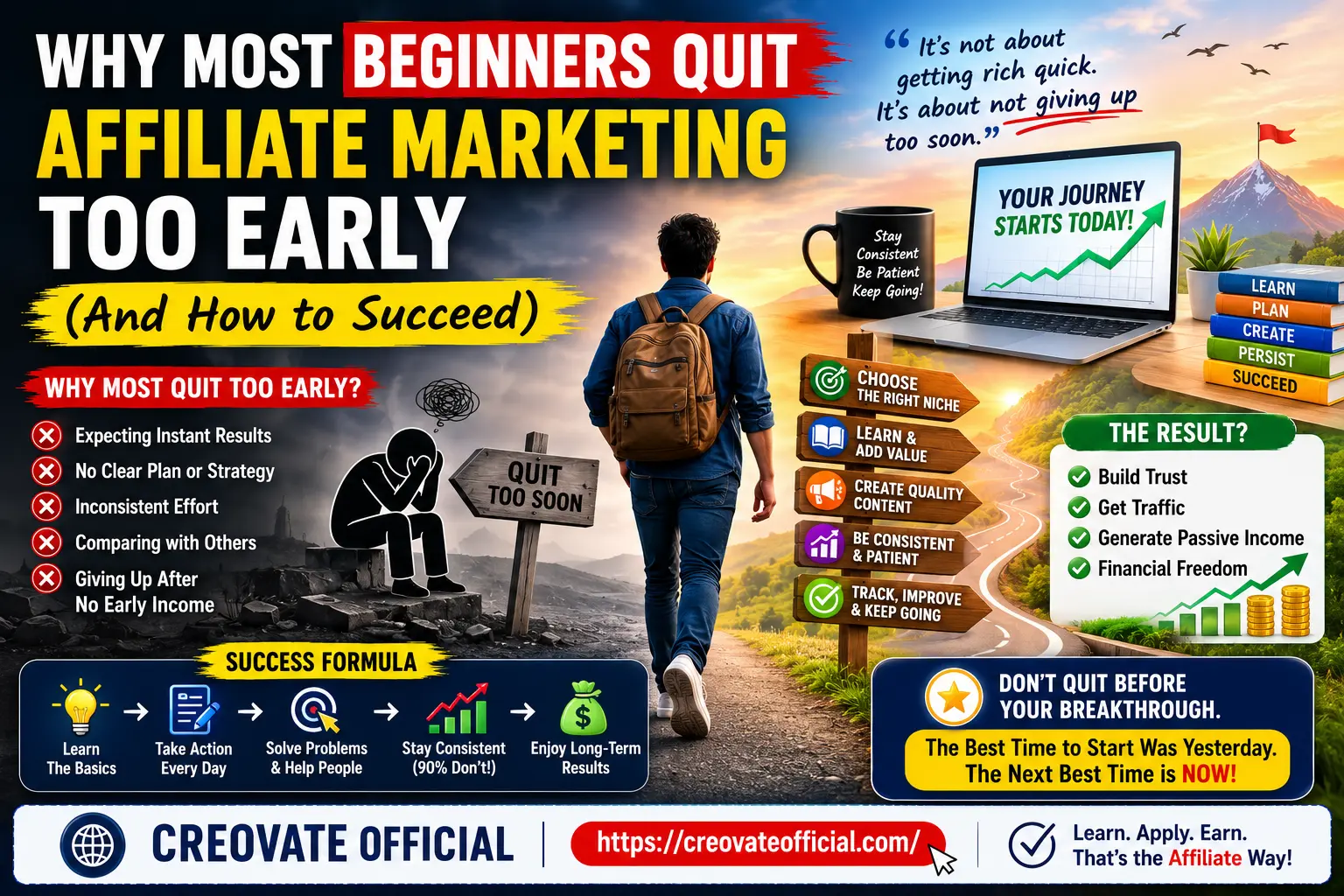
Many beginners quit affiliate marketing somewhere around month 2 to month 6 — often right before the compounding period where content, SEO, and trust start converting. Common causes include unrealistic timelines, no repeatable content system, inconsistent publishing, and comparing raw effort against other people's highlight reels. Beginners who succeed tend to treat the first year as an investment phase, track leading indicators instead of income, and keep publishing through the flat part of the curve.
The 90-Day Affiliate Consistency Tracker
A simple, printable tracker that logs what actually predicts affiliate income — content published, backlinks earned, and email subscribers gained — so you can see progress on the days income doesn't show it. Drop your email below and it lands in your inbox.
No spam. Unsubscribe anytime. See our affiliate disclosure below.
This guide is written from the operating side of an affiliate business, not from theory. Creovate Official is built on hands-on experience creating content, testing email funnels, and evaluating tool stacks for niche sites, and this article reflects what we've found actually moves the needle versus what sounds good in a course.
Some links in this article are affiliate links. If you click through and make a purchase, Creovate Official may earn a commission at no extra cost to you. That never changes our recommendations — we only link to tools we've personally used or evaluated, and we say so plainly when we haven't run long-term tests on something. Pricing and features change often, so always confirm current details on the provider's site before buying.
Get The No-Portfolio Client Playbook and learn how to choose a service, create practice samples, find prospects, write outreach, and take your first steps with confidence.
👉 Get it hereWhy Most Beginners Quit Affiliate Marketing Too Early
Affiliate marketing has a reputation for a high beginner dropout rate — not because it doesn't work, but because the payoff is delayed and invisible for longer than most people expect. Here are the five reasons we see most often.
Expecting instant results
Most beginners mentally budget 30 to 60 days before they expect commissions. Search engines alone can take that long just to index and start ranking a new page. When nothing happens in month one, it feels like proof it's not working, when really it's proof nothing has had time to work yet.
No clear plan or strategy
Publishing without a content plan means every article is a coin flip. Beginners who succeed usually work from a keyword and content calendar, not inspiration. Without a plan, motivation runs out long before a strategy has been tested properly.
Inconsistent effort
Two articles one week, then three weeks of nothing, is a common pattern. Search engines and email lists both reward consistency because it signals an active, trustworthy source. Sporadic effort resets momentum every time it stalls.
Comparing progress with others
Screenshots of six-figure months rarely show the eighteen months of near-zero income before them. Beginners compare their month one to someone else's year three, conclude they're behind, and quit — often while actually on a normal trajectory.
Giving up after no early income
Affiliate income is famously back-loaded: old content keeps earning while new content is still ramping up. Beginners who stop before that backlog builds never get to experience the compounding that makes the model work in the first place.
The Real Timeline: How Long Affiliate Marketing Actually Takes
If you search "how long does affiliate marketing take," you'll find a lot of vague answers. Here's a more honest breakdown based on typical niche site and content-channel timelines:
| Phase | Typical Timeframe | What's Actually Happening |
|---|---|---|
| Foundation | Month 0–2 | Niche research, site or channel setup, first 10–15 pieces of content, no meaningful traffic yet. |
| Indexing & testing | Month 2–5 | Search engines start crawling and ranking pages; first trickle of organic traffic and maybe a first commission. |
| Early traction | Month 5–9 | A handful of pages break into page one for long-tail keywords; email list starts growing; income becomes irregular but real. |
| Compounding | Month 9–18 | Backlog of content compounds, authority builds, traffic and commissions start growing without proportional new effort. |
| Scaling | Month 18+ | Reinvestment into better content, paid promotion, or a team; income becomes more predictable and diversified. |
This is where the connection to quitting becomes obvious: many people give up somewhere in the "foundation" or early "indexing" phase — exactly the stretch where the model looks the most broken and, based on typical timelines, is often closest to turning a corner.
The Success Formula That Actually Works
There's no secret shortcut, but there is a repeatable pattern among beginners who make it past year one:
Learn the basics once, properly
Take action every day, even small
Solve real problems for real people
Stay consistent — most don't
Let long-term results compound
Notice that "consistency" is the step most beginners skip, and it's also the one doing the most work. A mediocre plan executed for twelve straight months will usually outperform a brilliant plan abandoned in month three.
Common Beginner Mistakes (Beyond Quitting Early)
Picking a niche based on commission size, not intent
High-ticket niches look attractive on paper, but if there's no genuine buyer search intent behind your content, a bigger commission rate multiplies zero by a bigger number. Match content to what people are actually searching to solve.
Promoting before building trust
Recommending a product on day one, before you've published anything genuinely useful, reads as a sales pitch. Lead with real help; let recommendations follow naturally once a reader already trusts your judgment.
Ignoring email from the start
Search rankings fluctuate and social algorithms change constantly. An email list is the one audience asset a platform update can't take away from you — yet it's usually the last thing beginners set up, if they set it up at all.
Treating content as a one-time task
Publishing an article and never updating it lets a page slowly lose relevance and rankings. A short refresh pass every few months, updating dates, links, and outdated claims, keeps older content earning.
How to Get Affiliate Marketing Traffic as a Beginner
Traffic problems are the single biggest reason "I'm not making money" reports come in. A few starting points that don't require a big budget:
- SEO on long-tail, buyer-intent keywords — target specific phrases ("best budgeting app for freelancers") over broad, competitive ones ("budgeting app").
- An email list from day one — even a simple lead magnet like a checklist or tracker starts compounding your owned audience immediately.
- One short-form video platform — pick one (not three) and post consistently; repurpose the same idea across formats instead of creating from scratch each time.
- Answering forum and community questions — genuinely helpful answers in niche communities build authority and occasional referral traffic long before SEO kicks in.
- AI search visibility — structuring content with clear answers, headers, and FAQs (like this article) helps it get pulled into AI-generated search summaries, an increasingly real 2026 traffic source.
Tools That Make Beginner Life Easier
None of these tools replace consistency, but the right ones remove enough friction that consistency becomes realistic. Below is the stack we actually recommend to beginners, based on the biggest bottlenecks: writing content faster, building an email list, editing video, and getting design or freelance help without hiring a full team.
| Tool | Category | Best For | Pricing Model |
|---|---|---|---|
| Rytr | AI writing assistant | Drafting content and product copy faster | Free tier + paid plans |
| GetResponse | Email marketing | Building and automating your list | Free trial + paid plans |
| Systeme.io | All-in-one funnel builder | Landing pages, funnels, and courses | Free tier + paid plans |
| Synthesia | AI video generation | Faceless video content at scale | Paid plans, free demo |
| CustomGPT | Custom AI chatbot | Turning your content into an on-site assistant | Paid plans, free trial |
| CapCut | Video editor | Short-form video editing | Free download, optional pro |
| FastPixel | Site speed optimization | Faster-loading affiliate sites | Paid plans |
| Fiverr | Freelance marketplace | Outsourcing design, editing, or setup | Pay per gig |
Individual Tool Reviews
Rytr — AI Writing Assistant
ContentRytr is a lightweight AI writing tool built for speed rather than complexity, which is exactly what most beginners need before they've built a full content workflow.
Advantages
- Fast first drafts and outlines
- Dozens of use-case templates
- Simple, low learning curve
Drawbacks
- Still needs human editing for EEAT-quality content
- Free tier is limited for high-volume publishing
Best for: Beginners who need to beat writer's block and get consistent first drafts out faster.
GetResponse — Email Marketing Tools
EmailSince an email list is the one traffic source beginners consistently under-invest in, GetResponse is worth setting up early. It combines list building, automation, and basic landing pages in one place.
Advantages
- Beginner-friendly automation builder
- Built-in landing pages for lead magnets
- Solid deliverability reputation
Drawbacks
- More advanced automations take time to learn
- Pricing scales with list size
Best for: Beginners ready to stop relying only on search traffic and start building an owned audience.
Systeme.io — All-in-One Funnel Builder
FunnelsSysteme.io bundles funnels, email, and simple course hosting into one platform, which suits beginners who don't want to stitch together five separate tools before publishing anything.
Advantages
- Generous free plan to start
- Funnels, email, and digital product hosting in one place
- No coding required
Drawbacks
- Design flexibility is more limited than dedicated builders
- Best suited to simpler funnels, not complex ecommerce
Best for: Beginners who want to sell a digital product or lead magnet without a big tool budget.
Synthesia — AI Video Generation
VideoSynthesia turns scripts into presenter-led videos using AI avatars, which lowers the barrier for beginners who want a video traffic channel but aren't comfortable on camera yet.
Advantages
- No filming or on-camera presence needed
- Fast turnaround from script to video
- Multiple languages supported
Drawbacks
- Avatar-based videos can feel less personal than real presence
- Higher price point than basic editing tools
Best for: Beginners building a faceless video or explainer-content channel.
CustomGPT — Custom AI Chatbot
AI ToolsCustomGPT lets you build a chatbot trained on your own content, which can help site visitors get quick answers and keeps them on your page longer.
Advantages
- Trains directly on your existing content
- Can improve on-site engagement
- No coding required to deploy
Drawbacks
- Adds more value once you already have a content library
- Ongoing cost to maintain
Best for: Beginners with an established content base looking to improve engagement, not day-one starters.
CapCut — Video Editor
VideoCapCut is a free, beginner-friendly editor that covers everything most short-form and YouTube content needs without a steep learning curve.
Advantages
- Free to download and use
- Templates built for short-form platforms
- Works on desktop and mobile
Drawbacks
- Advanced color and audio tools are more limited than pro software
- Some features are USA-availability specific
Best for: Beginners editing short-form video content on a $0 budget.
FastPixel — Site Speed Optimization
PerformanceA slow affiliate site loses both rankings and conversions. FastPixel focuses specifically on speeding up sites without needing deep technical knowledge.
Advantages
- Targets Core Web Vitals directly
- Minimal technical setup
- Can meaningfully improve load times
Drawbacks
- Most valuable once you already have a live site with traffic
- Results vary by hosting and existing setup
Best for: Beginners whose site is live but loading slowly on mobile.
Fiverr — Freelance Marketplace
OutsourcingFiverr is useful for the tasks beginners don't need to (or shouldn't) DIY forever — logo design, thumbnail creation, basic site setup, or proofreading.
Advantages
- Huge range of skills and price points
- Reviews help vet freelancer quality
- Good for one-off tasks without hiring
Drawbacks
- Quality varies significantly by seller
- Can add up if used for everything instead of strategically
Best for: Beginners who need design or technical help outside their own skill set.
Pros & Cons of Affiliate Marketing for Beginners
Pros
- Low startup cost compared to most businesses
- No inventory, shipping, or customer support burden
- Income can become passive once content compounds
- Works alongside a full-time job while you start
Cons
- Slow, delayed feedback loop that tests patience
- Income isn't guaranteed and isn't linear
- Dependent on platforms you don't control (search engines, social algorithms)
- Requires real skill-building in writing, SEO, or video
Decision Guide: Where Should a Beginner Actually Start?
With eight tools listed above, the natural question is where to start without overspending before you've earned a dollar. A simple way to think about it:
- If you have $0 to spend: Start with CapCut (free) for video and the free tiers of Rytr and Systeme.io. Prove the model works before paying for anything.
- If you can invest a little: Add GetResponse once you have your first lead magnet ready, so you're not losing the traffic you're already earning.
- If your site is live but slow: FastPixel becomes worth it once speed is actually costing you rankings or conversions, not before.
- If you're camera-shy: Synthesia removes the biggest excuse for skipping video content.
- If you're stretched thin on design or setup: Use Fiverr strategically for one-off tasks rather than trying to learn every skill yourself.
Common mistake to avoid here: buying every tool in month one. Tool debt is real — subscriptions quietly become a bigger monthly cost than most beginners' entire early affiliate income. If budgeting for tools and income feels shaky, our Monthly Budget Planner is built specifically for tracking a side income business alongside personal expenses.
Frequently Asked Questions
How long does affiliate marketing actually take to make money?
As a general guideline, many beginners see their first commission somewhere between month 3 and month 9, with consistent, meaningful results typically taking 12 to 24 months of steady publishing. These are rough, commonly reported ranges rather than guarantees — your actual timeline depends on your niche, content volume, and existing traffic or audience.
Why is my affiliate marketing not making money yet?
The most common reasons are too little published content, no clear traffic source, weak search intent match, or promoting products before you've built any trust with your audience. Low or no traffic is usually the biggest factor, more often than a "bad niche" or "bad product."
What is the biggest mistake beginners make in affiliate marketing?
Quitting during the flat part of the growth curve. Many niche sites and content channels look almost identical in month 2 and month 5 from the outside, even though month 5 is often closer to a breakthrough.
Is affiliate marketing still worth it in 2026?
It can be, though the bar for quality has gone up. Thin, generic content is increasingly filtered out by search engines and readers alike. Beginners who publish genuinely useful, experience-backed content and diversify traffic sources tend to have the best odds of building a profitable affiliate business in 2026.
How much money can a beginner realistically make from affiliate marketing?
Results vary widely, but many consistent beginners report earning anywhere from a few hundred to a few thousand dollars total in year one, not per month. Income tends to compound after year one as content, backlinks, and email lists build up, which is one reason beginners who quit early often don't see a payoff.
Final Verdict
Affiliate marketing doesn't reward talent as much as it rewards the beginners who are still publishing in month nine. If you take one thing from this guide, let it be this: judge your progress by what you shipped this month, not by what landed in your bank account this month. Build a simple content system, add one owned-audience channel like email, use just enough tools to remove friction (not to feel productive), and give the model the twelve to eighteen months it typically needs.
Next step: grab the free 90-Day Consistency Tracker above, or if you're ready to get organized around your income and expenses as a beginner, check out the Monthly Budget Planner.
Get the Budget Planner →