Quick Answer
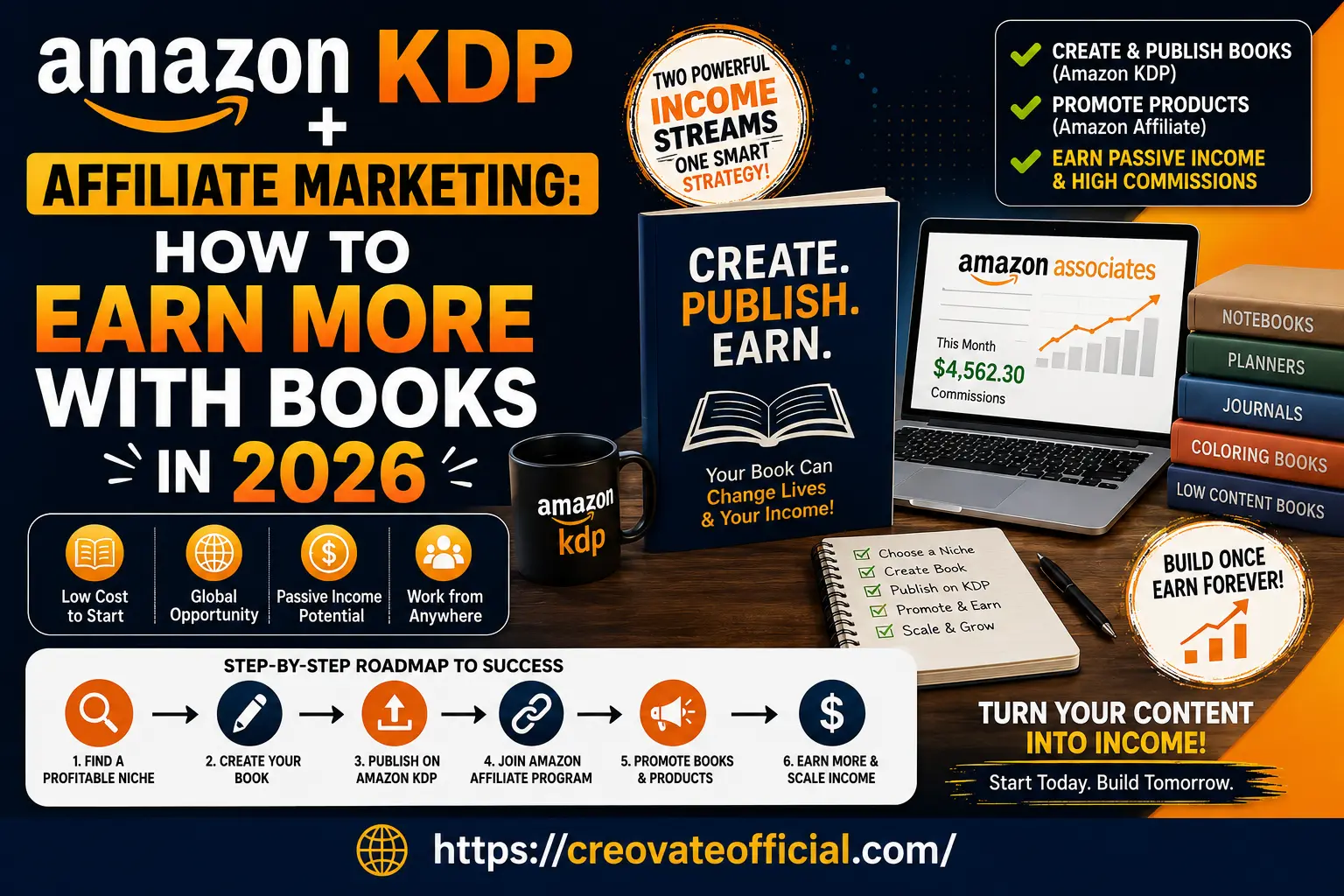
Amazon KDP lets you publish and sell books — planners, journals, low-content books, or full non-fiction guides — and earn royalties on every copy sold. Affiliate marketing lets you earn commissions by recommending tools your readers actually use, like writing assistants, design apps, or email software. Combined, your book becomes a lead magnet and trust-builder, while affiliate links inside and around it turn a single reader into two income events instead of one.
🎁 Free Online Income Starter Kit (2026)
Grab the same niche-research worksheet and tool checklist we use before publishing a new KDP book. No spam — just the kit and occasional updates from Creovate Official.
You're in! Check your inbox for the download link.
By subscribing you agree to receive emails from Creovate Official. Unsubscribe anytime.
Why Trust This Guide
This guide is written from the operator's seat, not a theory desk. Creovate Official researches, tests, and writes about digital income strategies — including our own KDP catalog and the tools we use to run it — every week.
- Written and reviewed by a founder who publishes on KDP and runs affiliate campaigns for this exact niche.
- Tools are selected based on hands-on testing, research, or practical evaluation — not picked from a random "best of" list.
- We update this guide as Amazon's KDP policies, categories, and affiliate terms change.
- Recommendations are balanced — we call out drawbacks, not just selling points.
Affiliate Disclosure: Some links in this article are affiliate links. If you sign up or purchase through them, we may earn a commission at no extra cost to you. We only recommend tools we've genuinely used or evaluated. This doesn't affect our opinions.
Get The No-Portfolio Client Playbook and learn how to choose a service, create practice samples, find prospects, write outreach, and take your first steps with confidence.
👉 Get it here1. What Is "Amazon KDP + Affiliate Marketing," Really?
Most creators treat Kindle Direct Publishing (KDP) and affiliate marketing as two separate businesses. Publish a book here, run affiliate content there, never the two shall meet. That's leaving money on the table.
Here's the shift: your book isn't just a product — it's an owned platform. A journal, planner, or how-to guide already has a captive reader who trusts you enough to buy. That trust is exactly what affiliate marketing needs to convert. When you point that same reader toward a tool that solves the next problem on their list — say, budgeting software after a debt-payoff workbook — you're not selling twice. You're finishing the story you already started.
In practice, "Amazon KDP + affiliate marketing" means three things working together:
- KDP royalties from your book sales themselves.
- Affiliate commissions from tools or products you recommend inside your book's resource pages, a companion blog post, or an email sequence.
- An owned audience (email list or niche site) that keeps earning from both streams long after the first sale.
2. How Amazon KDP Works for Beginners
If you're brand new to self-publishing, here's the short version. Amazon KDP is Amazon's free platform for publishing paperbacks, hardcovers, and Kindle eBooks. You upload a manuscript and cover, set your price, choose your categories and keywords, and Amazon handles printing (for paperbacks, via print-on-demand) and distribution.
The core publishing steps
- Create a free KDP account at kdp.amazon.com using your existing Amazon login.
- Choose your format — eBook, paperback, or hardcover. Many authors start with paperback + eBook together.
- Upload your interior file as a formatted PDF or Word document, following Amazon's trim size and margin requirements.
- Upload a cover using KDP's free Cover Creator or a professionally designed file.
- Set your metadata — title, subtitle, description, seven backend keywords, and two BISAC categories. This is where SEO for books actually lives.
- Set pricing and royalty options and publish. Review typically takes 24–72 hours.
3. How Affiliate Marketing Works for Authors
Affiliate marketing is simple in mechanics: a company gives you a unique tracked link, you share it with an interested audience, and you earn a commission when someone buys or signs up through it. For authors, the "interested audience" is anyone who bought or downloaded your book.
Where affiliate links naturally fit into a book-based business
- Back matter / resource page — a "Tools I Recommend" page at the end of your book.
- A companion blog post — an article that expands on your book's topic and links to relevant tools (like this one).
- An email welcome sequence — sent to readers who claim a free lead magnet tied to your book.
- Your author website or link-in-bio page — a simple hub listing your books and the tools behind them.
The key difference between this and generic affiliate marketing: your recommendations come with built-in credibility, because the reader already paid you for expertise once. That context converts far better than a cold blog post ever will.
4. Finding KDP Books That Sell (and Pair Well With Affiliate Offers)
Not every book niche supports affiliate income equally. A children's picture book, for instance, gives you almost no natural tie-in to software or productivity tools. A budgeting workbook, on the other hand, sits right next to a dozen relevant affiliate products.
Look for niches with a "next step"
The best KDP niches for this strategy solve a problem that has an obvious next problem — one a tool or product can solve. A few examples:
| Book Niche | Reader's Next Problem | Natural Affiliate Tie-In |
|---|---|---|
| Budgeting / debt payoff workbook | Tracking spending long-term | Budgeting software, spreadsheet templates |
| Content creator planner | Producing content faster | AI writing tools, video editors |
| Small business journal | Marketing and outreach | Email marketing platforms |
| Habit tracker / wellness journal | Staying consistent | Apps, printable bundles |
| Social media growth guide | Editing and scheduling content | Design and video tools |
Practical ways to validate a niche before you write a word
- Search the niche directly in Amazon's search bar and see what autocompletes — that's real buyer demand.
- Check the Best Sellers Rank (BSR) of the top 10 books in that category. Consistently under 100,000 suggests healthy demand.
- Look at review counts. A handful of strong sellers with hundreds of reviews and few competitors is a good sign; hundreds of books all with zero reviews usually means thin demand.
- Ask whether you could realistically write a helpful blog post or lead magnet around this topic — if not, the affiliate side won't work.
5. The 6-Step Roadmap to Combine Both
This is the exact sequence we follow whenever we launch a new KDP title with an affiliate layer built in from day one.
Find a profitable niche
Validate demand on Amazon first, then confirm the niche has a natural "next step" that affiliate tools can solve.
Create your book
Outline around your reader's real problem. Use AI writing assistance to speed up drafting, but edit for a genuine, human voice.
Publish on Amazon KDP
Format the interior, design a cover that matches top performers in your category, and fill out metadata with real search terms.
Add your affiliate layer
Build a short resource page inside the book's back matter and a companion blog post or landing page with the same recommendations.
Promote books and products together
Use email capture and a lead magnet to keep readers on your list, then promote both your next book and relevant tools.
Earn more and scale
Reinvest early royalties and commissions into better covers, more titles, and paid tools that save you time.
6. Best Tools for a KDP + Affiliate Income Stack
You don't need a big budget to start. Most of these tools have usable free tiers — upgrade only once a book or campaign is actually earning.
| Tool | Category | Free Option | Best For | Overall Fit |
|---|---|---|---|---|
| Rytr | AI writing assistant | Yes, limited credits | Drafting outlines, descriptions, and back matter copy | Great starting point for new authors |
| FastPixel | Image compression / site speed | Free trial | Optimizing cover mockups and blog images for fast loading | Solid for a companion website |
| CapCut | Video editor | Free option available; some features may require a paid plan | Book promo clips and social content | Best for short-form promotion |
| GetResponse | Email marketing platform | Free trial / limited plan | Building your reader list and automating affiliate follow-ups | Core tool for the "owned audience" layer |
7. Individual Tool Reviews
Rytr
Rytr is a budget-friendly AI writing tool that's handy for drafting book descriptions, back-matter resource pages, and outline ideas before you write the full manuscript yourself.
Advantages
- Low cost compared to most AI writing subscriptions
- Fast for short-form copy like blurbs and descriptions
- Useful for brainstorming chapter outlines
Drawbacks
- Not a substitute for a full manuscript-writing workflow
- Output still needs a human editing pass for voice and accuracy
Best for: Beginners who want to speed up the "blank page" parts of publishing without outsourcing the whole book.
Pricing: Offers a free tier with limited credits; paid plans scale with usage. Check current pricing on their site, as it changes periodically.
FastPixel
If you build a companion blog or landing page to support your books, FastPixel compresses and optimizes images so your site loads quickly — which matters for both SEO and reader trust.
Advantages
- Noticeably faster page-load times on image-heavy pages
- Simple setup for non-technical users
Drawbacks
- Only useful once you have a website — not needed for KDP publishing alone
- One more subscription to manage if you're just starting out
Best for: Authors who've grown into a full companion website and need it to load fast on mobile.
Pricing: Trial-based; paid tiers scale with site traffic and image volume. Confirm current pricing before committing.
CapCut — Video Editor
Short-form video is one of the fastest ways to promote a new book launch. CapCut is a free, beginner-friendly editor that works well for book teasers, "behind the scenes" clips, and reels pointing to your Amazon listing.
Advantages
- Free to download and use for most core features
- Templates make it easy to produce polished clips quickly
Drawbacks
- Some advanced effects and templates sit behind a paid tier
- Video promotion still takes consistent effort to see results
Best for: Authors promoting books on TikTok, Instagram Reels, or YouTube Shorts.
Pricing: Free option available; some features may require a paid plan.
GetResponse
GetResponse is the workhorse behind the "owned audience" piece of this strategy. It lets you capture reader emails from a lead magnet, send automated welcome sequences, and promote both future books and affiliate tools without starting from zero each time.
Advantages
- Built-in landing pages and automation, not just email sending
- Scales from a small reader list to a larger funnel
Drawbacks
- Learning curve if you're brand new to email marketing
- Free/trial tiers are limited compared to paid plans
Best for: Authors ready to move past one-off book sales and build a real, repeatable income funnel.
Pricing: Free trial available; paid plans scale with subscriber count. Verify current pricing on their site.
8. Pros & Cons Summary
Pros of Combining KDP + Affiliate Marketing
- Two income streams from one audience
- Low startup cost compared to most online businesses
- Your book acts as a trust-building asset for affiliate offers
- Royalties and commissions can both become semi-passive over time
- Easy to reinvest early earnings into better tools and more titles
Cons to Be Aware Of
- Neither income stream is truly "instant" — expect a few months of testing
- Requires learning two skill sets: publishing and basic marketing
- Affiliate terms and commission rates can change without notice
- Over-promoting affiliate links inside a book can hurt reader trust if done poorly
9. Buying Guide: Choosing Your Tools and Niche
What to look for in a niche
- Clear, searchable demand on Amazon (not just personal interest)
- A natural "next problem" you can solve with an affiliate recommendation
- Low legal/medical risk — avoid niches requiring professional credentials you don't have
What to look for in tools
- A usable free tier so you can test before paying
- Clear pricing with no hidden renewal surprises
- A tool that actually removes a bottleneck in your workflow — not just something you saw recommended everywhere
Budget considerations
You can realistically start this strategy for under $50, using free AI credits, KDP's free Cover Creator, and free tiers of the tools above. Reserve paid upgrades for the parts of your workflow that are actually generating income.
Who should try this strategy
Beginners comfortable writing or outlining content, freelancers and bloggers who already have some audience-building experience, and small business owners looking to diversify income beyond client work.
Who should hold off
If you're not willing to spend at least a few hours a week on both writing and basic promotion, this strategy will underperform — it isn't a "set it and forget it" system in the first few months.
10. Common Mistakes to Avoid
- Publishing without keyword research. A beautifully written book with no searchable title or categories will sit invisible on Amazon.
- Stuffing affiliate links everywhere. Two or three well-placed, relevant recommendations outperform a wall of links every time.
- Ignoring your email list. Without a way to reach readers again, you're relying entirely on one-time Amazon traffic.
- Chasing every niche at once. Depth in one profitable niche beats scattering five half-finished books across unrelated topics.
- Skipping the affiliate disclosure. Beyond being an FTC requirement, transparency is what keeps reader trust intact.
11. Frequently Asked Questions
Can you really make money combining Amazon KDP and affiliate marketing?
Yes. KDP pays you royalties for books you publish, while affiliate marketing pays you commissions for recommending tools and products your readers already need. Run together, one audience can fund two income streams instead of one.
How much money can you make with Amazon KDP for beginners?
Most beginners earn little or nothing at first. Results vary significantly depending on niche demand, book quality, pricing, discoverability, and promotion. Income typically improves as you publish more titles, refine your keywords and covers, and layer affiliate income on top.
Do I need a website to do affiliate marketing for authors?
No, but it helps. You can start by adding affiliate links inside your book's back-matter resource page, then grow into a simple companion website or blog post once you see traction.
What KDP books sell best in 2026?
Low-content books (planners, journals, trackers), niche non-fiction guides, and workbooks tied to a specific problem tend to perform well because they solve a clear need and pair naturally with affiliate recommendations.
Is affiliate marketing better than Amazon KDP for passive income?
Neither is strictly better. KDP gives you an owned asset — your book — with recurring royalties, while affiliate marketing can scale faster once you have traffic. Combining both reduces your reliance on a single income source.
How do I promote my KDP books with affiliate marketing?
Add a resources page inside your book pointing readers to tools you genuinely recommend, build a simple landing page or blog post that expands on your book's topic, and use email capture to keep nurturing readers with both book updates and relevant offers.
What tools do I need to start KDP and affiliate marketing together?
At minimum: a writing or AI-assist tool, basic design software for covers and graphics, a video editor for promotion, and an email marketing platform to build your list. You don't need to pay for all of them on day one — most have usable free tiers.
Can I sell my own digital products alongside KDP and affiliate income?
Yes, and it's a natural third layer. Once you have an audience from your books, a digital product like a monthly budget planner or similar tool gives you a higher-margin offer to sell directly, without relying on royalty splits or affiliate commission rates.
12. Final Verdict
Key takeaway: Amazon KDP and affiliate marketing aren't competing strategies — they're complementary. Your book builds trust and traffic; affiliate offers turn that trust into a second income stream without requiring a second product.
Best next step: Pick one validated niche, publish a single well-researched book, and add just two or three relevant affiliate recommendations to start. Resist the urge to launch five books and ten affiliate offers at once — depth beats breadth in the first 90 days.
Honest limitation: This isn't a get-rich-quick system. Expect a genuine learning curve on keyword research, formatting, and basic promotion before either income stream feels meaningful.