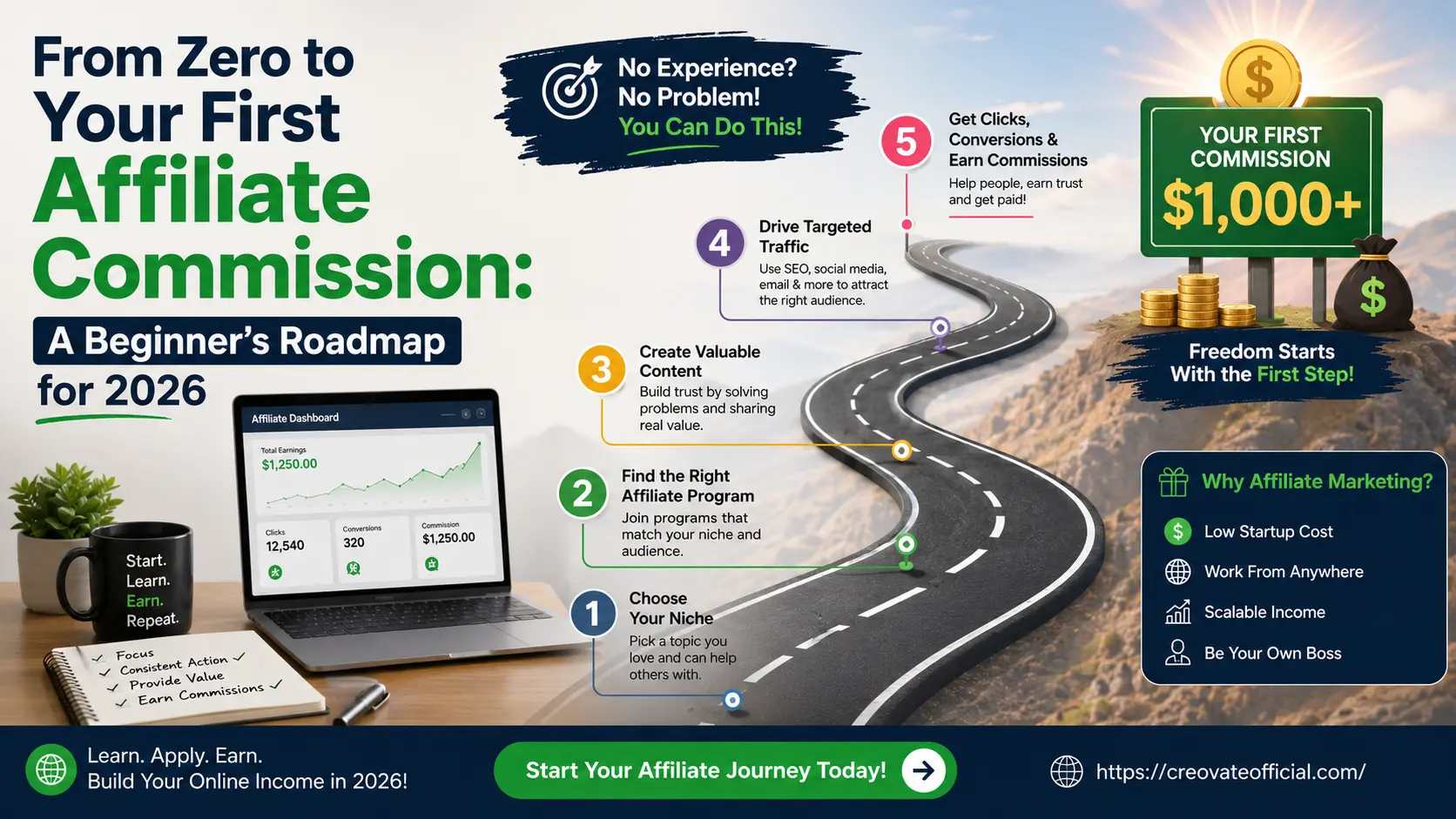
To get your first affiliate commission, pick one specific niche, join two or three affiliate programs that match it, publish content that solves a real problem your audience already has, and send that content to people actively searching for a solution — not just to your followers. Some beginners who follow this order, instead of jumping straight to "traffic," see their first commission within 60 to 120 days, but results vary significantly by niche, traffic source, content quality, offer, and consistency.
Affiliate Disclosure: Some links in this guide are affiliate links. If you purchase through them, we may earn a commission at no additional cost to you. Recommendations are based on suitability, not commission size. Read our full disclosure.
🎁 Free Online Income Starter Kit (2026)
Grab the checklist, niche worksheet, and program shortlist we reference throughout this guide. Drop your email below and the download link unlocks instantly — no spam, just the kit.
By submitting your email, you agree to receive the Starter Kit and occasional Creovate Official emails. You can unsubscribe at any time. Privacy Policy
This roadmap is built from actually running affiliate content on Creovate Official, not from summarizing other people's blog posts. Where possible, we test tools directly and combine hands-on experience with current product information and program terms — not picked because a tool pays the highest commission.
Get The No-Portfolio Client Playbook and learn how to choose a service, create practice samples, find prospects, write outreach, and take your first steps with confidence.
👉 Get it hereWhat Affiliate Marketing Actually Looks Like in 2026
Affiliate marketing is still, at its core, the same trade it was a decade ago: you recommend a product, someone buys it through your link, and the company pays you a cut. What's changed by 2026 is how fast average content gets made — and that's actually good news for a careful beginner.
AI writing and video tools have made it trivial to publish generic "top 10" roundups by the thousand. Google and readers have both gotten better at spotting them. That means the beginners who actually use a product, write from that experience, and answer the specific question someone typed into Google now have an easier time standing out than they did a few years ago — even with zero audience.
If you're new to the whole concept, our beginner's guide to affiliate marketing covers the terminology. This post picks up where that leaves off: the actual sequence of steps to your first payout.
The 6-Step Roadmap From Zero to First Commission
Step 1: Pick a Niche You Can Actually Compete In
Skip "fitness" or "make money online." Those niches are saturated with sites that have ten years of authority you don't have yet. Instead, narrow until you can picture the exact person searching — someone comparing budgeting apps after a bad month, a new freelancer looking for invoicing software, a small business owner trying to automate social posts.
A workable niche test: can you name 15 specific blog post topics for it in under five minutes, without repeating yourself? If yes, there's enough depth to build on. If you're stuck after three, it's too narrow or too vague.
Step 2: Find Affiliate Programs Worth Your Time
Not all programs are equal. As a beginner, look for programs with a reasonably fast approval process and a product you'd genuinely recommend. Software and digital tools are often a friendlier entry point because approval frequently doesn't depend on your traffic numbers the way many physical-product programs do — but requirements still vary by program, so always check the current terms before applying.
For content creators and freelancers specifically, tools like Rytr for AI writing, GetResponse for email, and Systeme.io for funnels run beginner-accessible affiliate programs. When a program offers recurring commissions, that can be attractive because a single referral may generate multiple payouts for as long as the customer stays subscribed — but confirm the structure on each program's own terms page, since it's not universal.
Compare structures side by side before committing using our Amazon Associates vs. ShareASale vs. CJ Affiliate breakdown, and check our running list of best affiliate programs for beginners in 2026 before locking anything in.
Step 3: Build Your Home Base
You need somewhere you control — a spot that isn't at the mercy of a platform's algorithm change. That doesn't have to mean a full custom website on day one. A simple funnel or landing page built in a tool like Systeme.io can get you publishing and collecting emails within an afternoon, and you can migrate to a full site once you've validated the niche.
If you're ready to commit to a proper site from the start, walk through our guide on building a niche website that makes money. Either path works — what matters is that you own the asset, not a platform.
Step 4: Create Content That Sells Without Feeling Salesy
The highest-converting affiliate content answers a decision, not just a definition. "What is email marketing" rarely converts. "GetResponse vs. Mailchimp for a solo creator" does, because the reader is already close to buying and just needs the last push of clarity.
Speed up production without sounding like a template. Rytr works well for first drafts and outlines you then rewrite in your own voice — never publish AI output unedited, since both readers and Google can tell. For video content, CapCut handles quick edits for TikTok, Reels, and YouTube Shorts, while Synthesia lets you produce a polished explainer or product-walkthrough video without ever being on camera, which matters if camera-shyness has been holding you back.
Need more format ideas? See our guide to free AI tools for content creators and our comparison of Claude vs. ChatGPT vs. Gemini for creators if you're deciding which AI assistant to draft with.
Step 5: Drive Targeted Traffic
Traffic without targeting just produces clicks that never convert. Three channels work reliably for beginners: search (SEO), email, and short-form video — in roughly that order of long-term payoff.
SEO takes longer to kick in but keeps paying long after you stop actively promoting a post; our SEO for affiliate marketing guide and the broader SEO for beginners guide both cover the mechanics. Email can be one of the highest-converting channels for affiliate offers because you're reaching people who have already raised their hand, which is why capturing addresses from day one (like the starter kit above) matters more than most beginners realize — start with building an email list from zero and our email marketing for beginners guide, then automate the follow-up sequence in GetResponse.
Step 6: Turn Clicks Into Your First Commission
This is where most guides stop, but it's the step that actually earns money. Getting clicks isn't the same as getting commissions — conversion happens when your recommendation removes the last bit of doubt.
- Put the affiliate link near the moment you've just answered the reader's objection, not just at the top and bottom of the post.
- Use one clear call-to-action per product, not five competing links pulling attention in different directions.
- Show your own numbers or screenshots where you can — specificity converts far better than generic praise.
- Follow up with anyone who joined your email list but hasn't clicked yet; a short nudge sequence in GetResponse routinely recovers commissions that a single post would have missed.
Once commissions start landing, the next skill is managing that income so it actually builds toward something — our own Monthly Budget Planner is built specifically for creators tracking irregular income like affiliate payouts alongside regular expenses.
Common Mistakes That Delay Your First Sale
Almost every beginner who takes six months instead of six weeks to land a first commission is making one of these errors:
- Promoting everything at once. Spreading five affiliate programs across three posts dilutes trust. Go deep on two or three products you actually use.
- Publishing and disappearing. A single post rarely converts. It's the fifth or sixth piece of content in a niche that starts pulling consistent search traffic.
- Skipping the email capture. Traffic you don't capture is traffic you only get to convert once. Even a simple lead magnet changes this.
- Chasing the highest commission instead of the best fit. A high payout on a product your audience doesn't trust converts worse than a modest payout on the right one.
- Ignoring page speed. Slow-loading pages lose both search rankings and impatient buyers — tools like FastPixel exist specifically to fix this without touching code.
Beginner Toolkit Comparison
Here's how the tools referenced throughout this roadmap stack up if you're deciding where to spend your first few dollars.
| Tool | Best For | Free Option | Starting Price | Key Feature |
|---|---|---|---|---|
| Rytr | AI drafting & outlines | Yes | Free tier, paid from ~$9/mo | Fast first drafts in your niche's tone |
| Systeme.io | All-in-one funnels | Yes | Free plan available | Landing pages, email, and courses in one place |
| GetResponse | Email automation | Trial | Paid plans, free trial | List building + automated follow-up sequences |
| FastPixel | Site speed | Trial | Paid, usage-based | Image + page speed optimization for WordPress |
| CapCut | Short-form video editing | Yes | Free (USA) | Fast Reels/TikTok/Shorts editing |
| Synthesia | AI avatar video | Trial | Paid plans, free trial | Camera-free explainer & review videos |
| CustomGPT.ai | Site chatbots | Trial | Paid plans, free trial | Trains a chatbot on your own content to capture leads |
| Fiverr | Outsourcing tasks | N/A | Pay per gig | Hire help for design, editing, or writing as you scale |
Tool-by-Tool Reviews
Affiliate disclosure: links below are affiliate links. If you sign up through them, Creovate Official may earn a commission at no extra cost to you. Where possible, reviews reflect direct hands-on use combined with current product information and program terms.
Rytr — AI Writing Assistant
Best for: fast first draftsRytr is a lightweight AI writing tool built around templates — blog outlines, product descriptions, ad copy, email subject lines. For a beginner publishing their first ten posts, it's genuinely useful for beating a blank page, provided you treat every output as a draft, not a finished piece.
Advantages
- Generous free tier to test before paying
- Tone and use-case templates suit niche content
- Built-in plagiarism checker
Drawbacks
- Long-form drafts still need heavy editing
- Generic voice unless you customize prompts carefully
Pricing: Free plan available; paid tiers scale with word volume. Best for: beginners drafting content in volume on a tight budget.
Try Rytr Free →FastPixel — Site Speed Optimization
Best for: WordPress niche sitesOnce your site is live, page speed quietly decides how many visitors stick around long enough to click an affiliate link. FastPixel compresses images and optimizes delivery without needing to touch a line of code, which matters if you're not a developer.
Advantages
- Noticeable load-time improvement on image-heavy posts
- No coding required to set up
- Works well alongside most WordPress themes
Drawbacks
- Adds another moving part to your hosting stack
- Most value shows once you have several image-heavy posts live
Pricing: Usage-based paid plans. Best for: anyone whose site has slowed down as content and images pile up.
Check FastPixel →CapCut — Free Video Editor (USA)
Best for: short-form video contentShort-form video is one of the fastest ways to build reach without an existing audience, and CapCut is the most beginner-friendly editor for it — free, mobile-friendly, and full of trending-format templates you can adapt for product reviews and tutorials.
Advantages
- Free download for US users
- Beginner-friendly editing interface
- Templates built for Reels, TikTok, and Shorts
Drawbacks
- Availability and features vary by region
- Advanced editing needs still favor desktop-grade software
Pricing: Free, with optional pro features. Best for: beginners building a social presence around affiliate reviews.
Get CapCut Free →GetResponse — Email Marketing & Automation
Best for: turning traffic into repeat buyersEmail can be one of the highest-converting channels for affiliate offers because you're reaching someone who already raised their hand. GetResponse handles the full loop — landing pages to capture emails, automated sequences to nurture them, and analytics to see what's actually converting.
Advantages
- Automation sequences built for affiliate and product promotion
- Includes landing pages, not just email
- Solid deliverability for a beginner-scale list
Drawbacks
- More features than a total beginner needs on day one
- Pricing scales with list size, so budget as you grow
Pricing: Free trial, then tiered paid plans by list size. Best for: anyone serious about building a list rather than relying on one-off traffic.
Try GetResponse →Systeme.io — All-in-One Funnel Builder
Best for: replacing five tools with oneSysteme.io bundles landing pages, email automation, a course builder, and its own affiliate program management into a single dashboard. For a beginner not ready to stitch together separate tools, this collapses a lot of early complexity into one login.
Advantages
- Genuinely usable free plan
- Funnel, email, and affiliate tracking in one place
- Shallow learning curve for non-technical beginners
Drawbacks
- Design flexibility trails dedicated page builders
- Can feel limiting once you outgrow the basics
Pricing: Free plan available; paid tiers unlock higher limits. Best for: beginners who want one platform instead of juggling five subscriptions.
Start Free on Systeme.io →Synthesia — AI Avatar Video
Best for: camera-free video contentSynthesia turns a script into a presenter-style video using an AI avatar, which is a legitimate shortcut for beginners who want video content but aren't ready to film themselves. It works especially well for tool walkthroughs and explainer content.
Advantages
- No filming or on-camera presence required
- Multiple languages and avatar styles
- Fast turnaround from script to finished video
Drawbacks
- Avatar delivery can feel less personal than real footage
- Best suited to explainer-style content, not vlogging
Pricing: Free trial, then paid plans by video minutes. Best for: beginners who want video content without appearing on camera.
Try Synthesia →CustomGPT.ai — Custom AI Chatbot
Best for: on-site lead captureCustomGPT.ai trains a chatbot on your own content so visitors can ask it questions instead of digging through your site. Once you've got a handful of posts published, embedding one on your home base is a low-effort way to keep visitors engaged and capture leads passively.
Advantages
- Trains directly on your existing content
- Reduces bounce by answering visitor questions instantly
- Straightforward embed on most site builders
Drawbacks
- Needs a reasonable amount of published content to be useful
- Overkill for a brand-new site with only a few posts
Pricing: Free trial, then paid plans. Best for: sites with enough content to make a chatbot genuinely helpful.
Explore CustomGPT.ai →Fiverr — Freelance Marketplace
Best for: outsourcing as you scaleYou don't need Fiverr on day one, but once your first commissions start rolling in, it's often the fastest way to reinvest — hiring help for a logo, a site cleanup, or a batch of SEO-optimized posts you don't have time to write yourself.
Advantages
- Wide range of skills at every budget level
- Reviews and portfolios make vetting easier
- Pay per gig, no ongoing subscription
Drawbacks
- Quality varies widely; vetting takes time
- Not a fit until you have income or a clear task to delegate
Pricing: Pay per project. Best for: reinvesting early commissions into tasks outside your own skill set.
Browse Fiverr →Pros & Cons at a Glance
Why This Roadmap Works
- Sequences niche → offer → content → traffic in the order that actually converts
- Every tool referenced has a genuine free or low-cost entry point
- Built around recurring-commission programs, not one-off payouts
What to Watch Out For
- Results depend on consistency — this isn't a one-post strategy
- Tool stacks can get expensive fast if you buy everything at once
- SEO-driven traffic takes weeks to months, not days, to build momentum
How to Choose the Right Tools for Your Budget
You don't need every tool on this page to earn your first commission. Here's how to prioritize spending as a genuine beginner.
What to look for
- A free tier or trial you can actually build something real with, not just a locked demo
- Recurring commissions if you're also promoting the tool as an affiliate
- A short learning curve — anything that takes a week just to set up delays your first post
Common mistakes at this stage
Buying a full paid stack before publishing anything is the single biggest waste of early budget. Start with free plans across the board, and only upgrade the specific tool that's actually becoming a bottleneck.
Budget considerations
A beginner can start with a $0/month stack using free plans — Systeme.io's free plan for your landing page and email, Rytr's free tier for drafting, and CapCut for video — then spend up to $50/month or more as specific needs arise. Add a paid tool only once a specific limitation (like list size or word count) is actively slowing you down.
Who should invest early vs. wait
If you already have a content plan and just need speed, paid tools pay for themselves quickly. If you're still figuring out your niche, stay on free tiers until that's settled — there's no tool that fixes an undefined audience.
Frequently Asked Questions
How long does it take to get your first affiliate commission?
Some beginners who publish consistently and pick a specific niche see their first commission somewhere between 60 and 120 days, but results vary significantly by niche, traffic source, content quality, offer, and consistency. It depends more on how targeted your content is than on how much of it you produce.
Do I need a website to start affiliate marketing?
No, but it helps. You can start promoting offers through social content or email, but a simple site or landing page gives you a place you own, which protects you from platform algorithm changes.
How much money do I need to start affiliate marketing?
You can start for under $50 a month using free plans and a low-cost domain. Paid tools speed things up, but none are required to publish your first piece of content.
What is the easiest affiliate program for beginners?
Software and digital-tool programs can be beginner-friendly, but approval requirements and commission structures vary by program. Always check the current terms before applying.
Can I do affiliate marketing without followers?
Yes. Search-driven content and email lists convert without needing a large social following, since the traffic comes from people already searching for a solution, not from an existing audience.
Is affiliate marketing still profitable in 2026?
Yes, though the bar has risen. AI tools have made average content easy to produce, so genuinely useful, experience-based content now converts noticeably better than generic listicles built purely for search engines.
How much can beginners realistically earn in their first year?
It varies enormously by niche and consistency, but a realistic early milestone is a few hundred dollars a month by month six to nine, growing from there as content compounds and your email list builds.
What's the biggest reason beginners fail at affiliate marketing?
Inconsistency, not lack of skill. Publishing five posts and stopping almost never works — the compounding effect of search traffic and email growth needs sustained output over months, not weeks.
Final Verdict & Next Steps
There's no secret shortcut to your first affiliate commission — but there is a sequence that removes most of the guesswork. Pick a niche narrow enough to actually compete in, join two or three affiliate programs whose terms and payout structure you've actually checked, build a simple home base you control, publish decision-stage content, and drive that content toward people already searching for an answer.
- Key takeaway: Depth in one niche beats breadth across five.
- Best starting stack: Systeme.io (funnel + email) + Rytr (drafting) + CapCut (video) — all with usable free tiers.
- Next step: Grab the free Starter Kit above, pick your niche this week, and publish your first decision-stage post before the month is out.