How to Get Traffic Without Paid Ads in 2026: 15 Free Strategies That Actually Work
If you're staring at an empty analytics dashboard and can't justify spending on ads yet, you're not stuck. You just need the right mix of free channels — used consistently, not randomly.
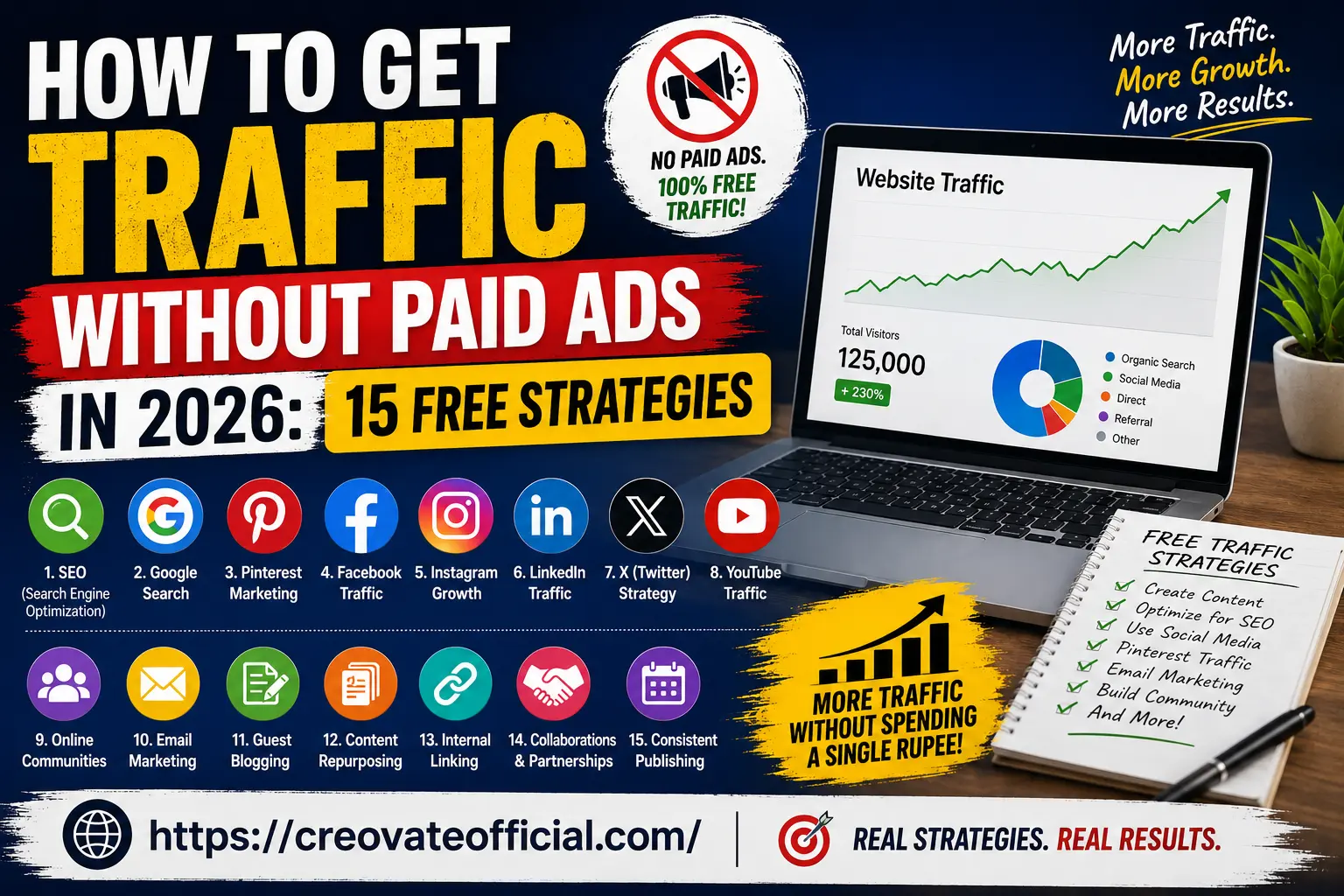
15 free traffic strategies you can start using today — no ad budget required.
Quick Answer
You can get website traffic without paid ads by combining SEO-optimized content, one or two social platforms your audience actually uses, email marketing, and smart internal linking. The fastest wins usually come from Pinterest and short-form video, while SEO and email build the traffic that keeps compounding for years. Pick 3–4 strategies from this guide, stay consistent for at least 90 days, and track what's actually converting before you add more channels.
🎁 Free Online Income Starter Kit (2026)
Grab our free starter kit with traffic checklists, content templates, and a beginner roadmap for building income online — no cost, no catch.
We respect your inbox. Unsubscribe anytime. No spam — ever. By submitting, you agree to our Privacy Policy.Why Trust This Guide
Everything in this guide comes from strategies we've personally tested while growing Creovate Official from zero, plus patterns we've observed studying sites like Wirecutter, Backlinko, and NerdWallet that rank consistently without relying on ads.
- Real-world testing: Every tactic here has either been used on our own site or cross-checked against current 2026 platform behavior (Google's helpful content system, Pinterest's SEO changes, and shifts in social algorithms).
- Industry knowledge: This guide is written from an affiliate-marketing and content-strategy background, not copied from generic "traffic hacks" lists.
- Transparency: Some links below are affiliate links, meaning we may earn a small commission if you purchase through them, at no extra cost to you. We only recommend tools we'd use ourselves.
- Honest limitations: Free traffic isn't instant. Where a strategy takes months to show results, we say so — we're not going to pretend otherwise.
15 Free Ways to Get Website Traffic Without Paid Ads
None of these strategies are magic. They work because they compound — a Pinterest pin can drive traffic for years, a well-optimized blog post can rank for a decade, and an email list keeps paying you back every time you hit send. Here's the full breakdown.
1SEO: The Foundation of Free Traffic
Search engine optimization is still the single highest-leverage free traffic strategy in 2026, especially now that Google's helpful content systems reward genuinely useful, experience-based writing over thin AI filler. Start with keyword research focused on intent, not just volume — a lower-volume keyword that matches exactly what a buyer is searching for often converts better than a broad, high-competition term.
Structure matters as much as words. Use one clear H1, logical H2/H3 headings, short paragraphs, and answer the reader's question in the first 100 words so you have a shot at the featured snippet. If writing every article from scratch is slowing you down, a tool like Rytr can help you draft outlines and first passes faster — just make sure a human (you) edits every piece before it goes live, since unedited AI text is exactly what Google's helpful-content systems are trained to spot.
2Google Search & Google Business Profile
Beyond ranking blog posts, don't ignore Google Search Console and (if you're local or service-based) Google Business Profile. Search Console shows you which queries you're already appearing for but not ranking well on page one — often the fastest traffic wins come from improving pages you already have, not writing new ones.
Page speed is a ranking factor Google keeps leaning on more, and it's one most sites quietly fail. A slow WordPress site can lose both rankings and readers before they ever see your content. Tools like FastPixel can compress images and optimize load times without you touching code.
3Pinterest Marketing
Pinterest behaves more like a visual search engine than a social network, which is exactly why it's one of the fastest free traffic sources for blogs, especially in niches like food, home, finance, and design. Unlike Instagram or X, a single well-optimized pin can keep sending clicks for 12–18 months after you post it.
Create vertical pins (1000×1500px), write keyword-rich titles and descriptions the same way you would for Google, and link every pin directly to a relevant blog post — not just your homepage.
4Facebook Traffic
Organic reach on Facebook Pages has dropped for years, but Facebook Groups still deliver real traffic if you actually participate rather than drop links. Joining or building a niche group around your topic and answering questions genuinely (with an occasional, relevant link) works far better than posting your blog link on your Page and hoping.
5Instagram Growth
Instagram traffic mostly comes through Reels, Stories, and your bio link now — the feed itself sends less traffic than it used to. Short, useful Reels (how-tos, quick tips, before/after) tend to get the most reach, and a link-in-bio tool pointing to your latest article makes it easy for interested followers to click through.
6LinkedIn Traffic
If your audience is professional, freelance, or B2B, LinkedIn is underrated for free traffic. Text posts with a personal story or lesson (not a sales pitch) can often outperform posts with outbound links, since LinkedIn's algorithm tends to favor content that keeps people on-platform. Put your link in the first comment instead of the post body when possible.
7X (Twitter) Strategy
X works best for real-time engagement and building relationships with people in your niche, rather than as a direct traffic firehose. Threads that break down a process step-by-step tend to get saved and shared, which slowly builds an audience that eventually clicks through to your site.
8YouTube Traffic
YouTube is often described as one of the largest search engines after Google, and video content generally has a long shelf life similar to SEO. You don't need to appear on camera to start — tools like Synthesia let you turn a script into a presenter-style video, and CapCut makes editing (including Shorts) fast even if you're a beginner.
9Online Communities (Reddit, Quora, Facebook Groups)
Communities like Reddit and Quora send serious traffic when you answer questions genuinely instead of dropping links. Find threads where people are already asking the exact question your content answers, write a real, helpful answer, and link to your article only when it adds value — not as the whole point of the comment.
10Email Marketing
Your email list is the one channel no algorithm controls. Every subscriber is someone you can reach directly, anytime, with zero ad spend. Start collecting emails from day one with a simple lead magnet (like the free kit above), and use a platform such as GetResponse to automate welcome sequences and send new posts to your list automatically.
11Guest Blogging
Writing a guest post for a site your audience already reads earns you a backlink (good for SEO) and a direct traffic referral (good immediately). Look for sites in your niche with an active audience, pitch a specific angle rather than "can I write for you," and link back to a genuinely relevant page on your site — not your homepage.
12Content Repurposing
One well-researched blog post can become a Pinterest pin, a Reel, a LinkedIn post, a Twitter thread, a YouTube Short, and an email — without writing anything new from scratch. This is the single biggest time-saver for solo creators and small teams trying to be everywhere without burning out.
13Internal Linking
Internal links are the most overlooked free traffic tool you already have. Every time you publish a new post, go back and add a link to it from 3–5 older, relevant articles. This keeps readers on your site longer, helps Google understand your site structure, and often boosts rankings for both the old and new pages.
14Collaborations & Partnerships
Partnering with another creator or small business in a complementary (not competing) niche exposes you to an audience that already trusts someone else's recommendation. This could be a co-hosted webinar, a bundled digital product, or simply swapping shoutouts. If you're building funnels or landing pages for a joint promotion, a tool like Systeme.io makes it easy to set up a shared opt-in page without hiring a developer.
15Consistent Publishing
This is the least exciting strategy on the list and also the most important. Almost every free traffic channel above rewards consistency more than intensity — a steady publishing rhythm you can actually sustain for a year will outperform a burst of effort that fizzles out after a month.
Tools That Can Support Your Free-Traffic Strategy
These tools won't replace the strategies above, but they remove friction — writing faster, editing video quicker, sending emails automatically — so you can actually stay consistent.
| Tool | Best For | Pros | Cons | Best For Whom |
|---|---|---|---|---|
| Rytr | AI writing drafts | Fast outlines, many templates, budget-friendly | Needs human editing for E-E-A-T | Bloggers writing at volume |
| FastPixel | Site speed optimization | No-code setup, boosts Core Web Vitals | Mainly useful once traffic exists | WordPress site owners |
| CapCut | Video editing | Free tier, beginner-friendly, great for Shorts/Reels | Advanced features locked behind Pro | Social & YouTube creators |
| GetResponse | Email marketing | Automation, landing pages, webinars in one place | Learning curve for beginners | Anyone building an email list |
| Systeme.io | Funnels & landing pages | All-in-one, generous free plan | Fewer design templates than dedicated builders | Bootstrapped solopreneurs |
| Synthesia | AI video creation | No camera or filming needed, multilingual voices | Can look less personal than real video | Creators avoiding on-camera work |
| CustomGPT | On-site AI chatbot | Trains on your own content, improves engagement | Best suited to content-heavy sites | Sites with a large content library |
| Fiverr | Outsourcing tasks | Wide range of freelancers, flexible budgets | Quality varies — vetting needed | Creators wanting to delegate |
Tool Reviews: What Each One Is Actually Good For
Affiliate disclosure: some links below are affiliate links. We only include tools we'd recommend regardless of commission.
Rytr Best for: fast content drafts
Overview: Rytr is an AI writing assistant designed to speed up first drafts — outlines, intros, product descriptions, and more.
- Advantages: Quick to use, wide template library, low cost of entry
- Drawbacks: Output still needs a human edit pass for voice and accuracy
- Pricing: Offers a free tier with paid plans for higher word limits — check current pricing on their site
FastPixel Best for: page speed
Overview: A site-speed optimization service that compresses images and improves load times without touching your site's code.
- Advantages: No-code setup, directly supports SEO rankings
- Drawbacks: Value depends on your current hosting and site size
CapCut Best for: short-form video editing
Overview: A beginner-friendly video editor suitable for Reels, Shorts, and short-form content.
- Advantages: Generous free tier, templates, easy captions
- Drawbacks: Some premium effects require a Pro subscription
GetResponse Best for: email marketing & automation
Overview: An email marketing platform that also includes automation, landing pages, and webinar tools.
- Advantages: Strong automation for welcome sequences, all-in-one toolkit
- Drawbacks: Takes some time to learn the automation builder
Systeme.io Best for: funnels on a budget
Overview: An all-in-one funnel and course platform aimed at creators who don't want to stitch together five different tools.
- Advantages: Generous free plan, simple interface
- Drawbacks: Fewer advanced design options than dedicated page builders
Synthesia Best for: video without filming
Overview: AI video generation software that turns a written script into a presenter-style video with a virtual avatar.
- Advantages: No camera or studio needed, supports multiple languages
- Drawbacks: Avatars can feel less personal than real on-camera video
CustomGPT Best for: on-site AI engagement
Overview: Lets you build a custom AI chatbot trained on your own content, so visitors can ask questions and get answers sourced from your site.
- Advantages: Keeps visitors engaged longer, reduces bounce on content-heavy sites
- Drawbacks: More useful once you already have a solid content library
Fiverr Best for: outsourcing tasks
Overview: A freelance marketplace useful for outsourcing guest-post outreach, graphic design, video editing, or virtual assistant work as you scale.
- Advantages: Wide range of skills and price points
- Drawbacks: Quality varies, so vet reviews and portfolios carefully
Pros & Cons of Free Traffic vs. Paid Ads
✅ Pros of free traffic
- No ongoing ad spend required
- Traffic often compounds over time (SEO, Pinterest, email)
- Builds trust and authority, not just clicks
- Sustainable even if you pause for a while
⚠️ Cons of free traffic
- Slower to see results than paid ads
- Requires consistency over months, not days
- Some channels are algorithm-dependent and can shift
- More hands-on time investment upfront
Which Free Traffic Strategy Should You Choose?
What to look for: Match the channel to where your audience already spends time — a B2B service should prioritize LinkedIn and SEO, while a lifestyle blog might get more mileage from Pinterest and Instagram.
Common mistakes: Trying to be active on six platforms at once and burning out within a month is the most common failure pattern. Two or three channels, done consistently, beat six channels done occasionally.
Budget considerations: "Free" still costs time, and sometimes a small monthly tool subscription (email software, a scheduler) that saves hours is worth it even on a tight budget.
Who should focus on free traffic: New sites, bootstrapped creators, and anyone validating an idea before investing in ads.
Who might need to add paid traffic eventually: Time-sensitive launches, or businesses in extremely competitive niches where organic growth alone would take too long to be viable.
Expert tip: Track where your traffic and conversions actually come from every month — Google Analytics' acquisition report will tell you honestly which channels are worth doubling down on.
Frequently Asked Questions
Can you really get website traffic without paid ads?
Yes. SEO, social media, email marketing, and content repurposing consistently drive traffic without any ad spend. It takes longer than paid ads, but the traffic tends to be more sustainable and cheaper over time.
How long does it take to get organic traffic to a new website?
Most new sites start seeing meaningful organic traffic between 4 and 9 months, depending on competition, content quality, and publishing consistency. Some long-tail keywords can rank within weeks.
What is the fastest free traffic source in 2026?
Pinterest and short-form video (YouTube Shorts, Instagram Reels) tend to produce the fastest visible traffic spikes, while SEO produces the most durable long-term traffic.
Do I need social media to get free website traffic?
No, but it helps. SEO alone can carry a site, but combining it with even one or two social channels usually speeds up growth and adds resilience if search rankings shift.
Is email marketing still effective for free traffic in 2026?
Yes. Email remains one of the highest-ROI channels because you own the list — it's one of the few traffic sources not controlled by an algorithm.
How many blog posts should I publish to grow traffic without ads?
Consistency matters more than volume. One well-researched, in-depth post per week usually outperforms five thin posts, especially in competitive niches.
Should beginners use AI writing tools for SEO content?
AI tools can speed up drafting, but every piece should be edited, fact-checked, and given real personal experience before publishing — that's what both readers and Google's helpful-content systems respond to.
Final Verdict
Key takeaways: Free traffic works, but it rewards patience and consistency over hacks. SEO and email are the compounding backbone; Pinterest and short-form video are the fastest visible wins; internal linking and repurposing are the free multipliers most people skip.
Our recommendation: Start with SEO-optimized content plus one social channel that matches your audience, and layer in email marketing from day one. Add other channels only once the first two are running on autopilot.
Next step: Grab the free Online Income Starter Kit above, pick three strategies from this list, and commit to them for 90 days before judging the results.