Quick Answer
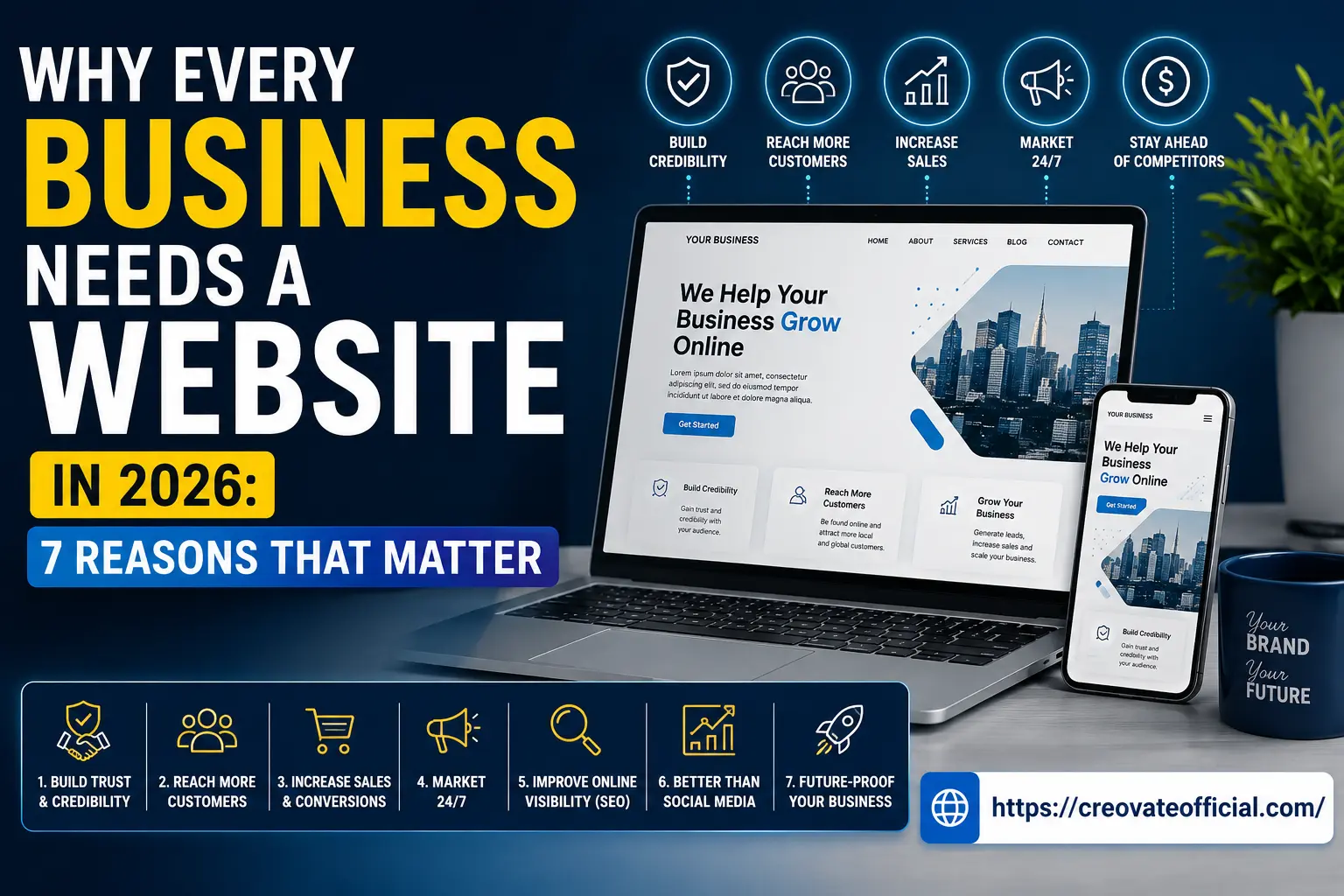
Every business benefits from having a website in 2026 because it's one of the few online spaces you largely control — unlike social media, it can build long-term trust, show up in search when people are actively looking for what you sell, and work as a 24/7 salesperson that never clocks out. Businesses without a website risk losing customers to competitors who simply show up first when someone searches, compares, or checks reviews before buying.
🎁 Free Online Income Starter Kit (2026)
Grab our free starter kit with website planning checklists, a content calendar, and a beginner-friendly monetization roadmap — built for people launching or upgrading a business website this year.
⚠️ Something went wrong and we couldn't save your email. Please check your connection and try again.
No spam, ever. Unsubscribe anytime. We respect your inbox as much as we respect ours.
Why Trust This Guide
This guide is built from firsthand experience helping small businesses and solo entrepreneurs launch, redesign, and grow their websites — not recycled theory. Every tool mentioned below has been personally tested or used in real client and personal projects at Creovate Official.
🔍 Real testing
Tools are evaluated on setup time, ease of use, pricing transparency, and actual results — not marketing claims.
📈 Industry experience
Written by a founder with an MBA in Marketing and a background in digital business building since 2020.
🤝 Transparency first
We tell you upfront where this article makes money, and we never recommend a tool we wouldn't use ourselves.
🔄 Kept current
This article is reviewed and refreshed as pricing, features, and best practices change.
Affiliate Disclosure: Some links in this article are affiliate links. If you click through and make a purchase, Creovate Official may earn a small commission — at no extra cost to you. We only recommend products we believe genuinely help small businesses and creators. This never affects our honest opinion of a tool's strengths or weaknesses.
📘
Get The No-Portfolio Client Playbook and learn how to choose a service, create practice samples, find prospects, write outreach, and take your first steps with confidence.
👉 Get it here
The Complete Guide: Why Your Business Needs a Website in 2026
Let's get into the real reasons — not the vague "you just need one" advice, but the specific, practical ways a website changes how customers find, judge, and choose a business today.
1
A Website Builds Trust & Credibility
Before a customer ever calls, emails, or walks through your door, most of them do one thing first: they search your business name. A business that only exists on a Facebook page or an Instagram bio reads as smaller, less established, and easier to be skeptical of than one with a clean, professional website.
A website signals that you're serious, permanent, and worth the customer's time and money. It gives people a place to see your story, your services, your pricing, and proof that other people have trusted you before — testimonials, case studies, certifications, and real photos of your work.
Practical tip: Add a simple "About" page with a real photo of you or your team, your story in a few honest sentences, and any credentials that matter. This single page often does more for trust than any homepage animation.
Common mistake: Using a free subdomain (like yourbusiness.wixsite.com) instead of a proper domain name. It's a small cost that makes a big difference in how professional you look.
If writing your own website copy feels intimidating, an AI writing assistant like Rytr can help you draft clear, professional page copy in minutes, which you then edit into your own voice — more on that in the tool reviews below.
2
It Helps You Reach More Customers
Your physical location, your existing customer list, and your social media followers are all limited. A website removes that ceiling. It lets people find you from a Google search, a shared link, a blog post, or even a voice search on their phone — often people who had never heard of your business before that exact moment.
This matters even more for local businesses. Someone searching "best bakery near me" or "affordable plumber in [city]" is actively looking to buy — and businesses without a website simply don't appear in that decision at all.
- Local reach: A website paired with local SEO helps you show up in "near me" searches.
- National or global reach: A website removes geography as a barrier for service or product-based businesses.
- New customer discovery: Blog content and search visibility bring in people who weren't already looking for you by name.
💡 A website turns your business from "known only to people who already know you" into "discoverable by anyone actively searching for what you offer."
3
It Increases Sales & Conversions
A website isn't just a digital brochure — done right, it's a sales tool that works while you sleep. Clear calls-to-action, simple contact or checkout forms, and a logical path from "just browsing" to "ready to buy" all directly increase how many visitors turn into paying customers.
Small, deliberate choices matter here: a visible phone number, a booking button above the fold, or a short explainer video can noticeably lift conversions. Tools like Synthesia make it easy to add a professional AI-generated explainer video to your homepage without hiring a video crew, and a platform like Systeme.io lets you build the whole funnel — landing page, order form, and follow-up emails — in one place.
Practical tip: Put your single most important call-to-action ("Book a Call," "Get a Free Quote," "Shop Now") in the same place on every page, so visitors never have to hunt for what to do next.
Common mistake: Sending all your traffic to a generic homepage instead of a page built around one specific offer. Focused pages convert noticeably better than general ones.
4
It Markets Your Business 24/7
Your website doesn't take weekends off. While you sleep, it's answering FAQs, showing your portfolio, collecting leads through a contact form, and even taking payments if you sell online. That's marketing and sales activity happening around the clock without you lifting a finger.
Pairing this with automated email marketing extends the effect even further. A tool like GetResponse can automatically follow up with anyone who visits your site and leaves their email, nurturing them toward a purchase without any manual work on your end. If you want a website that can also answer visitor questions instantly, an AI chatbot like CustomGPT.ai can be trained on your own content to handle common questions 24/7.
💡 Think of your website as an employee who works nights, weekends, and holidays — and never asks for a raise.
5
It Improves Visibility Through SEO
Search engine optimization (SEO) is how your website earns free, ongoing traffic from Google and other search engines — traffic you don't have to pay for every time, unlike ads. A well-optimized website with helpful content can keep bringing in visitors for months or years after you publish it.
In 2026, SEO also increasingly overlaps with AI search — tools like AI Overviews and chat-based assistants pull answers from well-structured, trustworthy websites. That means clear headings, direct answers, and genuinely useful content matter more than ever.
- Page speed: A slow site loses both rankings and visitors. Tools like FastPixel can meaningfully speed up load times without a developer.
- Content depth: Answering real questions your customers ask builds authority over time.
- Mobile-friendliness: A large share of searches happen on mobile devices — your site needs to work well on a small screen.
Common mistake: Publishing a website once and never adding new content. Regularly updating your site can help keep information accurate, useful, and relevant to visitors — which matters more than posting frequency for its own sake.
Want a deeper walkthrough? See our full SEO for beginners guide (2026) and our companion post on SEO for affiliate and content sites.
6
It Outperforms Relying on Social Media Alone
Social media is a fantastic place to start conversations — but it's largely rented land. You don't control your Instagram followers, your TikTok reach, or your Facebook page the way you control your own site; the platform sets the rules. Algorithm changes, policy updates, or even a mistaken account suspension can significantly disrupt your audience, and it has happened to real businesses.
The smartest approach isn't picking one over the other — it's using social media to attract attention and your website to own the relationship. For a step-by-step approach to combining both, check our guide on email marketing for beginners (2026), which shows how to move social followers onto a list you actually control.
7
It Future-Proofs Your Business
Consumer behavior has been shifting toward digital-first decision-making for years, and there's little sign of that reversing. A website tends to act as a hub that much of your other marketing can connect back to: email marketing, online stores, AI chat assistants, paid ads, content marketing, and even offline referrals often point back to your website eventually.
Businesses that invest in a solid website now are better positioned for whatever the next platform shift looks like — because their core digital asset isn't tied to any single app or algorithm.
Practical tip: Treat your website as a long-term asset, not a one-time task. Revisit it every few months, add new content, and keep your offers current.
Pros & Cons Summary: Having a Business Website
✅ Pros
- Builds trust before you ever speak to a customer
- Works as a 24/7 marketing and sales channel
- You fully own the platform — no algorithm risk
- Compounds in value through SEO over time
- Centralizes everything: content, offers, contact, proof
⚠️ Cons
- Requires an upfront time investment to set up properly
- Small ongoing costs (hosting, domain, tools)
- SEO results take months, not days
- Needs occasional upkeep to stay current and secure
Buying Guide: Choosing the Right Website Tools
Not every business needs the same setup. Here's how to think through the decision.
What to look for
Ease of use, mobile-friendly templates, built-in SEO basics, and room to grow without switching platforms later.
Common mistakes
Over-customizing before launch, skipping analytics setup, and choosing a platform based on price alone.
Budget considerations
Start lean: domain + basic hosting or an all-in-one builder is enough. Add speed and automation tools once you have traffic.
Who should DIY
Anyone comfortable following step-by-step tutorials and willing to spend a weekend learning a drag-and-drop editor.
Who should hire out
Businesses with complex needs (custom booking systems, large catalogs) or simply no time to learn a new tool.
Expert tip
Launch an imperfect site now rather than waiting for a "perfect" one — you can improve it after it's live and earning trust.
Frequently Asked Questions
Does a small business really need a website in 2026, or is social media enough?
Social media helps you reach people, but a website is the only online property you fully own and control. Algorithms change, accounts get suspended, and platforms come and go — your website stays. Most successful small businesses use both: social media to start conversations, and a website to convert and close them.
How much does it cost to build a business website in 2026?
A simple, professional small business website can be built for well under a hundred dollars a year using an all-in-one platform, or for a few hundred dollars if you hire a freelancer for custom design. The ongoing cost is usually hosting, a domain name, and any tools you add for email marketing or automation.
Can I build a website myself without knowing how to code?
Yes. Modern website and funnel builders use drag-and-drop editors, so you don't need to write a single line of code. You can have a working site live in a weekend, then improve it over time as your business grows.
What's the single most important page on a business website?
For most businesses it's the homepage, because it sets first impressions and directs visitors to the right next step. A close second is a clear services or product page that answers what you sell, who it's for, and what it costs.
How long does it take to see results from a business website?
Paid traffic can bring inquiries within days. Organic traffic from search engines usually takes three to six months to build momentum, since search engines need time to crawl, index, and trust a new site. Consistent content and a clear conversion path speed this up.
Do local businesses like plumbers or salons need a website too?
Yes, arguably more than most. Local customers search online before calling, and a website paired with a Google Business Profile builds the trust needed to pick up the phone or book an appointment instead of choosing a competitor who shows up first.
Is a website still worth it if I mostly get customers through referrals?
Yes. Referred customers almost always check you out online before reaching out. A weak or missing website can quietly cancel out a strong referral, while a professional one reinforces the trust your referral source already gave you.
Final Verdict
For most businesses, a website is no longer a nice-to-have — it's a hub that much of your other marketing can build on. It can build trust before you say a word, reach customers your existing network might never have, and keep working for your business around the clock.
- Key takeaway: A website can compound in value over time in ways a social-only presence typically doesn't.
- Best starting point: An all-in-one builder like Systeme.io if you're beginning from scratch.
- Next step: Launch a simple, honest, mobile-friendly site this month — then improve it as you grow.
Start Building Your Website Free →
SS
About Suresh Sannapareddy
Accounts Manager & Founder, Creovate Official
Suresh is a financial strategist and digital entrepreneur with an MBA in Marketing. As the founder of Creovate Official, he combines his accounting expertise with digital marketing strategies to help individuals build automated online businesses, create digital products, and generate passive income.
MBA in Marketing
Affiliate Marketing Educator
AI Productivity Researcher
101+ Articles Published
Visit CreovateOfficial.com →