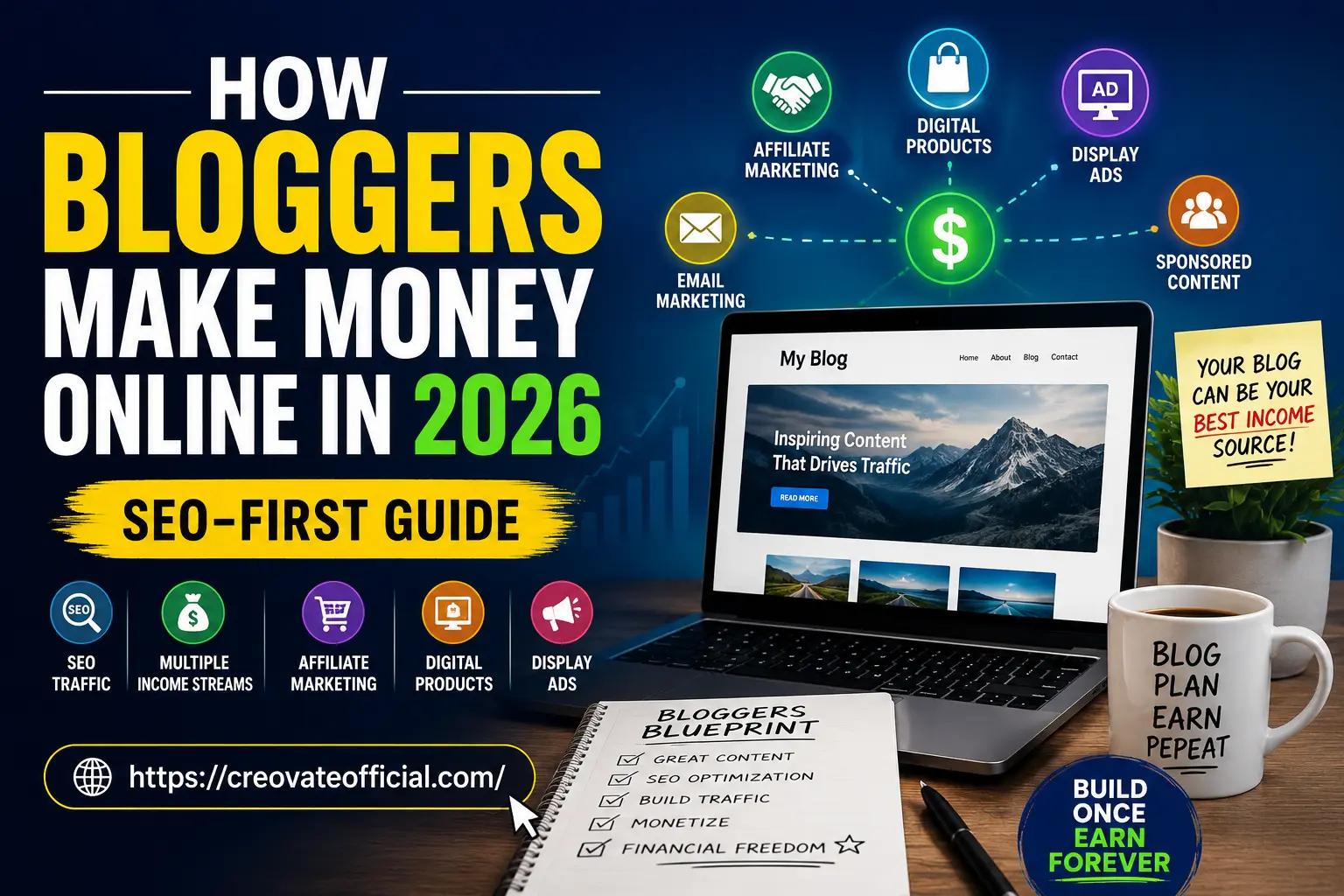
1. What "Making Money Blogging" Actually Means in 2026
Blogging income rarely comes from one big source. It comes from stacking several smaller, semi-independent revenue streams on top of a single traffic engine: your content. A post about budgeting apps might earn a small affiliate commission, display ad revenue from the same pageview, and an email signup that turns into a digital product sale weeks later.
That stacking is the real shift from how blogging worked a decade ago. Search and AI answer engines in 2026 reward pages that show first-hand experience and clear expertise, so thin, generic posts increasingly get skipped in favor of specific, tested, well-organized content. The upside is that bloggers who put in genuine research now face less noisy competition than they would have a few years ago.
2. Income Stream 1: Affiliate Marketing for Bloggers
Affiliate marketing is usually the fastest realistic path to a blogger's first dollar because it doesn't require a large audience — it requires the right audience at the right moment in their decision. You recommend a product or tool, link to it with a tracked affiliate link, and earn a commission when someone buys through that link.
How it actually works
- Find products your readers already want. Comparison and "best X for Y" posts convert far better than random product mentions.
- Match content to buying stage. "What is X" content rarely converts; "X vs Y" and "best X" content converts well because the reader is close to a decision.
- Disclose clearly. A short, honest disclosure near the top of the post builds trust rather than costing conversions.
Common mistakes
For content creators specifically, AI writing assistants like Rytr can speed up first drafts of outlines and meta descriptions, which is useful if affiliate content is your main format — see the full review below.
3. Income Stream 2: Display Advertising
Display ads pay per pageview rather than per purchase, which makes them the most passive income stream — but also generally the slowest to become meaningful. Premium ad networks typically favor sites with an established, steady traffic base rather than brand-new blogs, though exact requirements vary by network and change over time, so it's worth checking current criteria directly with any network you're considering.
What affects your earnings
- Niche RPM (revenue per thousand pageviews): finance, insurance, and software niches pay far more per pageview than general lifestyle content.
- Reader geography: ad rates vary by region, and RPM varies substantially by niche, audience location, seasonality, and ad network — there's no single figure that applies universally.
- Page speed: slow-loading pages both hurt rankings and cause ad networks to serve lower-value ads, so image and asset optimization directly affects ad revenue.
Because page speed directly impacts ad RPMs, image and asset optimization tools such as FastPixel are worth evaluating once ads are live on your site.
4. Income Stream 3: Sponsored Content
Sponsored content means brands pay you directly to write about their product, mention it in an existing post, or run a dedicated review. It typically becomes viable once a blog has a defined niche audience and enough traffic or email subscribers to demonstrate reach.
Best practices
- Only accept sponsorships that genuinely fit your niche and that you'd recommend even unpaid.
- Disclose sponsored posts clearly, both for reader trust and legal compliance in most regions.
- Set a rate card once you have consistent traffic — brands respond better to clear pricing than to open-ended negotiation.
5. Income Stream 4: Digital Products
Digital products — templates, planners, courses, or notion-style toolkits — often carry the highest margin of any blogger income stream because there's no per-sale cost once the product exists. They also don't depend on an external platform's approval or payout terms the way ad networks and some affiliate programs do.
Where digital products fit
They work best when built from a problem your content already proves you understand. A blog that regularly covers personal budgeting is a natural fit for something like a structured monthly budget planner — the content builds trust, and the product monetizes readers who want a done-for-you version of what the blog teaches.
Getting your first sale
- Start small — a single focused product beats a bloated bundle nobody finishes.
- Promote it inside relevant blog posts and to your email list before running any paid promotion.
- Price based on the specific problem solved, not on what competitors charge.
Try the tool this section is built around
If budgeting or personal finance content is part of your niche, the Creovate Official Monthly Budget Planner is a ready-made example of a low-cost, high-conversion digital product you can study or use directly.
View the Budget Planner6. Income Stream 5: Email Marketing
Email is the one channel you own outright — algorithm changes at Google or social platforms don't touch it. A blog that captures emails consistently can re-promote affiliate offers, digital products, and new posts to a warm audience instead of relying entirely on fresh search traffic.
How bloggers monetize email
- Welcome sequences that lead new subscribers toward a relevant affiliate recommendation or lead magnet.
- Launch sequences when releasing a new digital product.
- Weekly or biweekly newsletters that keep subscribers engaged between blog posts, increasing repeat traffic.
A dedicated email marketing platform such as GetResponse handles the automation side — welcome sequences, tagging, and landing pages — so this doesn't become a manual, unscalable process as your list grows.
7. The SEO-First Strategy That Funds All Five Streams
Every income stream above depends on one thing: consistent, targeted traffic. An SEO-first approach means choosing what to write based on what people are already searching for and how likely that search is to convert, rather than writing whatever feels inspiring that week.
The core SEO-first workflow
- Target intent-matched keywords. Informational keywords build authority and traffic volume; commercial and transactional keywords convert into income.
- Cover topics comprehensively. Address the follow-up questions a reader would naturally have, not just the headline query.
- Structure for scanning. Clear H2/H3 headings, short paragraphs, and tables help both readers and AI answer engines parse your content accurately.
- Build internal links. Linking related posts together helps both readers and search engines understand your site's topical depth.
- Update older posts. Refreshing statistics, screenshots, and recommendations on existing posts is often faster than writing new content from scratch.
8. Profitable Blog Niches for 2026
Niche choice affects every income stream at once, because it determines both how much advertisers will pay per click and how expensive the products you can recommend are.
| Niche | Affiliate Potential | Ad RPM | Digital Product Fit |
|---|---|---|---|
| Personal finance | High | High | Excellent (planners, templates) |
| Software / SaaS reviews | Very High | Medium | Good (guides, courses) |
| Health & wellness | Medium-High | High | Good (plans, trackers) |
| Productivity / AI tools | High | Medium | Excellent (templates, courses) |
| Travel | Medium | Low-Medium | Fair (itineraries) |
None of these require picking the single "best" niche — they require picking one narrow enough to build topical authority in, with commercial intent baked into at least some of your content plan.
9. Common Mistakes That Keep Bloggers at $0
- Publishing without keyword research. Great writing on a topic nobody searches for earns nothing.
- Monetizing too early or too aggressively. Ads and links before the content has earned trust hurt conversion rates.
- Ignoring page speed. Slow sites lose both rankings and ad revenue.
- Ignoring email capture. Traffic that leaves without subscribing is traffic you can't re-monetize later.
- Giving up before month six. Most SEO-driven blogs take several months of consistent publishing before compounding traffic growth becomes visible.
10. Tool Comparison Table
These are the tools referenced throughout this guide, compared side by side.
| Tool | Category | Best For | Pros | Cons | Overall |
|---|---|---|---|---|---|
| Rytr | AI Writing Assistant | Drafting outlines, meta descriptions, first drafts | Fast, affordable, many tone templates | Needs heavy human editing for E-E-A-T content | Good starting-draft tool |
| FastPixel | Image & Page Speed Optimization | Sites with heavy images that need faster load times | Improves Core Web Vitals, easy setup | Adds a recurring cost as traffic scales | Strong for ad-revenue sites |
| CapCut | Video Editing | Short-form video for Reels, TikTok, YouTube Shorts | Free tier, intuitive, mobile-friendly | Advanced features gated behind subscription | Solid for repurposing content |
| GetResponse | Email Marketing | Automations, landing pages, list growth | All-in-one, beginner-friendly automation | Pricier than bare-bones ESPs at scale | Strong all-in-one pick |
11. Individual Tool Reviews
Rytr AI Writing
Rytr is an AI writing assistant built for speed — outlines, meta descriptions, social captions, and first-draft blocks of content. For bloggers, it's most useful as a drafting accelerator rather than a finished-content generator: the strongest posts still come from editing AI drafts with your own experience, examples, and opinions.
Advantages
- Fast first drafts and outlines
- Multiple tone and use-case templates
- Low learning curve
Drawbacks
- Generic output if used without heavy editing
- Not a substitute for original research or testing
Best for: Bloggers who need to speed up outlining and first drafts, not final publish-ready copy.
Trust note: Pricing changes periodically — check current plans on the official site before purchasing.
Try Rytr →FastPixel Speed
FastPixel focuses on image compression and page-speed optimization, both of which directly affect SEO rankings and display ad RPMs. For image-heavy blogs — especially recipe, travel, or product-review sites — speed optimization is one of the highest-leverage technical fixes available.
Advantages
- Noticeable Core Web Vitals improvement
- Simple setup for most CMS platforms
- Directly supports both SEO and ad revenue
Drawbacks
- Ongoing subscription cost
- Benefit is smaller on already-lightweight sites
Best for: Image-heavy blogs already running display ads or close to qualifying for a premium ad network.
Trust note: Test before/after load times on your own site — gains vary based on current hosting and theme.
Try FastPixel →CapCut Video
CapCut is a mobile-first video editor useful for bloggers repurposing written content into short-form video for social traffic — a growing discovery channel that feeds back into blog traffic and email signups.
Advantages
- Free download, beginner-friendly
- Templates built for short-form platforms
- Fast mobile editing workflow
Drawbacks
- Some effects and export options require a subscription
- Not a replacement for desktop editing on complex projects
Best for: Bloggers repurposing posts into Reels, TikToks, or Shorts to drive additional traffic.
Trust note: Free download currently available for USA users; availability can vary by region.
Check CapCut Availability in Your Region →GetResponse Email
GetResponse bundles email automation, landing pages, and basic funnel tools — useful for bloggers who want to build the welcome sequences and product-launch emails described in the email marketing section above without stitching together several separate tools.
Advantages
- Automation and landing pages in one platform
- Beginner-friendly workflow builder
- Useful for both list growth and digital product launches
Drawbacks
- Costs scale with list size, like most ESPs
- Some advanced features have a learning curve
Best for: Bloggers ready to move beyond a basic email capture form into automated sequences.
Trust note: Compare current plan tiers directly on GetResponse's site, as pricing and included features are updated periodically.
Try GetResponse →12. Pros & Cons Summary
Why Blogging Still Works in 2026
- Low startup cost compared to most online businesses
- Multiple income streams from the same content
- Owned traffic and email list, independent of any single platform
- Compounding returns — older posts keep earning as they rank
What to Be Honest About
- Income is slow in the first few months for almost everyone
- Requires consistent publishing, not occasional bursts
- Competitive niches need genuinely original, tested content to rank
- Ad revenue depends on traffic volume most new blogs don't have yet
13. Which Income Streams Should You Start With?
You don't need all five streams on day one. Sequence them based on your traffic level and available time.
What to look for at each stage
- Early stage (just getting started): focus on affiliate marketing within your content and start email capture from post one.
- Growth stage (steady, growing traffic): layer in a digital product built from your best-performing content topic.
- Established stage (consistent, substantial traffic): apply to a premium display ad network and consider sponsorship outreach.
Budget considerations
Many bloggers can get started with a modest tools budget — hosting, an email platform's free or starter tier, and free keyword research tools — since costs for these vary by provider and change over time. Reinvest early affiliate or ad income into speed optimization and email automation before spending on paid traffic.
Who should hold off on monetizing immediately
If your blog is under a month old with only a handful of posts, prioritize publishing consistency and keyword targeting first. Monetization added too early, before any trust or traffic exists, rarely converts and can clutter posts unnecessarily.
14. Frequently Asked Questions
How much money do bloggers realistically make in 2026?
Income varies enormously and most new bloggers earn little to nothing in the first several months. Bloggers who publish consistently and target commercial keywords tend to see meaningful income develop gradually over the first year, with earnings scaling as traffic and trust compound, though there's no universal timeline or dollar figure that applies to every niche.
What is the fastest way for a new blogger to make money?
Affiliate marketing on low-competition, high-intent keywords is typically the fastest path, because it doesn't require existing traffic volume the way display ads do, and it doesn't require you to build a product first.
Do you need a lot of traffic to make money blogging?
Not necessarily. A smaller audience that is highly targeted and searching with buying intent can often outearn a much larger, untargeted audience. Traffic quality and intent generally matter more than raw volume, though more traffic does open up additional income streams like display advertising.
Is blogging still profitable in 2026?
Yes, but the bar has risen. Search engines and AI answer engines now prioritize genuinely helpful, experience-backed content, so generic, thin articles rank poorly. Bloggers who demonstrate real expertise and originality still see strong results.
How many income streams should a blog have?
Most sustainable blogs run two to three income streams at once — commonly affiliate marketing plus display ads plus one digital product — so income isn't dependent on a single source or a single advertiser's policies.
Do I need to show my face or be an influencer to make money blogging?
No. Text-based blogs can rank in search and convert readers into buyers without any on-camera presence. What matters is demonstrated expertise and trustworthy, well-organized content.
How long does it take to make your first dollar blogging?
There's no fixed timeline. With consistent publishing and SEO-first keyword targeting, many bloggers see their first affiliate commission or ad revenue within the first several months, but this varies widely by niche, competition, and publishing consistency.
What blog niches make the most money in 2026?
Personal finance, software and SaaS reviews, health, and B2B tools tend to have the highest commercial value per visitor, because the products they promote carry higher price points and commissions.